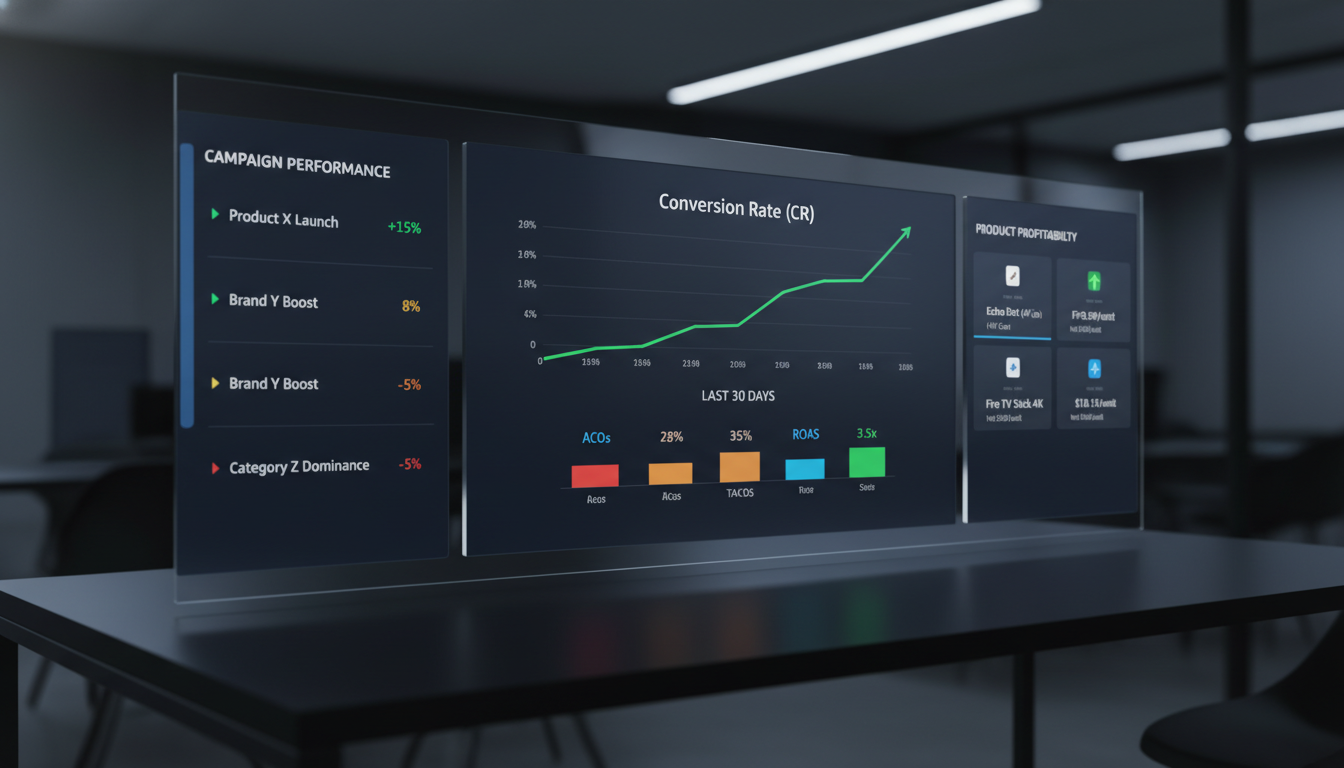
The Paradigm Shift in E-Commerce Advertising: Emphasizing Speed, Profitability, and AI
The marketplace landscape for digital retail has fundamentally transformed. Brand managers, agency owners, and digital marketers are no longer competing in static marketplaces; they are operating in hyper-dynamic, multi-hourly auction environments. On Amazon, where pay-per-click dynamics dictate visibility, relying on human monitoring or simplistic rule-based software is no longer a sustainable strategy. This reality has driven the massive rise of ai advertising and the complete integration of ai and marketing to optimize brand performance.
Historically, managing an amazon advertising campaign meant hours of manual spreadsheet analysis, bulk file uploads, and retrospective bidding adjustments. By the time a marketer identified a non-converting keyword or adjusted a bid to capture high-intent search traffic, market dynamics had already shifted. Today, utilizing an advanced ai advertising platform allows brands to make real-time, algorithmic decisions that eliminate wasted ad spend while actively scaling sales velocity.

Recent industry research underscores this operational pivot. According to SalesDuo's report on AI-driven campaign launches, AI-driven campaign management enables 67% faster campaign launches and substantially minimizes the administrative burden of daily manual oversight. Concurrently, data compiled in Helium 10's research on real-time bid adjustments reveals that continuous AI-driven bid optimization reduces manual management hours by 70% to 85% while simultaneously improving Return on Ad Spend (ROAS). For Amazon-first brands striving to maintain a competitive edge, deploying sophisticated automation marketing tools is no longer an optional upgrade—it is a baseline requirement for survival.
Why Manual Amazon PPC Management Falls Short in a Multi-Hourly Auction Market
To appreciate the value of ppc automation, one must first analyze the sheer complexity of manual amazon ppc management. A typical Amazon Seller Central account manages hundreds, sometimes thousands, of active keywords across diverse campaign types, including Sponsored Products, Sponsored Brands, and Sponsored Display. Within an amazon pay per click ads ecosystem, each keyword possesses unique performance characteristics influenced by seasonal shifts, time-of-day buying patterns, competitor pricing strategies, and real-time inventory levels.
Human campaign managers face cognitive limitations that prevent them from scaling optimization efforts effectively:
- The Speed Bottleneck: Bid adjustments in Seller Central typically occur once or twice a week. In contrast, Amazon auctions happen continuously. This means manual campaigns spend hours or days bidding too high on non-converting terms or missing out on high-converting traffic due to low bids.
- The Granularity Problem: To maximize efficiency, campaigns require precise search term isolation, match type transitioning (broad to phrase to exact), and negative keyword pruning. Managing this at scale across hundreds of parent-child ASIN variations is humanly impossible without errors.
- The Data Fragmentation Gap: Human decision-making is often siloed. A media buyer might see a high conversion rate on an amazon ads campaign but remain unaware that the specific ASIN is running low on inventory or yielding low net profitability due to rising supply chain costs.
By shifting to an advanced amazon advertising platform powered by predictive intelligence, brands can easily overcome these structural limitations. An automated amazon ppc tool works tirelessly in the background, analyzing millions of data points and executing continuous micro-adjustments to protect profit margins and maintain organic search rank.
Demystifying Amazon PPC AI: Legacy Rule-Based Tools vs. True Machine Learning
When searching for the best amazon ppc software, it is critical to distinguish between legacy "rule-based" software and modern, predictive ai software for marketing. Legacy software operates strictly on user-defined, "if-this-then-that" rules. For example: "If ACoS is greater than 30%, lower the bid by 10%."
While rule-based systems are superior to manual adjustments, they suffer from significant limitations:
- Reactive Adjustments: They require performance thresholds to be breached before taking corrective action, meaning you must lose money before the software corrects the bid.
- Rigid Structures: They do not adapt to sudden market shifts, holiday shopping surges (such as Prime Day or Black Friday), or changing consumer intent.
- Lack of Predictive Modeling: Rule-based systems cannot calculate the latent conversion probability of a keyword that has zero clicks but holds highly relevant search intent.
In contrast, true ai ppc management utilizes sophisticated machine learning algorithms. Platforms like AdAstraa employ advanced models that continuously learn from historical performance, category trends, and real-time buyer behavior. Instead of waiting for a campaign to lose money, predictive ppc ai calculates the optimal bid for every single search auction. These algorithms analyze conversion signals, geographical factors, click-through rates (CTR), and conversion rates (CVR) to adjust bids proactively, keeping your amazon advertising strategy agile and highly efficient.
| Capability | Manual Management | Legacy Rule-Based Software | True Predictive AI (e.g., AdAstraa) |
|---|---|---|---|
| Optimization Frequency | Weekly or bi-weekly | Daily (usually once per 24 hours) | Multi-hourly / 24-7 Real-Time |
| Keyword Discovery | Manual Search Term Report audits | Basic harvesting based on set parameters | Semantic discovery and automated match type transitioning |
| Bid Calculations | Educated guessing based on historical averages | Static adjustments (e.g., raise bid by $0.10) | Predictive mathematical calculation of conversion probability |
| Profit Alignment | Siloed spreadsheet calculations | No direct inventory or cost alignment | True Profit per ASIN tracking (integrating COGS & inventory) |
How AI Powered Ad Creative Redefines Click-Through & Conversion Rates
Bidding optimization represents only half of the modern advertising equation. Even the most refined, hyper-targeted keyword strategy will underperform if the consumer is greeted by lackluster, generic visual assets. High-converting creative assets are the cornerstone of successful ai marketing strategies. Historically, sourcing these assets meant coordinating long, expensive photo shoots and waiting weeks for creative agencies to deliver formatted files.
Through sophisticated innovations, ai ads creator systems and ai tools for advertising have eliminated this bottleneck entirely. Modern systems enable the generation of ai powered ad creative assets within minutes rather than weeks. This capability is exceptionally vital on Amazon, where Sponsored Brands and Sponsored Display placements require high-quality lifestyle imagery, clean layouts, and compelling messaging to grab buyer attention.

Using a tool like AdAstraa’s AdCreative+ suite, Amazon sellers can instantly build beautiful, brand-aligned visual assets that adhere perfectly to Amazon’s strict style policies. By deploying an advanced ai ad generator, brands can rapidly split-test dozens of distinct background variations, lifestyle overlays, and value proposition text blocks. This rapid creative testing ensures that your artificial intelligence ads continuously match evolving consumer expectations, maximizing click-through rates and driving down cost-per-acquisition metrics.
Core Pillars of an All-in-One AI Advertising Operating System
To successfully transition your Amazon business away from inefficient manual work and high ACoS, you need to implement a comprehensive marketing management platform designed for the modern e-commerce landscape. This requires a tool that manages every dimension of the brand journey, going beyond simple keyword bids to address the holistic ecosystem of inventory, pricing, and consumer intent. A fully optimized system relies on several core pillars to drive scale and efficiency:
1. 24/7 Bid Optimization (Autopilot)
E-commerce never sleeps. Your competitors are constantly adjusting their strategies, and shoppers are looking for your products at all hours of the day and night. An enterprise-level amazon ads automation software monitors campaigns around the clock, implementing precise micro-bid changes based on hourly search volume and seasonal conversion variations. This levels the playing field against competitors who only adjust bids during business hours.
2. Buyer Intent Intelligence (Shopper OS)
To scale rapidly, brands must look beyond standard keyword matches and dive deep into buyer behavior. Implementing advanced intent tracking, such as AdAstraa's Shopper OS buyer intent intelligence, enables brands to intercept active shoppers. By analyzing search paths, category page behavior, and cross-channel conversion actions, the software isolates the exact moments when consumers are ready to purchase, shifting ad spend dynamically to maximize high-converting touchpoints.
3. Automated Customer Operations & Review Management
Advertising performance on Amazon is deeply tied to organic brand health, star ratings, and review velocity. If a brand scales ad traffic to a listing with poor customer reviews, conversion rates drop, causing CPCs to climb. Integrating automated messaging and AI-driven operations helps brands protect their listings' conversion readiness. Maintaining an active, positive feedback loop supports higher rankings, ensuring your paid ad campaigns yield the highest possible return.
4. True Profit and Financial Visibility
Vanity metrics like high ROAS or low ACoS can be deceptive. A brand might run a highly visible, high-budget campaign that appears successful on paper, but actually loses money due to hidden costs like high return rates, steep Amazon FBA storage fees, or rising product costs. A modern marketing analytics ai platform integrates directly with your product COGS and seller metrics, giving you real-time visibility into the exact profitability of every single ASIN. This ensures you only scale campaigns that generate positive net returns for your business.
Actionable Amazon Advertising Tips and Campaign Strategies for 2024 and Beyond
Transitioning from manual oversight to automated campaign management requires a strategic, structured approach. To maximize the value of your chosen ad campaign automation tools, we recommend implementing the following structured framework:
Pillar 1: The Multi-Tiered Funnel Structure
Never rely on a single campaign type. Structure your advertising portfolio across three distinct levels to capture buyers at every stage of the funnel:
- Top of Funnel (Awareness): Use Sponsored Brands and clean lifestyle creatives generated with an ai advertisement generator to capture broad, category-level terms. Focus on establishing brand presence and driving new-to-brand (NTB) customers.
- Middle of Funnel (Consideration): Deploy Sponsored Products targeting highly relevant competitor ASINs and specific phrase-match keywords. This captures buyers who are actively comparing products in your niche.
- Bottom of Funnel (Conversion): Focus exact-match campaigns on high-performing, high-intent keywords while running robust defensive campaigns to protect your brand name from competitor conquesting.
Pillar 2: Intelligent Keyword Harvesting & Match Type Transitioning
Let your amazon ppc automation software work for you. Set up broad-match research campaigns with conservative budgets to surface new, high-converting customer search terms. Once the software identifies a high-converting phrase, configure it to automatically promote that keyword to exact-match campaigns with higher bidding budgets, while simultaneously adding it as a negative keyword in the broad-match campaign. This structure prevents internal keyword competition and ensures your ad spend is directed toward your highest-performing assets.
Pillar 3: Adaptive Dayparting and Bid Multipliers
Most product categories experience sharp, predictable conversion fluctuations throughout the day. For example, household items might convert at high rates during mid-morning work hours, while personal care products might see purchase spikes in the late evening. Traditional manual management cannot adjust to these patterns. However, a modern amazon ppc automation tool dynamically scales bids up during high-conversion peak hours and scales them down during low-intent periods, protecting your daily ad budget from wasted clicks.
"True scale on Amazon is achieved not by outspending your competitors, but by out-optimizing them. Implementing continuous, multi-hourly machine learning bidding is the single most effective lever for driving down ACoS while maintaining dominant organic search visibility."
The Business Impact of Automated Ad Operations
When brands implement a comprehensive, all-in-one marketing optimization tool, the business impact goes far beyond simple advertising efficiency. It reshapes the team's daily operations, cash flow, and overall scalability. Let's look at the primary ways automated ad operations transform an e-commerce business:
Reclaiming Critical Resource Hours
By automating repetitive daily tasks like keyword bidding, negative match selection, and bulk campaign adjustments, marketing teams can reclaim hundreds of hours of manual labor. Instead of getting bogged down in spreadsheet management, brand builders can focus on high-impact growth levers like product development, supply chain optimization, and overall brand positioning.
Eliminating Expensive Human Error
Manual management is always prone to errors. A simple typo in a bulk upload sheet can accidentally pause a top-performing campaign, blow through an entire weekly budget in a few hours, or set an unprofitable bid on a high-volume keyword. Automating your processes with a structured ad management platform ensures that bidding changes are always based on clean, mathematical models, removing human error and emotional decision-making from your campaign management.
Maximizing Working Capital and Cash Flow Efficiency
Wasted ad spend is a major drain on a growing brand's working capital. Every dollar spent on non-converting terms is a dollar that could have been reinvested in inventory, product development, or expanding your product catalog. Employing real-time ppc optimization software ensures your advertising budget is continuously focused on your most profitable opportunities, accelerating inventory turnover and boosting your overall cash flow efficiency.
Transitioning to Automated Ad Management: What to Look For
As you plan to upgrade your advertising operations, it is vital to select a platform that can grow alongside your business. The market is filled with basic, entry-level systems that often lack the features required to manage complex product catalogs. When comparing different campaign management tools and ad software options, look for the following essential capabilities:
- Direct API Integration: The platform should integrate seamlessly with Amazon's official Advertising and Selling Partner APIs to ensure clean, instant data transfer and prevent system latency.
- Support for All Amazon Ad Types: Ensure your tool can optimize Sponsored Products, Sponsored Brands, Sponsored Display, and Video campaigns within a single, unified interface.
- Advanced Profit Analytics: Avoid tools that only track advertising metrics like ACoS. Choose a platform that pulls in COGS, FBA fees, storage costs, and shipping fees to measure the real profitability of your campaigns.
- Dynamic Creative Generation: Seek out platforms that combine powerful, algorithmic bid optimization with built-in creative tools, giving you a comprehensive, end-to-end advertising solution.
According to Ad Badger’s analysis on climbing CPCs, the brands that succeeded in navigating recent competitive surges were those that combined strategic, brand-focused creative direction with fast, automated, and algorithmic bidding systems. Investing in the right tools today ensures your business is built to scale in tomorrow's competitive landscape.
Conclusion: Reclaim Your Ad Spend and Dominate the Digital Shelf with AdAstraa
The era of manual, spreadsheet-driven Amazon campaign management is behind us. In a marketplace where ad auctions change on a multi-hourly basis, brands that rely on manual workflows or simple rule-based tools will continue to lose ground to competitors leveraging modern, predictive automation. Achieving sustained growth on Amazon requires a fast, unified, and AI-driven approach.
By implementing a comprehensive, all-in-one operating system like AdAstraa, Amazon-first brands can eliminate wasted ad spend, reclaim valuable manual management hours, and scale their sales velocity. With powerful features like Autopilot's 24/7 predictive bidding, Shopper OS buyer intent intelligence, and the AdCreative+ suite generating high-converting visual assets, AdAstraa handles the heavy lifting of campaign management. This gives you clear, real-time visibility into True Profit per ASIN and empowers your team to focus on building a category-dominating brand.
Ready to transform your Amazon advertising strategy, lower your ACoS, and scale your brand's profitability? Partner with a team that understands the intersection of AI and e-commerce growth. Explore how AdAstraa can streamline your advertising operations and help you dominate the digital shelf today.