
Modern retail media has reached a critical tipping point. For years, Amazon sellers, D2C brands, and aggregators relied on human-driven amazon ppc management or basic rules-based software to handle their campaigns. You would set a target Advertising Cost of Sales (ACoS), write a few rigid "if-then" bidding scripts, and hope for the best. But in today's hyper-competitive marketplace—where ad inventory is expensive, shopper behavior shifts in milliseconds, and programmatic players dominate search results—these legacy approaches are no longer enough.
To stop wasting ad spend and reclaim hundreds of hours of manual management, brands must look beyond isolated bidding tweaks. The future of marketplace growth lies in a unified, agentic AI-powered ad optimization and operating system. By transitioning from basic, disconnected tools to a cognitive advertising flywheel—one that seamlessly connects real-time predictive bidding, deep customer intent tracking, generative creative asset production, and automated post-purchase customer operations—brands can finally unlock true efficiency.
This technical blueprint explains how to build and scale this unified AI advertising ecosystem. You will learn how modern ai advertising platform architectures operate, why they outperform traditional tools, and how you can implement these advanced strategies to maximize your Return on Ad Spend (ROAS) and secure long-term profit.
1. The Evolution of Retail Media and the Failure of Legacy PPC Software
Retail media is growing at an unprecedented pace. In fact, retail media spending is projected to hit $60B in 2025 according to Affiliate Summit retail media growth forecasts, highlighting how critical the channel has become. As millions of brands flock to the amazon advertising platform to capture these high-intent buyers, ad auctions have become incredibly dense.
Historically, brands used manual amazon advertising services or standard ppc software tools to optimize their ads. These platforms operated on simple heuristics: if a keyword's ACoS exceeded 30%, lower the bid by 10%; if a keyword generated 10 clicks without a sale, pause it.
While this rules-based approach was a step up from manual spreadsheet uploads, it has three massive flaws in the modern era:
- Latency and Delay: Rule-based systems typically evaluate performance on a 24- to 72-hour delay. By the time a rule triggers to lower a bid, a non-converting search term may have already drained thousands of dollars of your budget.
- Lack of Contextual Nuance: Static systems treat all clicks the same. They do not account for external variables like search volume volatility, organic share-of-voice (SoV), inventory levels, dayparting patterns, or competitor price changes.
- Siloed Data Operations: Standard ppc campaign management software focuses entirely on bids. It does not communicate with your creative library, your buyer intent signals, or your customer support channels. As a result, you waste money bidding on terms with poor listing conversion rates or high return percentages.
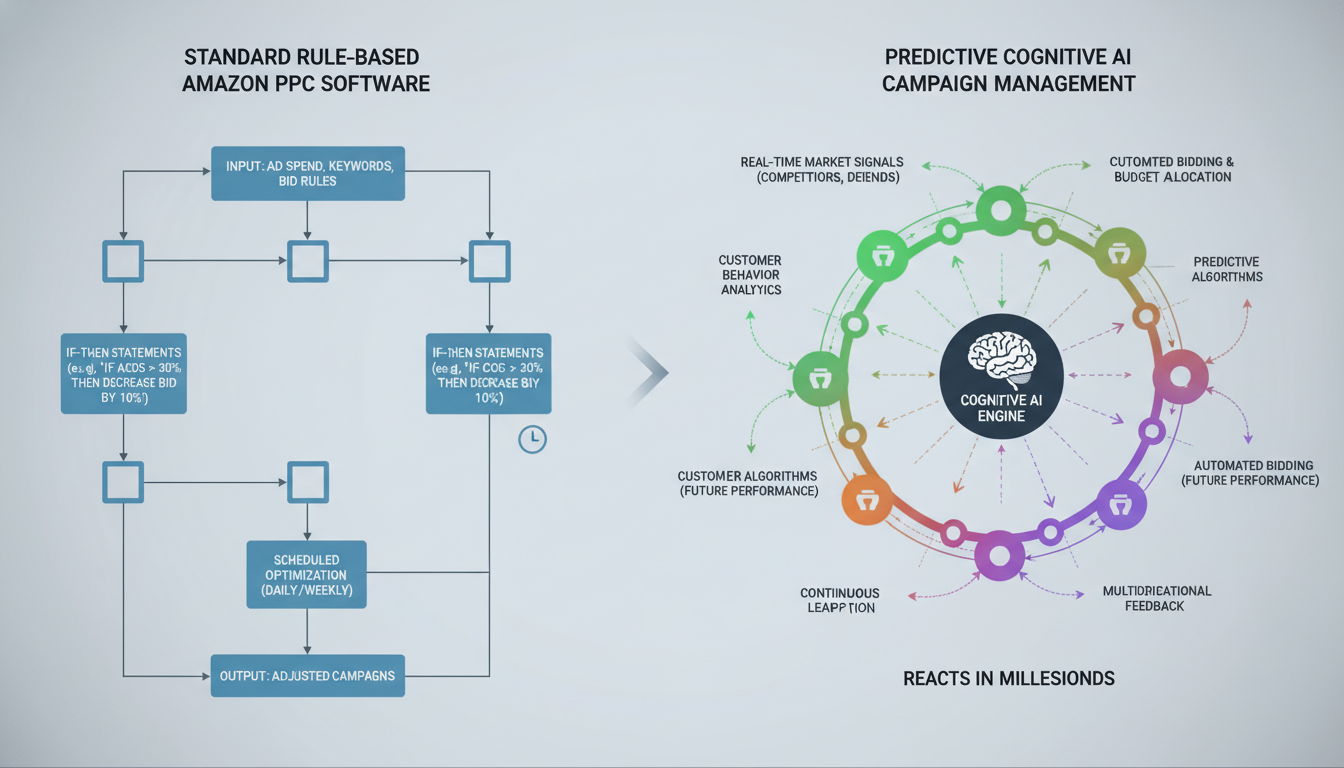
According to retail media channel expansion metrics by Nielsen and Skai, the retail media market is expanding far faster than the broader ad market. With this rapid expansion, brands can no longer rely on rigid, manual setups. They need a continuous machine learning engine that makes predictive decisions every single minute.
2. The Anatomy of a Unified AI Advertising Flywheel
True amazon ppc automation is not about offloading manual work to simple automated scripts. Instead, it is about building a cognitive, multi-layered ecosystem that connects every part of your advertising funnel. This is known as the AI Advertising Flywheel.
Unlike legacy amazon campaign optimization tools that only adjust bids, a unified flywheel integrates four key areas:
- Predictive Bidding (Autopilot): Continuously optimizes bids 24/7 across your catalog, adjusting budgets in real-time based on purchase probability.
- Intent Intelligence (Shopper OS): Harvests high-converting keywords, maps consumer buying behavior, and isolates non-converting search terms before they drain your budget.
- Generative Creative (AdCreative+): Automatically designs, tests, and refines high-performing ad assets to improve click-through-rates (CTR) and product engagement.
- Post-Click Operations (EcomGPT): Uses AI to manage customer interactions, optimize listings, and address buyer concerns—which directly boosts conversion rates and lowers ad waste.
| Capabilities | Legacy Amazon PPC Software | Cognitive AI Platforms (AdAstraa) |
|---|---|---|
| Optimization Frequency | Batch processing once every 24-48 hours | Continuous, real-time bid adjustments 24/7 |
| Bidding Methodology | Rigid rules (e.g., if ACoS > Target, reduce bid) | Predictive machine learning algorithms and conversion probability models |
| Creative Management | Manual graphic creation and separate asset uploads | Automated, high-CTR generative image and video creation |
| Post-Click & Operations | Completely disconnected from customer service and listing health | Integrated operations to improve conversion rates and listing health |
3. Predictive Bid Management (Autopilot): The AI PPC Engine
At the heart of any modern amazon ads automation platform is the bid engine. Legacy ppc optimization software struggles because it only reacts to past performance data. In contrast, predictive ai ppc management uses advanced machine learning models to forecast future purchase behavior.
This transition from rules-based software to predictive bidding involves key algorithmic shifts:
- Continuous Probability Estimation: Instead of waiting for historical data to accumulate over days, an advanced amazon ppc ai evaluates thousands of real-time signals. It analyzes device types, current search volume fluctuations, historical dayparting patterns, and competitor stockout rates to calculate the conversion probability of each individual ad impression.
- Multi-Armed Bandit Algorithms: When launching new campaigns or testing fresh keywords, legacy campaign management tools often burn through budgets on unproven terms. Predictive systems use Multi-Armed Bandit models to allocate small, smart test budgets to new search terms, scaling spend dynamically only when a term proves it can convert.
- Dynamic Portfolio Budgeting: Instead of managing bids on isolated keywords, a modern ad automation system groups your campaigns into performance portfolios. This setup allows the AI to automatically shift budget from low-performing products to high-margin, top-converting ASINs in real time.
"By replacing rigid rules with continuous predictive bidding, brands can automatically capture high-intent traffic during peak converting hours, while instantly lowering bids when conversion probability drops."
Transitioning to this level of automation ensures you spend your budget efficiently. You no longer have to worry about manual bid adjustments or the outdated suggestions of a generic amazon ppc course. Instead, your campaigns adapt instantly to changing market conditions.
4. Buyer Intent Intelligence: Going Beyond Basic Keywords
Successful amazon ppc advertising requires deep, real-time keyword insights. Simply targeting broad search terms often leads to high ad spend with very little return. To scale profitably, brands need a system that tracks actual buyer intent and monitors how organic search trends shift over time.
By deploying sophisticated buyer intent intelligence engines—such as AdAstraa's Shopper OS intent platform—you can identify the exact search terms driving long-term profitable sales. This approach optimizes your ad spend through three key strategies:
- Semantic Intent Grouping: Advanced intent systems group search terms by actual buying behavior rather than just keyword matching. The system automatically identifies whether a user is looking for a budget-friendly option, a premium alternative, or a specific feature variation, adjusting your bids to match that intent.
- Automated Keyword Harvesting: The AI continuously scans search term reports to identify high-converting, long-tail terms. It automatically graduates these terms to exact match campaigns, while instantly adding non-converting search terms to negative keyword lists to prevent wasted ad spend.
- Organic Share-of-Voice Safeguards: Bidding aggressively on keywords where your product already ranks number one organically is often highly inefficient. An intelligent intent system monitors your organic rankings. If your product ranks top-of-page organically, the AI can lower your paid bids on that specific keyword, protecting your margins while maintaining your overall sales volume.
5. Generative AI Powered Ad Creative: Scaling Click-Through Rates
Even the most optimized bid will fail if your ad creative does not capture attention. With Amazon expanding visual formats like Sponsored Brands and Sponsored Display, high-quality images and videos are essential for driving conversions. However, manually producing and testing creative assets for hundreds of ASINs is incredibly expensive and slow.
This is where an automated ai ad creator becomes a massive competitive advantage. Instead of relying on manual graphic design processes, brands can utilize generative design systems—such as AdCreative+ automated design tools—to build, test, and deploy high-performing creative assets directly into Amazon's creative API.

By leveraging an advanced ai ad generator, you can implement a highly structured approach to creative testing:
- Dynamic Background Insertion: An automated ai advertisement generator can take a standard white-background product shot and instantly generate multiple realistic lifestyle backdrops. This allows you to place your product in various relevant settings—such as a modern kitchen, a fitness studio, or an outdoor landscape—tailored to specific customer interests.
- Dynamic Ad Copy Variation: Instead of using static headlines, the AI generates highly relevant copy based on the specific search intent of the shopper. For example, if a user searches for "eco-friendly baby bottle," the generator can automatically select your product's "100% BPA-Free" headline to display in the Sponsored Brands banner.
- Automated Creative Performance Testing: The system automatically rotates dynamic variations, evaluates key metrics like click-through-rate (CTR) and CTR-to-conversion, and replaces underperforming creatives with fresh AI-generated layouts to prevent creative fatigue.
This systematic testing structure eliminates guesswork. By continuously optimizing your creative assets alongside your bids, you significantly improve the performance of your entire amazon advertising campaign.
6. Post-Click Conversion Loops: Closing the Funnel with AI Operations
Many brands treat advertising as an isolated process. However, paid traffic is only half of the equation. If your product listing has negative reviews, unanswered customer questions, or unoptimized content, your conversion rates will suffer. This poor conversion performance directly forces your amazon pay per click ads algorithms to lower bids, hurting your organic rankings and visibility.
An effective AI flywheel solves this by connecting post-click customer operations directly to your advertising strategy. By leveraging customer intelligence tools like AdAstraa's EcomGPT, you can build a highly responsive optimization loop:
- Real-Time Customer Sentiment Analysis: The AI constantly analyzes buyer-seller messaging, negative reviews, and product return reasons. If a specific product receives complaints regarding size confusion, the system can instantly alert you to adjust your listing copy, preventing further wasted ad spend.
- Automated Q&A and FAQ Resolution: By automatically resolving customer questions and addressing common pain points directly on your product pages, the AI helps keep conversion rates high, which keeps your PPC bids highly competitive.
- Dynamic Bid Adjustments for Listing Health: If a product listing's rating drops or return rates spike, the flywheel automatically scales back ad spend on high-cost terms until the listing issue is resolved. This protects your margins and prevents you from paying for traffic that is unlikely to convert.
7. The Math Behind True Profit: Moving Beyond ACoS and ROAS
Many brands make the mistake of evaluating their campaigns purely on ACoS or ROAS. However, these metrics can easily mislead you. For example, a high ROAS might look great on paper, but if you are burning through your inventory too quickly or selling products with very thin margins, your business could actually be losing money.
A high-performing marketing management platform shifts the focus from simple advertising metrics to True Profit per ASIN. This calculations tracks and balances several key financial values:
How to Calculate True Profit per ASIN:
True Profit = Gross Revenue - (COGS + Amazon FBA Fees + Ad Spend + Customer Return Costs + Storage Fees)
By factoring in these additional operational costs, the AI can make far smarter bidding decisions. If the storage fees for a specific ASIN spike due to excess inventory, the system can temporarily increase ad spend on high-converting keywords to move stock and avoid costly long-term storage fees.
This margin-first approach ensures that your amazon advertising strategy is always aligned with your actual cash flow. Instead of chasing vanity metrics, your automated systems focus entirely on driving profitable, sustainable growth.
8. Implementing the Flywheel: A Step-by-Step Transition Guide
Transitioning from manual campaign management or basic, rules-based software to a fully automated AI flywheel does not have to be complicated. To ensure a smooth transition without risking unexpected spikes in ad spend, follow this structured blueprint:
Step 1: Connect Your Amazon Advertising API and Set Up Guardrails
Start by connecting your Amazon Seller Central account to your chosen amazon ppc automation tool. Before turning on full automation, establish clear operational guardrails. Define your maximum daily budgets, set target ACoS limits for individual product categories, and establish minimum profitability thresholds at the ASIN level to keep your spend controlled.
Step 2: Initialize Intent Intelligence and Negative Harvesting
Let the AI's intent engine analyze your historical campaign data. The system will quickly identify non-converting, high-cost search terms and automatically add them to negative keyword lists. This initial cleanup process can quickly reduce wasted ad spend by 15% to 30%, freeing up valuable budget for higher-converting search terms.
Step 3: Deploy Automated Bidding portfolios
Group your campaigns into logical, goal-based portfolios (such as "Maximize Brand Awareness," "Target Core Efficiency," or "Inventory Liquidation"). Enable predictive bidding on these portfolios, allowing the system's machine learning models to take over micro-adjustments and optimize bid distribution based on real-time traffic.
Step 4: Launch Dynamic Creative Testing
Identify your top-selling products and use the generative design tools to create visual assets for Sponsored Brands and Display campaigns. Allow the system to automatically test and rotate lifestyle backdrops, ad headlines, and layouts, ensuring your ads stay fresh and continue to drive high click-through rates.
Step 5: Connect Customer Operations and Refine Listing Health
Integrate your customer support tools to continuously analyze buyer-seller messaging, negative review trends, and return reasons. The AI uses this feedback to optimize listing copy and address customer concerns, driving higher overall conversion rates and maximizing the ROI of your advertising campaigns.
Take Control of Your Amazon Growth with AdAstraa
Relying on manual campaign management or basic, rules-based software will only hold your brand back in today's highly competitive retail media landscape. To drive consistent sales, lower your ACoS, and scale profitably, you need a unified, intelligent system that manages every aspect of your advertising funnel.
AdAstraa's comprehensive suite of AI-powered tools—including Autopilot predictive bidding, Shopper OS buyer intent tracking, AdCreative+ design tools, and EcomGPT customer support integration—is built specifically to eliminate ad waste and maximize your True Profit per ASIN. Let our intelligent operating system handle the heavy lifting so you can focus on building a more profitable, scalable brand.