
The Next Era of AI Advertising: Driving Amazon Growth with Intelligent Automation
The global e-commerce landscape is undergoing a permanent structural shift. For Amazon-first brands, direct-to-consumer (D2C) sellers, and fast-moving consumer goods (FMCG) conglomerates, the era of static, manual search advertising is officially over. As market penetration deepens and customer acquisition costs rise, relying on basic rules-based software to manage your budget is no longer a viable competitive strategy. Successful brands are rapidly transitioning toward comprehensive ai advertising and advanced marketing automation using ai to manage their digital real estate.
To win on Amazon today, you must align real-time buyer behavior with precise, sub-hourly adjustments. This requires a dynamic marketing management platform designed specifically to process massive streams of marketplace data, predict future demand, and optimize creative assets on the fly. In this deep-dive strategy guide, we will unpack how leading brands use ai ads to streamline their amazon ppc advertising campaigns, eliminate wasted ad spend, and scale their global operations without expanding manual headcount.
The Evolution of E-Commerce Ad Architecture: From Manual Rules to Deep AI
For years, digital marketing teams managed their portfolios using simple campaign management tools. These legacy systems operated on rigid, static "if-then" statements. For example, if a keyword's advertising cost of sales (ACoS) exceeded 35%, the tool would decrease the bid by 10%. While this was a minor improvement over manual bulk sheets, this primitive approach to ad automation was severely limited by its lack of situational awareness. Static rules do not adapt to intraday traffic spikes, competitor stockouts, seasonal shifts, or localized changes in user behavior.
In contrast, modern artificial intelligence ads and ai based advertising are powered by deep learning models that evaluate hundreds of behavioral signals simultaneously. Rather than looking back at historical performance in isolation, an intelligent ai advertising platform dynamically models the probability of conversion for every search query. By examining multiple variables—including category conversion rate shifts, search volume velocity, dayparting performance, and organic ranking fluctuations—this software makes precise adjustments designed to maximize yield. Integrating ai and marketing transforms your strategy from defensive, backward-looking cost-cutting to offensive, forward-looking market capture.
Furthermore, leading platforms look past basic click metrics to align with overarching strategic goals. According to Amazon Ads expert insights on AI marketing trends, successful brands are increasingly focusing on use cases where automation removes operational friction without sacrificing human judgment. By combining ai tools for advertising with human oversight, brands can move away from repetitive, manual tasks and focus on long-term portfolio growth, product differentiation, and creative innovation.
How AI PPC Automation Revolutionizes Amazon Bid Optimization
At the center of any successful amazon advertising campaign is the keyword auction. Managing bids manually across thousands of SKUs and tens of thousands of keywords is an impossible task. This is where specialized amazon ppc automation and intelligent ppc software become indispensable assets.
Unlike standard ad software, which makes adjustments once a day at best, an advanced amazon ppc ai system operates on a continuous feedback loop. It runs sophisticated calculations to optimize bids in near real-time, focusing on three major vectors:
- Predictive Dayparting: Standard Amazon campaign settings apply bids uniformly across a 24-hour cycle. However, shopping habits are highly cyclical. An amazon ppc automation software system analyzes when your target demographic is most likely to click and convert, shifting budgets away from low-converting midnight hours and funneling capital into high-converting peak periods.
- Semantic Keyword Harvesting: Traditional manual keyword research is incredibly slow and reactive. An ai ppc management system automatically identifies emerging long-tail search terms, analyzes their contextual relevance, and dynamically launches new targeting groups. Simultaneously, it flags non-converting search terms and adds them as negative keywords to eliminate wasted spend instantly.
- Bid-to-Value Calibration: Instead of chasing a static ACoS target, a modern best amazon ppc automation tool dynamically calculates the optimal bid based on the real-time conversion probability of the user. If a shopper shows high-intent signals, the system increases the bid to win the premium top-of-search placement. If the conversion probability is low, the bid is lowered to protect your operating margins.
Consider the typical baseline for paid acquisition: historical benchmarks show that average Amazon PPC conversion rates hover around 9.96% to 11.55%, depending on the category and season. For brands trying to outperform these industry benchmarks, relying on static ppc optimization software is no longer enough. You need ppc ai systems that can dynamically forecast outcomes and protect your bottom line from rising cost-per-click (CPC) pressures.
Unifying Intent Intelligence and Full-Funnel Targeting
An effective amazon advertising strategy must address every stage of the customer journey, from initial discovery to repeat purchase. Achieving this requires moving beyond standard Sponsored Products campaigns to coordinate Sponsored Brands, Sponsored Display, and Amazon DSP (Demand-Side Platform) campaigns into a single cohesive system.
This level of execution is only possible when you connect your bid automation with deep consumer intelligence. For example, AdAstraa's proprietary Shopper OS acts as an intelligence layer that maps out consumer intent across the entire platform. By feeding real-time buyer intent signals back into your amazon campaign optimization engine, the platform can automatically adjust your targeting parameters. When a customer demonstrates active consideration of a competitor's product, the system instantly triggers aggressive Sponsored Display retargeting ads, ensuring your brand stays top-of-mind at the exact moment of purchase.
This dynamic orchestration is becoming even more critical as natural language interfaces change how consumers interact with search engines. As explored in recent analyses of AI agents reshaping Amazon PPC, tools like Amazon's Rufus conversational shopping assistant are shifting the search landscape. To capture traffic in an environment mediated by AI assistants, brands must transition toward semantic relevance and automated intent alignment, rather than simply bidding on isolated, high-volume search phrases.

The Creative Bottleneck: Scale Click-Through Rates with AI Ad Creators
Historically, the biggest bottleneck in scaling digital campaigns was visual content. Even the most powerful advertising software free of bidding constraints cannot convert traffic if the visual assets are stale or generic. Writing custom ad copy, designing lifestyle imagery, and producing video assets for hundreds of SKUs requires immense resources, often limiting brands to testing just a few creative variations per quarter.
Generative AI has completely transformed this workflow. By utilizing a high-performance ai ad generator or a dedicated ai ads creator, brands can instantly generate high-quality visual assets at a fraction of the cost. These tools allow brands to:
- Generate Performance-First Assets: By analyzing thousands of high-converting creative structures, an ai advertisement generator can instantly build product backgrounds, lifestyle scenes, and visual themes that are proven to convert.
- Automate Iterative Testing: An ai ads generator can automatically produce dozens of creative variations for a single product. The system tests different backgrounds, visual hooks, and benefit callouts, shifting your budget toward the best-performing assets to consistently improve your click-through rates (CTR).
- Design Contextually Relevant Ads: Rather than using a generic product-on-white shot, brands can match their imagery to specific customer segments. For instance, if intent data reveals a shopper is looking for eco-friendly products, the creative engine can dynamically swap the background for a clean, natural setting and update the copy to focus on sustainability.
For brands looking to launch high-performance creative campaigns without overloading their design teams, AdAstraa’s AdCreative+ provides a purpose-built solution. By combining conversion data with creative generation, it ensures that every ai powered ad creative is designed to perform, helping brands build beautiful, high-converting assets at scale.
Comparing Amazon Advertising Platforms: Legacy vs. Modern AI Architecture
As you evaluate the best solutions to scale your brand, it is important to understand the structural differences between traditional tools and a modern, fully automated system. Use the comparison table below to understand how different architectures handle key aspects of your campaigns:
| Core Capability | Manual Management & Bulk Sheets | Legacy Rule-Based Software | Modern AI-Powered Operating System |
|---|---|---|---|
| Bidding Speed & Precision | Manual, weekly updates. Subject to human error and major lag times. | Once daily. Relies on rigid "if-then" rules that ignore intra-day trends. | Sub-hourly predictive bidding. Adapts instantly to traffic spikes and inventory changes. |
| Keyword Management | Manual research using search term reports. Prone to missed opportunities. | Basic automation based on search volume thresholds. Slow to adapt. | Continuous semantic discovery and real-time negative keyword filtering. |
| Creative Production | Slow, expensive creative pipelines. Limited testing capabilities. | No built-in creative features. Requires external graphic design teams. | Instant, automated asset generation and creative testing designed for conversions. |
| Profit Tracking | Siloed data. Requires manually combining advertising and financial reports. | Focuses on vanity metrics (ACoS/ROAS) without accounting for real margins. | Real-time tracking of True Profit per ASIN, accounting for COGS, fees, and returns. |
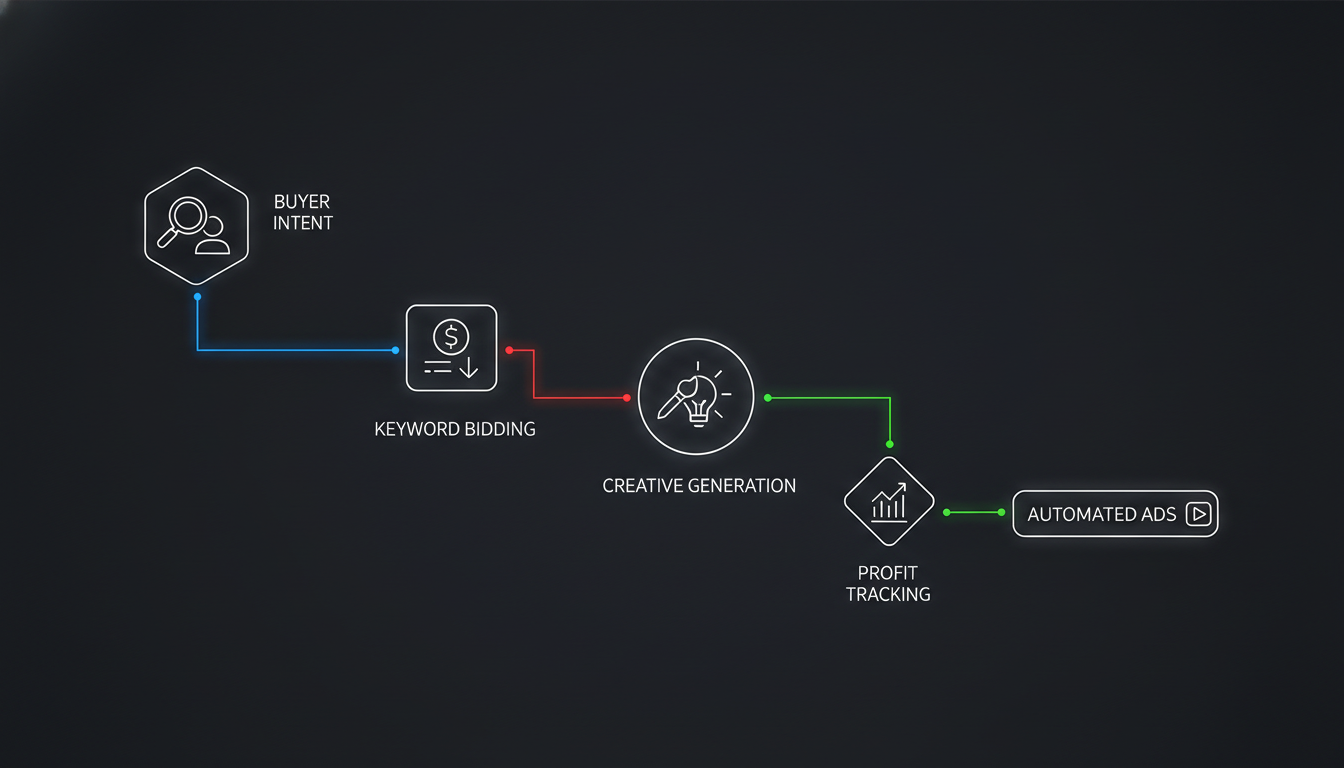
As this comparison highlights, relying on basic ppc software tools or limited ad management software leaves your brand vulnerable to agile competitors who utilize real-time automation. True scale requires a unified approach that connects bidding, creative generation, and financial tracking into a single ecosystem.
The Profitability Trap: Looking Past Vanity Metrics to Track True Margins
One of the most common mistakes in digital marketing is evaluating performance using vanity metrics. Many brands celebrate a low ACoS or a high ROAS on their amazon ads campaign, only to discover at the end of the quarter that their actual take-home profit is flat or declining. This discrepancy occurs because traditional advertising software operates in a vacuum, ignoring critical operational costs like cost of goods sold (COGS), Amazon storage fees, returns, and shipping costs.
To scale a brand sustainably, you must align your advertising spend with your net margins. This requires an all-in-one advertising platform that goes beyond basic bidding to provide deep, SKU-level financial visibility. By tracking True Profit per ASIN in real time, you can ensure that your advertising budget is actually driving profitable growth, rather than just inflating your top-line revenue at the expense of your margins.
With this level of visibility, your marketing strategy shifts from a simple cost-minimization approach to a dynamic growth driver. If a product has healthy margins and high organic visibility, the system can systematically adjust bids to maximize total market share. Conversely, if a product's shipping costs rise or its return rate spikes, the software automatically scales back ad spend to protect your profitability, ensuring your capital is always allocated to your most profitable products.
Implementing Your Automated Amazon PPC Strategy: A Step-by-Step Guide
Migrating from a manual or rule-based setup to a fully automated system can feel like a daunting task. However, by taking a structured approach, you can ensure a smooth transition while protecting your active campaigns. Follow this roadmap to implement a high-performing automated workflow:
Step 1: Auditing Your Account and Structuring Campaigns
Before launching any automation, clean up your existing account structure. Group your products logically by profit margin, conversion rate, and inventory levels. Consolidate overlapping campaigns to prevent your ads from bidding against each other, and establish clean, dedicated portfolios for your core products. This ensures the AI model has clean, well-organized data to work with from day one.
Step 2: Feeding Clean Performance Data to Your AI Models
Once your campaigns are structured, connect your account to your automated platform to begin the training phase. The machine learning models need a short period of historical data to analyze category-specific conversion patterns, search volume trends, and competitor behavior. During this initial calibration window, keep your target margins realistic and let the system establish its baseline.
Step 3: Setting Profit Targets and Launching Bidding Automation
Input your cost of goods sold (COGS), target profit margins, and maximum bid thresholds for each product group. Once these guardrails are in place, activate the bidding automation. The system will begin making sub-hourly adjustments, continuously optimizing your bids based on conversion probability, inventory levels, and real-time margin changes.
Step 4: Automating Negative Keyword Harvesting and Expansion
Set up automated search term rules to keep your targeting clean and relevant. The system will continuously monitor search term reports, instantly adding non-converting terms to your negative keyword list to prevent wasted spend. At the same time, it will automatically graduate high-converting search queries into dedicated campaign targets to scale your reach.
Step 5: Launching Dynamic Creative Testing
With your bidding running smoothly, focus on optimizing your click-through rates. Generate multiple variations of custom product imagery and custom headlines using your creative generation tools. Launch these as automated A/B tests within your Sponsored Brands campaigns, allowing the system to continuously test and scale your best-performing creative assets.
The Future of Amazon Advertising: Driving Profitable Scale in 2025 and Beyond
As the Amazon marketplace continues to evolve, the brands that thrive will be those that embrace full-funnel, margin-aligned automation. Relying on slow, manual adjustments or rigid rule-based tools is no longer enough to stay ahead in a highly competitive landscape. By connecting real-time bidding, automated creative testing, and SKU-level profit visibility, brands can eliminate wasted spend and scale their campaigns with absolute confidence.
The transition toward intelligent automation is not just a way to save operational hours; it is a fundamental shift in how successful e-commerce businesses are built and scaled. By deploying an advanced marketing operating system, your brand can unlock consistent, profitable growth, dominate your target categories, and build a lasting competitive advantage on Amazon.