
The High-Stakes Evolution of Amazon PPC Management
In the hyper-competitive landscape of modern e-commerce, executing a manual amazon advertising strategy has transitioned from a labor-intensive task to an operational impossibility. Amazon's marketplace functions as a real-time, high-frequency auction where consumer behavior, competitor pricing, and search algorithms shift by the minute. For brands managing hundreds of ASINs and thousands of keywords across multiple match types, attempting to adjust bids, target search terms, and manage budgets manually is a recipe for wasted ad spend and missed revenue opportunities.
As average Cost-Per-Click (CPC) rates continue to rise across almost every retail vertical, profit margins are under severe pressure. Traditional methods of amazon ppc management rely heavily on historical reports, lagging data, and human intervention that is structurally too slow to keep pace. To maintain a competitive edge, Amazon-first brands, D2C sellers, and ad agencies must adapt. The integration of ai advertising and advanced automation is no longer a luxury—it is the baseline requirement for modern brand scalability.
By leveraging ai and advertising technologies, sophisticated sellers can analyze billions of data points in real time. Rather than relying on gut feelings or weekly campaign reviews, artificial intelligence ads systems use predictive modeling to automate bidding decisions, harvest high-performing search terms, prune non-converting traffic, and scale high-impact creative. This shift is turning amazon ppc advertising from a reactive guessing game into a proactive, high-yield science.
Why Legacy Amazon PPC Software and Rule-Based Tools Fall Short
Many legacy options on the market claim to offer automated bidding, but a closer look reveals they are merely basic ppc software wrapped in marketing hype. These platforms operate on rigid, rule-based logic—often structured around simple "if-this-then-that" formulas (e.g., "If ACoS exceeds 35%, lower the bid by 10%."). While these automation marketing tools provide a basic level of automation, they are fundamentally limited because they lack predictive capabilities and cannot adapt dynamically to market fluctuations.

Rule-based automation systems suffer from several distinct structural flaws:
- Lagging Adjustments: Rules typically run once a day or once a week. They cannot react to sudden intra-day spikes in traffic, conversion rates, or competitor stockouts.
- Internal Keyword Cannibalization: Basic rule-based systems often struggle to track how different campaigns interact, leading to bidding wars between your own Sponsored Products and Sponsored Brands campaigns.
- No Inventory Awareness: Rule-based systems will continue aggressively driving traffic to an ASIN that is nearly out of stock, causing devastating stockouts that severely damage organic search rankings.
- Inability to Process Complex Data: Human-configured rules cannot calculate the interplay between conversion rates, average order values, organic rankings, and seasonal fluctuations simultaneously.
To overcome these challenges, next-generation ai ppc management uses neural networks and machine learning models. Instead of executing pre-packaged rules, a true ai advertising platform continuously calculates the probability of a conversion for every single ad impression. This allows brands to shift from static rules to an elastic, predictive ad campaign automation system that actively protects and maximizes profitability.
The Mathematical Core of AI PPC: Predictive Bidding and Elasticity
At the center of any highly effective amazon ppc automation software is a predictive bid optimization engine. To understand why this is superior, we must look at how bids are calculated at a granular level. Amazon's ad platform operates on a second-price auction model, where the winner pays $0.01 more than the next highest bidder. To optimize this, the AI calculates the optimal bid using a dynamic conversion probability formula:
Optimal Bid = Target ACoS × Retail Price × Predicted Conversion Rate (pCVR)
While a human or standard amazon ppc tool can estimate historical conversion rates, an advanced machine learning model forecasts the pCVR on a rolling basis, evaluating multiple dynamic factors simultaneously:
- Intra-Day Shopper Behavior (Dayparting): Traffic and purchase intent vary wildly depending on the hour of the day and day of the week. Advanced AI-driven dayparting analyzes seasonal, weekly, and hourly traffic patterns, dynamically adjusting bids to maximize visibility during high-conversion hours and scaling back spend during low-conversion windows.
- Historical Conversion Confidence: The AI applies statistical confidence intervals to keyword performance. If a high-volume search term historically converts well but experiences a brief dip due to a temporary stockout, the system recognizes this anomaly and avoids permanently slashing the bid, maintaining valuable organic keyword positioning.
- Competitor Action Analysis: By monitoring changes in competitor pricing, review velocity, and buy-box ownership, the algorithm adjusts bid aggression to capture market share when competitors are weak and conserve budget when competitors run aggressive promotions.
Elevating ROAS with AI-Powered Ad Creative Generation
Bidding optimization is only one side of the coin; creative assets represent the other. Even the most mathematically perfect bid cannot convert a shopper if the ad creative itself is generic, unappealing, or suffering from ad fatigue. Historically, producing unique, high-quality images and video assets for Sponsored Brands, Sponsored Display, and Amazon DSP campaigns required extensive design resources, creating a massive bottleneck for fast-growing brands.
Generative artificial intelligence has completely transformed this workflow. Today, an ai ad generator or ai ads creator can produce high-converting lifestyle imagery, product mockups, and video storyboards in a matter of seconds. For example, brands can utilize Amazon Ads AI-powered image generation capabilities to instantly generate rich, lifestyle-focused backgrounds that place their products in realistic consumer settings, significantly improving click-through and conversion rates.
To take creative optimization a step further, sophisticated brands rely on specialized, performance-driven tools. AdAstraa’s custom creative engine, AdCreative+, leverages specialized neural networks to analyze top-performing creative layouts within specific product categories. By combining design elements with real-time performance data, it builds variations of custom lifestyle images and video assets tailored to what is actively converting shoppers. This eliminates creative stagnation, allowing brands to launch automated, multivariate creative testing campaigns that continuously refresh assets to combat banner fatigue.
Automated Search Term Harvesting and Negative Keyword Pruning
One of the most tedious and error-prone tasks in manual amazon campaign optimization is keyword management. Without continuous oversight, broad and phrase match campaigns quickly accumulate hundreds of irrelevant search queries that drain budgets without yielding conversions. Conversely, identifying high-performing customer search terms and graduating them to exact-match campaigns is vital to scaling sales volume.
A sophisticated amazon ppc automation tool manages this entire workflow programmatically, removing human delay and error:
- Search Term Isolation: When a customer search query generates a pre-defined threshold of sales (e.g., 3 sales within a 14-day window) in a broad or phrase campaign, the AI isolates that query. It automatically creates an exact-match keyword in a dedicated target campaign and simultaneously adds it as a negative keyword in the exploratory campaign. This prevents internal keyword competition and ensures clean data tracking.
- Statistical Negative Match Pruning: Instead of waiting for a keyword to spend a flat dollar amount before pausing it, the AI calculates the statistical probability of conversion. If a keyword receives 15 clicks with zero conversions, and the average category conversion rate is 10%, the AI can calculate with high statistical confidence that the keyword is non-converting and will immediately add it as a negative target.
- Asynchronous Match Type Scaling: The algorithm continuously tests new keyword variations, synonyms, and long-tail phrases, expanding your product's organic reach while systematically eliminating non-converting search terms to lower ACoS.
A Holistic Blueprint for AI-Powered Amazon Advertising Strategy
True success on Amazon requires moving beyond isolated ad campaigns. Top-performing brands understand that advertising must be deeply integrated with overall business operations, including inventory levels, profitability targets, and organic search rank. This is where holistic ai marketing strategies and unified operating systems come into play.
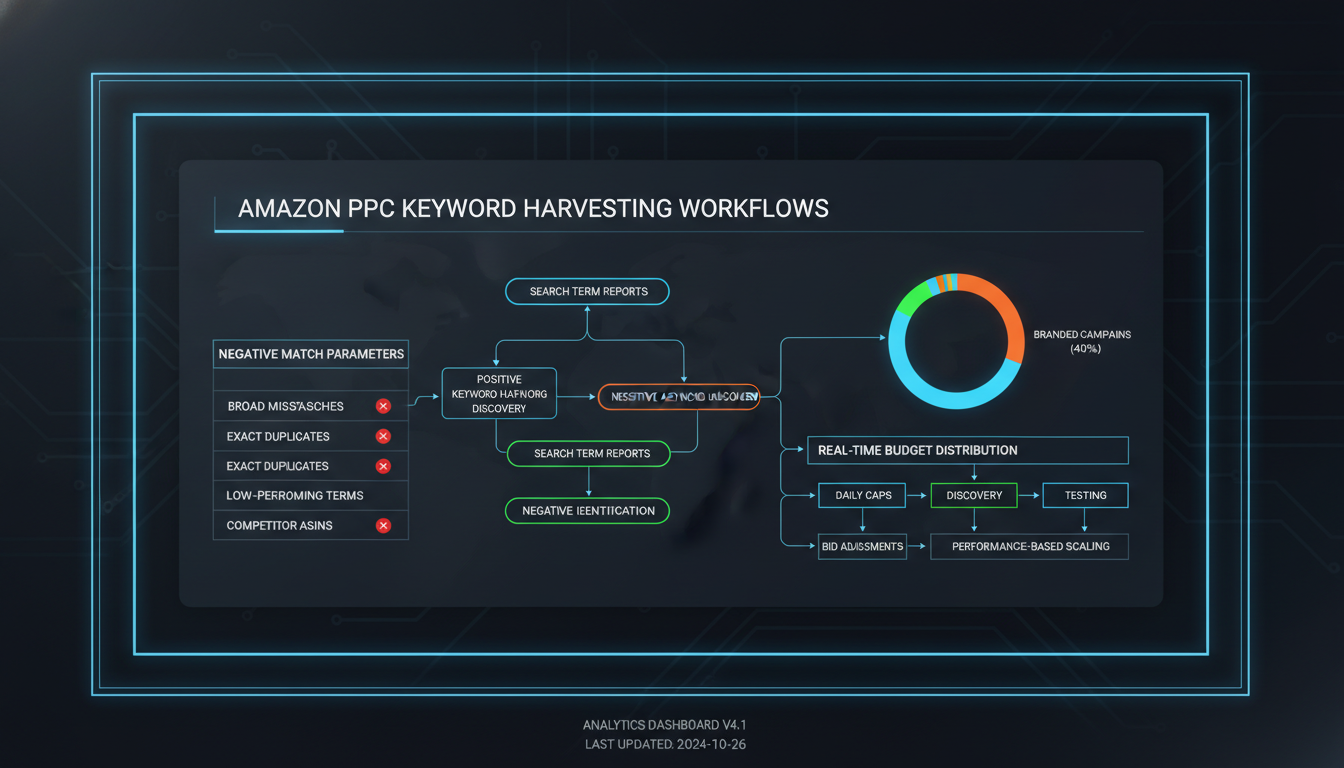
By connecting real-time advertising data with inventory forecasting, brands can avoid the devastating "out-of-stock loop." When inventory levels for a specific ASIN run low, an intelligent marketing workflow automation system automatically scales back ad spend on that product, preserving inventory for higher-margin organic sales and protecting the listing's search ranking. When new inventory arrives, the system programmatically ramps up bid aggression to quickly regain lost organic momentum.
Furthermore, using advanced consumer intelligence engines—such as AdAstraa's buyer intent intelligence Shopper OS—enables brands to target shoppers based on actual purchase intent data. This deep integration allows brands to implement highly sophisticated customer acquisition strategies, matching top-of-funnel Sponsored Brands campaigns with down-funnel, intent-based retargeting. Additionally, leveraging Amazon's official suite of generative AI ad solutions helps advertisers deploy rich, visually compelling content across the entire buyer journey, maximizing conversion rates at every touchpoint.
Evaluating the Best Amazon PPC Software Options
As the market floods with platforms claiming to offer "AI-powered" solutions, brands and agencies must carefully evaluate their options. Choosing the wrong ppc software tools can result in programmatic mistakes, poor bid execution, and wasted budget. Below is an analytical comparison of the different types of ad management solutions available today:
| Core Capability | Traditional Rules-Based Software | Basic AI Bidding Tools | AdAstraa AI Ad Operating System |
|---|---|---|---|
| Bidding Engine | Static, user-defined rules ("If/Then" logic). Adjusts once daily. | Basic machine learning. Adjusts bids based on historical performance. | Predictive neural networks. 24/7 Autopilot bidding with intra-day adjustments. |
| Keyword Optimization | Manual graduation based on basic click/sale thresholds. | Automated harvesting based on simple conversion thresholds. | Statistical confidence mapping, search term isolation, and negative mapping. |
| Creative Production | None. Requires external design resources. | Basic templates or no creative capabilities. | AI-powered AdCreative+ for custom, performance-driven asset generation. |
| Inventory Integration | None. Operates completely independently of inventory status. | Basic stock alerts; requires manual adjustments to pause ads. | Fully automated, inventory-aware budget and bid scaling. |
| Data Synchronization | Lagging Amazon API sync (often 24 to 48 hours). | Daily API sync; basic hourly adjustments. | Real-time streaming API integration with continuous data processing. |
While basic ppc optimization software can help manage small-scale campaigns, enterprise-level sellers and rapid-growth brands require a comprehensive, all in one advertising platform that coordinates bid adjustments, creative assets, search term harvesting, and business-wide unit profitability in real time.
An Actionable Roadmap to Automate and Scale Your Amazon Ads
Transitioning from manual campaign management to a fully automated, AI-driven strategy does not have to be an all-or-nothing leap. By following a structured implementation roadmap, brands can systematically scale their operations while maintaining full control over their advertising metrics:
- Audit and Clean Your Campaign Architecture: Before launching any automation tool, clean up your campaign structure. Consolidate overlapping campaigns, pause duplicate keywords, and establish clean naming conventions. This provides the AI with a structured data foundation to learn from.
- Deploy Predictive Bidding: Integrate a specialized platform like AdAstraa to take over automatic bid adjustments. Start by setting target ACoS or TACoS boundaries for your top-performing ASINs, allowing the AI to optimize bids 24/7 to capture low-hanging fruit and lower ACoS.
- Automate Keyword and Search Term Management: Configure your target keyword thresholds and allow the automation software to handle search term harvesting and negative keyword pruning, ensuring non-converting search terms are quickly identified and blocked.
- Implement Multi-Variant Creative Testing: Leverage automated creative tools to build diverse image and video assets for Sponsored Brands and Sponsored Display campaigns. Run continuous A/B tests to identify high-performing assets and keep creatives fresh.
- Integrate Inventory and Profitability Metrics: Connect your inventory data to ensure your automated campaigns align with stock levels. Monitor true profit per ASIN to ensure your ad spend is driving bottom-line profitability, not just superficial top-line revenue.
The future of e-commerce belongs to brands that successfully combine human creativity with algorithmic execution. By deploying a comprehensive, AI-powered ad operating system, you can eliminate wasted ad spend, reclaim manual management hours, and scale your Amazon campaigns with unparalleled precision.