Here's a number that should stop you in your tracks:
Amazon India alone attracted 454 million monthly visitors in 2024 — more than double Flipkart's traffic — while India's total e-commerce market surged past US $129 billion in 2025, growing at nearly 20% CAGR through 2034. And yet, thousands of sellers leave enormous revenue on the table every single month because they either set up their Amazon seller account incorrectly, list products without optimisation, or run pay-per-click campaigns with no strategy whatsoever.
If you're a D2C brand, FMCG company, or aspiring entrepreneur wondering how to finally crack Amazon India sales, this is the essential, step-by-step guide you've been searching for. We'll walk you through everything — from Amazon seller registration all the way to running breakthrough performance marketing campaigns that compound your growth while you sleep.
🚀 Stop guessing. Start growing with AI-powered ad automation.
AdAstraa's Autopilot optimises your Amazon bids 24/7, kills wasted spend, and boosts ROAS — automatically.
Start Your Free Trial on AdAstraa →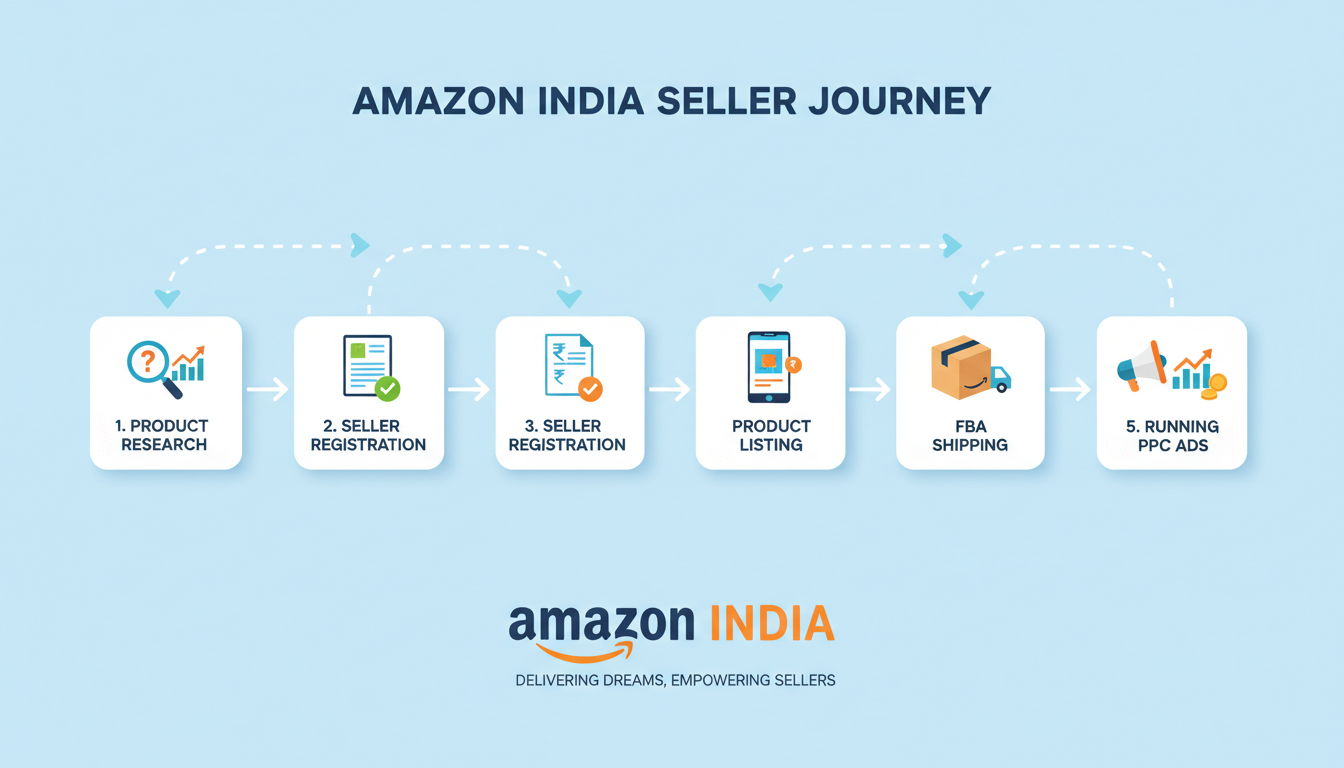
Why Amazon India Is the Ultimate Ecommerce Opportunity Right Now
India's e-commerce landscape is not just growing — it's exploding. With over 125 million new online shoppers added in three years and another 80 million expected by 2025, the customer base available to Amazon sellers has never been larger. During Amazon Prime Day 2025, the platform recorded over 18,000 orders per minute at peak, with 70% of new Prime sign-ups coming from Tier-2 and Tier-3 cities.
That last data point is game-changing. It means your products aren't just competing for metro shoppers — you now have access to an entirely new wave of buyers in smaller cities who are coming online for the first time and choosing Amazon as their preferred shopping destination.
The Top-Selling Categories on Amazon India in 2025
Before you invest a single rupee in inventory or ads, you need to understand where the highest-selling products on Amazon India are concentrated. According to current market data, these categories dominate:
- Fashion & Apparel — commands 31.67% of India's e-commerce market share, led by demand for affordable yet trendy styles.
- Consumer Electronics — wireless audio brands like boAt, smartphones, and smart home devices remain consistently top-selling items on Amazon India.
- Grocery & Daily Essentials — Food & Beverages are growing at a 17.68% CAGR, fuelled by quick commerce dark stores.
- Beauty & Personal Care — skincare personalization is a major trend; clean beauty is especially high-momentum.
- Baby Products, Home & Kitchen — high repeat-purchase categories with strong brand loyalty potential.
Picking the right category is the single most powerful early decision you'll make. A product that's a top seller in the US marketplace doesn't automatically translate to a best seller on Amazon India — consumer preferences, price points, and competitive dynamics are entirely different here.
Step-by-Step: Amazon Seller Registration in India
Getting set up on Amazon Seller Central India is far more straightforward than most people assume. Here's the proven registration process that gets your seller account live fast.
Documents You'll Need to Register as an Amazon Seller
Before you head to sellercentral.amazon.in to register, gather these essential documents. Missing even one can delay your approval by days.
- GST Registration Number — mandatory for most product categories in India.
- PAN Card — individual or business, depending on your entity type.
- Active Bank Account — for receiving payments from Amazon.
- Mobile Number & Email Address — for OTP verification and account communication.
- Business Address Proof — utility bill or government-issued address document.
The Amazon Seller Account Setup Process
- Visit Seller Central: Go to sell.amazon.in and click "Register Now" to begin the Amazon seller registration process.
- Create Your Selling Account: Choose between an Individual plan (for low-volume sellers) or a Professional plan (for serious brands scaling on the platform).
- Enter Business Details: Provide your legal name, store name, GST number, and bank information. Accuracy here is non-negotiable.
- Verify Your Identity: Complete the OTP verification and upload required KYC documents.
- Set Up Your Seller Dashboard: Once approved, you'll gain access to the full Amazon Seller Central dashboard — your command centre for orders, inventory, and ad management.
It typically takes 90 to 120 days before a brand-new seller account starts receiving consistent orders at scale. This is why setting up your listings and advertising correctly from day one is absolutely essential — you cannot afford to waste those early weeks with poor configurations.
Already selling on Amazon? Learn how AI-driven advertising on Amazon can transform your seller performance from the very first week.
Understanding Amazon Seller Fees and Charges in India
One of the most must-know topics for every Amazon India seller is the fee structure. Get it wrong and you'll watch your margins evaporate — even with strong sales volume.
The Main Amazon Seller Costs You Need to Track
| Fee Type | What It Covers | Typical Range |
|---|---|---|
| Referral Fee | Commission on each sale, category-dependent | 2% – 15% |
| FBA Fulfillment Fee | Pick, pack, ship & customer service by Amazon | Varies by weight & size |
| Storage Fee | Monthly storage in Amazon fulfillment centres | Seasonal rate card applies |
| Easy Ship Fee | Amazon picks up & delivers your self-stored items | Reduced by 20%+ for products under ₹300 |
| Amazon Ads / PPC | Sponsored Products, Brands & Display campaigns | Pay-per-click, bid-based |
Critical update for 2025: Amazon India expanded its zero referral fee policy to over 12.5 crore products priced under ₹1,000 across 1,800+ categories. This is a breakthrough opportunity for sellers in the affordable goods segment to dramatically improve their net margins. Use the Amazon FBA and revenue calculator guide to model your true profit per ASIN before listing anything.
How to Create Product Listings That Actually Convert
Getting traffic to your Amazon product listing is only half the battle. The listing itself must instantly convince shoppers to buy. Poor listings are the silent profit killer most sellers never diagnose.
The Non-Negotiable Elements of a High-Converting Amazon Listing
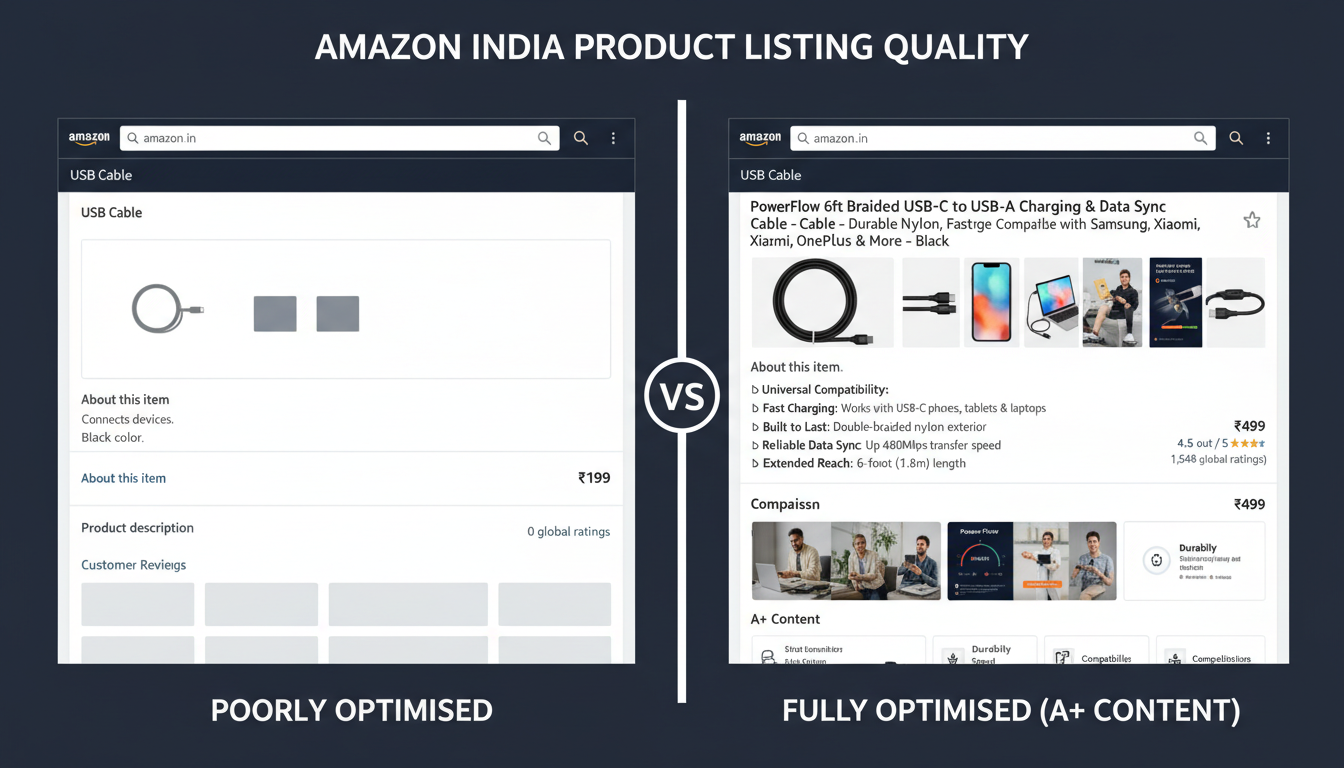
- Keyword-Rich Title: Front-load your primary keyword (e.g., brand + product type + key feature + size/colour). Amazon's A9 algorithm reads titles first.
- Bullet Points (5 of them): Each bullet should highlight one core benefit. Lead with the benefit, then explain the feature. Don't waste bullets on generic filler language.
- Backend Search Terms: Use all available characters in the backend keyword field — include synonyms, regional variants, and competitor brand terms where permissible.
- A+ Content / Enhanced Brand Content: If you're Amazon Brand Registered, use A+ Content to tell your product story with images and comparison charts. Conversion rates typically improve by 5–10%.
- High-Resolution Images: Minimum 6 images — main white-background image, lifestyle shots, infographic callouts, and a size/scale reference photo. Image quality is the single biggest driver of add-to-cart rates on mobile.
The Power of Amazon Brand Registry
If you have a registered trademark, enrol in Amazon Brand Registry immediately. This is not optional for serious sellers — it unlocks A+ Content, Sponsored Brands ads, the Amazon Vine program for reviews, and critically, brand protection tools that prevent competitors from hijacking your listings.
Brand-registered sellers consistently report higher ROAS, lower return rates, and stronger customer trust compared to non-registered competitors in the same category. Explore how building your brand on Amazon with the right infrastructure can deliver compounding long-term returns.
“A well-optimised Amazon listing functions like a 24/7 salesperson — it answers every customer question, handles objections, and closes the sale without you being in the room.”
FBA vs. Easy Ship vs. Self-Ship: Choosing the Right Fulfilment Strategy
Your fulfilment method directly impacts your Buy Box win rate, customer experience, and net profit. This is one decision that most new sellers get wrong because they optimise only for the lowest upfront cost — which almost always costs them more downstream.
Fulfilment by Amazon (FBA): The Effortless Scale Option
FBA means Amazon stores your inventory, picks and packs orders, handles shipping and returns, and provides 24/7 customer service. The trade-off is a higher per-unit fee, but the advantages are powerful: FBA sellers are Prime-eligible by default, win the Buy Box far more frequently, and benefit from Amazon's trusted 1–2 day delivery promise — which is increasingly expected across Tier-1 and Tier-2 India.
Easy Ship: The Middle-Ground Model
With Easy Ship, you store the inventory and pack the orders — Amazon's logistics network handles pickup and delivery. It's a strong option for sellers with limited capital who still want the reliability of Amazon's delivery infrastructure. With Amazon India's recent 20%+ reduction in Easy Ship fees for products under ₹300, this has become an even more attractive option for FMCG and consumer goods brands.
Self-Ship: Maximum Control, Maximum Responsibility
Self-Ship gives you complete control over inventory and fulfilment but demands strong logistics capabilities. It's best suited for large, heavy, or fragile items that FBA handles less efficiently, or for sellers with pre-existing logistics partnerships. Note that Self-Ship sellers typically see lower Buy Box win rates compared to FBA equivalents.
Mastering Amazon Advertising: The Proven Performance Marketing Playbook
Here's the brutal truth: organic ranking alone cannot scale an Amazon brand in 2025. With millions of products competing across every category, Amazon advertising — specifically pay-per-click (PPC) campaigns — is the engine that separates growing brands from stagnant ones.
The good news? When run intelligently, Amazon ads don't just drive immediate sales — they feed the organic ranking algorithm, creating a compounding flywheel of visibility and revenue. Let's break down each ad type and when to use it.
Sponsored Products: Your Most Powerful Day-to-Day Ad
Sponsored Products appear directly in search results and on competitor product pages. They're the most widely used Amazon ad format — and for good reason. They drive targeted traffic to specific ASINs at a cost-per-click you control. For new product launches, running an automatic Sponsored Products campaign first is a proven strategy to discover which search terms convert, before building a highly optimised manual campaign around your winners.
Key formula: ACoS = Ad Spend ÷ Ad Revenue × 100. If you spend ₹1,000 on ads and generate ₹5,000 in attributed sales, your ACoS is 20%. The industry benchmark for a healthy ACoS on Amazon India varies by category, but anything below your net margin percentage means your campaigns are profitable.
Sponsored Brands: Game-Changing for Brand Visibility
Available exclusively to Brand Registry sellers, Sponsored Brands display your logo, a custom headline, and up to three products at the very top of search results. These ads are essential for building brand awareness, defending your brand's search terms, and driving buyers to your Amazon storefront. The click-through rate (CTR) for Sponsored Brands can be significantly higher when the ad creative is personalised and visually compelling.
Sponsored Display & Amazon DSP: Reach Buyers Beyond Search
Sponsored Display ads allow you to retarget shoppers who viewed your product or competitor products — both on and off Amazon. Amazon DSP (Demand-Side Platform) takes this further, enabling programmatic display advertising across third-party websites and apps to reach Amazon audiences who haven't yet searched for your product. For FMCG brands and D2C players serious about scaling, DSP is the next-level growth lever that most sellers haven't yet activated.
Understanding ad type selection and campaign architecture is just the starting point. Discover how advanced AI advertising strategies drive consistent, compounding ROAS improvements without requiring constant manual intervention.
⚡ Your Amazon ads shouldn't need babysitting.
AdAstraa's Autopilot adjusts bids in real time — 24 hours a day, 7 days a week — so your campaigns never overspend or miss a conversion opportunity.
See AdAstraa Autopilot in Action →5 Costly Amazon PPC Mistakes Indian Sellers Must Avoid
Running Amazon ads without a clear strategy is how brands silently haemorrhage their budget. These are the five most devastating mistakes we see sellers make — and how to fix them immediately.
1. Ignoring Negative Keywords
Not adding negative keywords to your campaigns is the equivalent of paying for every person who walks past your shop window, whether or not they'll ever buy. Irrelevant search terms drain your daily budget. Review your Search Term Reports weekly and aggressively negative-match any query that spends without converting — this single action can instantly reduce wasted ad spend by 20–40%.
2. Running One Catch-All Campaign
Bundling all your products into a single automatic campaign is a beginner trap. Every ASIN has different margins, conversion rates, and competitive landscapes. Segment your campaigns by product category, funnel stage (awareness vs. retargeting), and keyword match type to get granular control over performance and profitability.
3. Not Setting a Break-Even ACoS Target
Before launching any campaign, calculate your target ACoS: the maximum you can spend in advertising as a percentage of sales and still be profitable. If your net margin after COGS and fees is 30%, your break-even ACoS is 30%. Running campaigns without this guardrail is a guaranteed path to negative margins, even with strong revenue numbers.
4. The Set-and-Forget Mentality
Amazon's auction-based PPC environment changes daily — competitor bids shift, keyword trends evolve, and your product's conversion rate fluctuates with reviews, pricing, and seasonal demand. Sellers who check their campaigns once a month consistently lose to sellers who optimise weekly (or use AI tools that adjust bids continuously).
5. Treating Ads and Organic Ranking as Separate Strategies
This is the most sophisticated mistake, and the most expensive. Amazon's A9 algorithm rewards velocity of sales — every ad-driven sale that includes the target keyword strengthens your organic ranking for that term. Sellers who structure their PPC campaigns to build organic rank first, and lower bids once organic kicks in, enjoy dramatically lower long-term ACoS and sustainable profitability.
Real-World Example: How an FMCG Brand Scaled on Amazon India
Consider the story of a mid-sized Indian personal care brand that had been selling on Amazon India for two years. Despite having a genuinely good product — a natural hair oil in the Beauty & Personal Care category — their monthly revenue had plateaued at ₹8 lakhs. Their ACoS sat at 38%, eating into margins that were never strong to begin with.
The core problem? They were running a single auto-targeting Sponsored Products campaign with no negative keywords, no bid adjustments, and no product-level segmentation. Roughly 43% of their ad spend was going to irrelevant search queries that had zero purchase intent.
After implementing proper campaign architecture — separating branded, category, and competitor keyword campaigns, adding 200+ negative keywords, and shifting to an AI-powered bid optimisation tool — they achieved the following in 90 days:
- ACoS dropped from 38% to 19%
- Monthly ad revenue nearly doubled to ₹14.5 lakhs
- Organic ranking for their top 3 keywords improved by an average of 11 positions
- Overall ROAS improved from 2.6x to 5.2x
This wasn't a one-in-a-million outcome. It's the guaranteed result of applying structured, data-driven advertising methodology to an Amazon business — and it's exactly what tools like AdAstraa's Shopper OS buyer-intent intelligence are built to deliver at scale.
Why AI Tools Are the Secret Weapon of Today's Best Amazon Sellers
The sellers who will dominate Amazon India in 2025 and beyond aren't working harder — they're working smarter, with AI doing the heavy lifting. Here's what purpose-built AI tools change for Amazon brands:
24/7 Bid Optimisation: Competing While You Sleep
Amazon's ad auction runs every second of every day. Human bid management — even by an experienced team — cannot match the speed and precision of machine learning models that analyse thousands of data points simultaneously. AI-powered Autopilot bidding adjusts keyword bids in real time based on conversion probability, time of day, competitive pressure, and profitability signals. This alone can recover 20–30% of wasted ad spend effortlessly.
Shopper Intent Intelligence: Target Buyers, Not Browsers
The most powerful advancement in Amazon advertising isn't louder ads — it's smarter targeting. AI tools that analyse shopper behaviour patterns, purchase history signals, and category intent data can identify which keywords and audiences are most likely to convert for your specific product. This means your ad budget goes to buyers, not browsers.
AI-Generated Ad Creatives: End the Design Bottleneck
Creative is one of the most overlooked performance levers in Amazon advertising. The right image or video in a Sponsored Brands campaign can improve CTR by 30–50%. AI creative tools can now generate and A/B test multiple ad variations at scale — putting the power of a full creative team into the hands of a single seller. Explore AdCreative+ by AdAstraa to see how AI-generated creatives are redefining performance benchmarks on Amazon.
Amazon Seller Central vs. Vendor Central: Which Is Right for Your Brand?
As your business scales, you may receive an invitation from Amazon to join Vendor Central — a separate platform where you sell your products wholesale directly to Amazon, who then retails them. This is a fundamentally different model from Seller Central, and the decision carries significant long-term implications.
| Factor | Seller Central | Vendor Central |
|---|---|---|
| Pricing Control | Full control | Amazon sets retail price |
| Payment Terms | Every 7–14 days | Net 30–60 days |
| Brand Trust Signal | "Sold by [Brand]" | "Sold by Amazon" |
| Ad Access | Full Seller Central ads | Vendor-exclusive ad types |
For most growing D2C brands, Seller Central remains the superior choice because of the pricing control, faster cash flow, and direct access to customer data via your Amazon seller account. Vendor Central can make sense for established brands with consistent large-volume wholesale capability, but losing pricing control is a significant and often irreversible trade-off.
The Proven Roadmap to Scaling Your Amazon India Brand Beyond ₹1 Crore
Most sellers plateau at a predictable revenue level — and then wonder why adding more products or increasing ad spend doesn't move the needle. Scaling on Amazon India is a systematic process, not a lucky break. Here's the step-by-step growth framework that separates eight-figure Amazon brands from everyone else.
- Nail Your Core ASIN First: Before expanding your catalogue, make sure your hero product is fully optimised — strong listing, 50+ reviews, Buy Box ownership, and profitable ad campaigns. One well-performing ASIN is worth more than ten mediocre ones.
- Systematise Your Ad Management: Move from manual bid adjustments to AI-powered optimisation. The efficiency gains compound every month — lower ACoS, higher ROAS, and time freed up for higher-leverage activities.
- Build True Profit Visibility: Know your actual profit per ASIN after all Amazon fees, ad spend, COGS, and returns. Vanity revenue metrics will lead you astray — True Profit per ASIN is the only number that matters.
- Expand Strategically Using Data: Use your existing sales data and buyer intent signals to identify adjacent categories or product variations that are high-probability wins — not guesswork.
- Leverage Amazon Vine and Deals: The Amazon Vine program (for registered brands) helps generate early, authentic reviews on new product launches. Combined with targeted Lightning Deals during sale events, this creates powerful launch momentum.
- Go Global When Ready: Amazon's sell globally programme allows Indian sellers to expand to the US, UK, UAE, and other marketplaces with surprising ease once your domestic systems are in place. The same product that wins in India can find a massive audience in the Indian diaspora market abroad.
The brands that execute this roadmap consistently — and use intelligent tools to automate the most time-consuming steps — are the ones building durable, compounding Amazon businesses. See how AdAstraa's full operating system integrates every layer of this framework into a single, unified platform.
Additional Resources
Deepen your knowledge with these authoritative external sources, hand-picked for Amazon sellers and ecommerce brand builders:
- 📖 India Brand Equity Foundation (IBEF): India E-commerce Industry Report — Authoritative data on India's e-commerce market size, growth forecasts, and sector breakdown, updated regularly by India's Ministry of Commerce.
- 📊 Payments & Commerce Market Intelligence: India E-Commerce Growth Trends 2024–2025 — Deep-dive statistics on India's online shopper demographics, top platform rankings, and category-level breakdown including grocery, fashion, and electronics.
- 🛒 Unicommerce: Complete Guide to Amazon India Seller Registration 2025 — Practical, step-by-step seller registration walkthrough covering KYC, account types, and onboarding timelines.
- 💰 KwickMetrics: Amazon FBA Fees Complete Guide 2025 — Comprehensive breakdown of FBA fulfilment fees, storage charges, and recent updates across the US, UK, India, and Australia marketplaces.
- 🎯 Sellsonomics: Amazon PPC Advertising Guide for Indian Sellers — Practical PPC guidance specifically tailored to the Amazon India marketplace, covering Sponsored Products, ACoS management, and campaign structure.
Your Amazon India Success Story Starts With the Right Foundation
Selling on Amazon India in 2025 is one of the most lucrative opportunities available to any Indian brand or entrepreneur — but only if you approach it with the right systems in place. The market is too large, and the competition too sharp, for shortcuts to work for long.
The sellers who win consistently follow a proven framework: they register correctly, optimise their listings relentlessly, choose the right fulfilment method, run structured and data-driven PPC campaigns, and use AI to automate the things that would otherwise consume their most precious resource — time.
Every month you spend managing campaigns manually, guessing at bids, or leaving negative keywords unchecked is a month of compounding growth handed to your competitors. The technology to change that exists right now — and it's built specifically for Amazon-first brands like yours.
Ready to turn your Amazon seller account into a profit machine?
Join hundreds of Amazon India brands using AdAstraa to automate bid optimisation, kill wasted spend, and scale ROAS — without the manual grind.
Start Free on AdAstraa Today →