




Studies show the average Amazon seller wastes 20–40% of their total ad spend on irrelevant clicks, poor targeting, and inefficient bids — money that quietly drains profit every single day.
If you're managing Amazon PPC manually, you already know the pain: endless bid adjustments, ballooning ACoS, campaigns that spend freely without converting, and reports that take hours to interpret. The competitive landscape on Amazon is unforgiving, and every dollar misdirected is a dollar your competitor uses to outrank you.
The brands pulling ahead in 2025 aren't just working harder — they're working smarter, leveraging AI-powered advertising software and proven campaign optimization frameworks to do in minutes what used to take entire teams a full week.
This guide breaks down 9 essential, battle-tested strategies for Amazon PPC campaign optimization. Whether you're a D2C founder, an FMCG brand manager, or an agency running accounts at scale, these tactics will help you eliminate waste, lower ACoS, and unlock the ROAS growth your ad spend deserves.
Ready to stop bleeding ad spend and start scaling profitably on Amazon?
Start Your Free Trial on AdAstraa →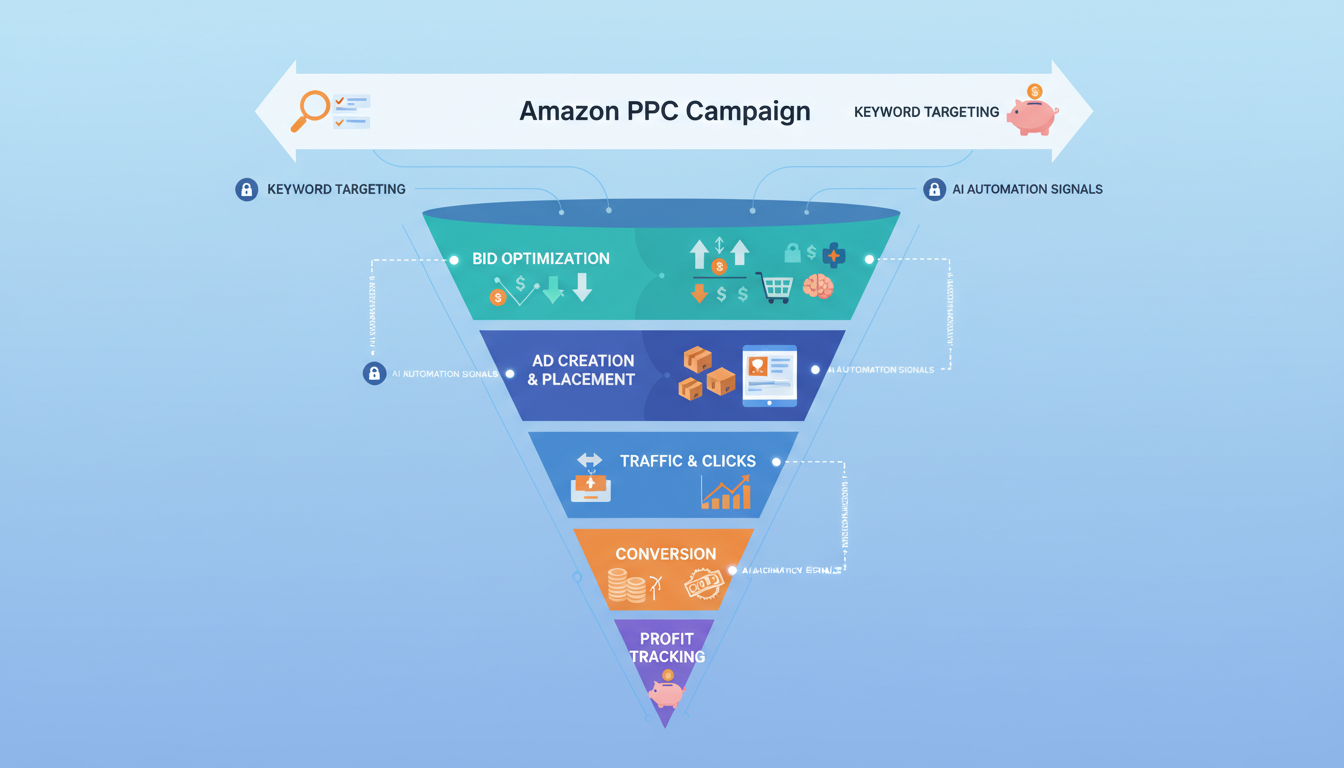

1. Master the Metrics: ACoS, ROAS, and True Profit per ASIN
Before you can optimize a single campaign, you need to know what you're actually optimizing for. Many Amazon sellers fixate on ACoS in isolation — but that one number tells an incomplete story.
ACoS (Advertising Cost of Sale) measures the percentage of ad revenue consumed by ad spend. A 25% ACoS means you spent $25 for every $100 in attributed sales. But if your product margin is only 28%, that same ACoS leaves almost nothing left after fees, fulfillment, and product costs.
ROAS (Return on Ad Spend) is the inverse: revenue divided by spend. A 4x ROAS means every $1 in ads generated $4 in revenue. The right ROAS target is personal — it depends entirely on your contribution margin per ASIN.
Why True Profit per ASIN Changes Everything
The breakthrough insight most sellers miss is True Profit per ASIN — a metric that accounts for ad spend, Amazon fees, COGS, returns, and fulfillment costs at the product level. Without it, you could be scaling a campaign that's actively destroying margin.
AdAstraa's advertising management platform surfaces True Profit per ASIN in real time, so your optimization decisions are grounded in actual economics — not vanity metrics.
Start here. Set your break-even ACoS for every ASIN, then build your campaign strategy around defending and improving that number.
2. Build a Powerful Campaign Structure That Gives You Real Control
Messy campaign structure is the silent killer of Amazon advertising performance. When products, keywords, and match types are tangled together in the same ad group, you lose visibility and bidding precision simultaneously.
A high-performance Amazon advertising campaign structure follows three non-negotiable principles:
- One product per ad group: Keyword and bid data maps directly to a single ASIN, enabling targeted optimization without cross-contamination.
- Match-type separation: Run separate campaigns for broad, phrase, and exact match. This isolates discovery (broad) from defense (exact) and prevents your best-performing exact-match keywords from being cannibalized by broad-match clicks.
- Auto + Manual pairing: Use automatic campaigns as keyword discovery engines. Mine their search term reports weekly and graduate proven performers to manual exact-match campaigns with tighter bid control.
This layered architecture gives you a clear funnel: automatic campaigns discover, broad campaigns refine, and exact campaigns convert. Each layer feeds intelligence into the next.
If you're managing dozens of ASINs, manually maintaining this structure becomes unsustainable. That's where AI advertising automation becomes essential — handling structural consistency at scale while you focus on strategy.
3. Use Negative Keywords Aggressively to Eliminate Non-Converting Spend
Here's a hard truth: a significant portion of your current ad spend is funding clicks that will never convert. Shoppers searching for something adjacent to your product trigger your ads, click through, and leave — and you pay for every single one of those exits.
Negative keywords are your most powerful defensive tool. They tell Amazon's algorithm precisely when not to show your ads, protecting your budget for the search terms that actually drive purchases.
The Two-Layer Negative Keyword System
Campaign-level negatives block irrelevant terms across all ad groups in a campaign. Use these for clearly off-target categories — competitor brand names (when not targeting them intentionally), incompatible product types, or demographic mismatches.
Ad-group-level negatives provide surgical precision. If you're running an exact-match campaign for a keyword, add that keyword as a negative in your broad and auto campaigns to prevent traffic fragmentation and bid cannibalization.
Review your search term reports every 7–14 days. Any term with 5+ clicks and zero purchases deserves immediate negative treatment. Over time, this continuous pruning is one of the most reliable ways to structurally lower ACoS without reducing bids.
AI-powered Amazon PPC management tools like AdAstraa's Autopilot identify and apply negative keywords automatically — scanning thousands of search terms 24/7 so you're never exposed to preventable waste.
4. Implement AI-Powered Bid Optimization for 24/7 Campaign Performance
Manual bid management is one of the most time-consuming and error-prone aspects of Amazon advertising. Bids need to respond to competition, time of day, conversion rate fluctuations, and inventory levels — factors that change by the hour, not the week.
Even the most dedicated PPC manager cannot realistically update thousands of keyword bids multiple times per day. The result? Brands overpay for clicks during low-conversion windows and miss impression share during high-intent peak hours.
How AI Bidding Algorithms Outperform Human Management
Modern AI bid optimization engines analyze historical conversion data, competitor auction dynamics, time-of-day performance patterns, and ASIN-level profitability signals simultaneously. They then apply micro-adjustments — often hundreds per day — that collectively move the needle in ways no manual process can replicate.
AdAstraa's Autopilot engine runs around the clock, dynamically raising bids when conversion probability is high and pulling back when it's not. The result is a guaranteed improvement in cost efficiency: your budget flows toward converting moments instead of being spread uniformly across the day.
"Advertisers who use AI-driven PPC tools can improve campaign performance by 10–13% on average — and that's just the floor. Brands running full AI automation frequently report 30–50% ACoS reductions within the first 90 days."
The step-by-step setup is straightforward: connect your Amazon Seller Central account, define your target ACoS or ROAS per ASIN, and let the AI do the heavy lifting. The platform learns from your specific account data, improving its accuracy continuously over time.
5. Leverage Buyer Intent Intelligence to Target Shoppers Ready to Purchase
Not all Amazon search traffic is created equal. A shopper typing "protein powder" is browsing. A shopper typing "whey protein powder unflavored 5lb grass-fed" is buying. The gap in conversion rate between these two intents can be 5x or greater.
Traditional keyword research tools give you search volume and competition data. What they don't tell you is the purchase intent signal strength behind each term — which keywords are typed by serious buyers versus casual browsers.
Mapping the Buyer Journey with AI-Powered Intelligence
AdAstraa's Shopper OS is purpose-built to decode buyer intent at scale. It analyzes behavioral patterns across search terms, identifying which keywords correlate with high purchase probability — not just high search volume.
By concentrating budget on high-intent terms and de-prioritizing low-intent discovery keywords, brands unlock a compounding effect: higher CVR improves organic ranking, which reduces the cost per acquisition over time. You're not just buying sales — you're building organic velocity.
Integrate buyer intent scoring into your keyword prioritization workflow. High-intent, long-tail keywords should receive premium bid positioning. Generic, high-volume terms should be tested conservatively before scaling.
Unlock Buyer Intent Intelligence
See exactly which search terms your highest-value shoppers are using — and stop bidding on the ones they're not.
Explore AdAstraa's Shopper OS →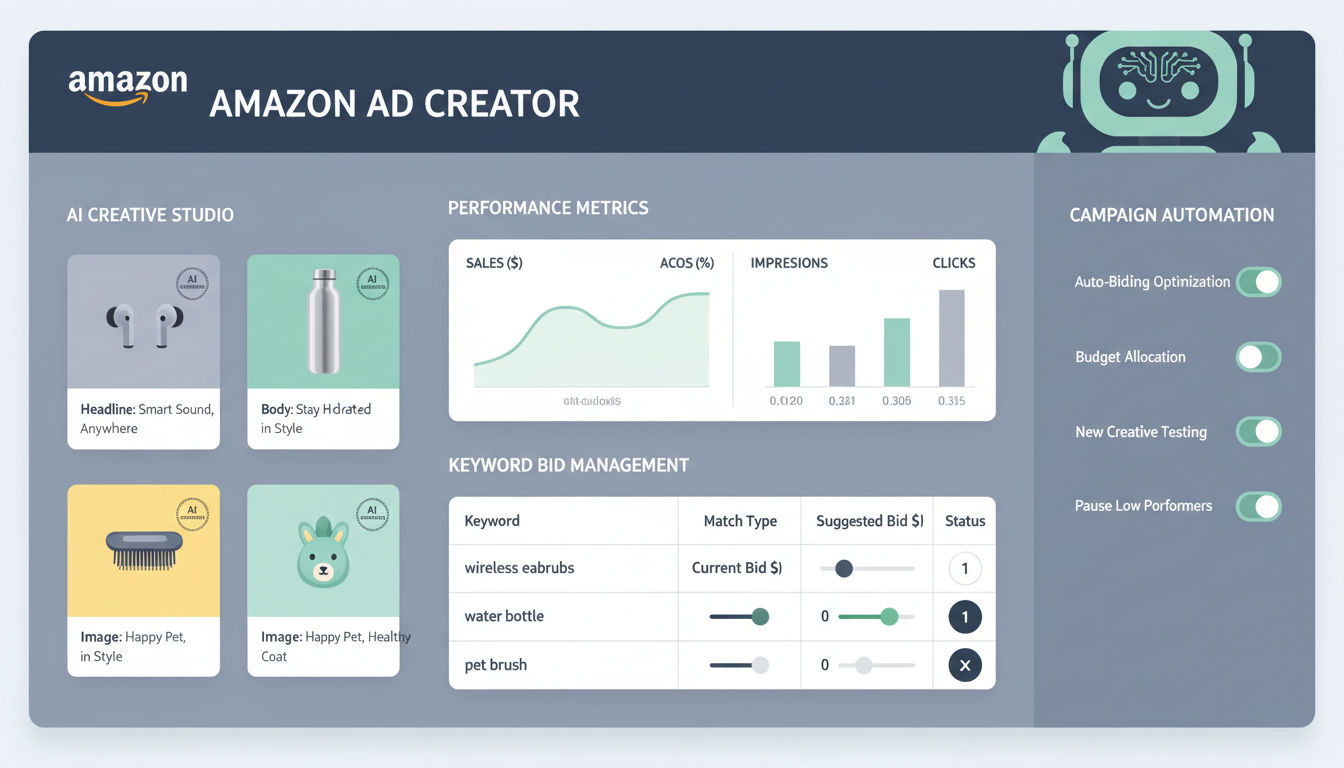

6. Generate High-Converting Ad Creatives at Scale with AI
Your ad creative is the first touchpoint between your brand and a potential buyer. A weak image, a generic headline, or a misaligned message destroys click-through rate — and a poor CTR signals Amazon's algorithm that your product isn't relevant, compounding the damage in auction dynamics.
For most brands, creative production is a bottleneck. Briefing a designer, iterating on concepts, testing variations, and refreshing tired creatives is a slow, expensive cycle that most PPC managers can't keep up with at the pace Amazon demands.
The Game-Changing Shift to AI-Generated Ad Creatives
AdAstraa's AdCreative+ uses AI to generate on-brand, performance-optimized ad images and copy variations instantly. Feed it your product images, brand guidelines, and target audience — and receive multiple creative variations ready for A/B testing.
The platform learns which creative elements perform best for your specific audience and product category, continuously refining outputs to improve CTR over time. This isn't just fast — it's effortless creative optimization that would require an entire in-house team to replicate manually.
Brands running AI-generated creative testing alongside optimized campaigns consistently report 15–30% CTR improvements within the first 30 days — translating directly into lower CPC and stronger ROAS.
7. Deploy Smart Budget Allocation and Dayparting to Maximize Every Dollar
Amazon shoppers don't behave the same way at 2am as they do at 7pm. Purchase conversion rates fluctuate significantly throughout the day — and if your campaign budget is distributed evenly across all hours, you're funding low-conversion windows at the same rate as your peak-performing ones.
Dayparting — adjusting bids and budgets based on time of day and day of week — is one of the most underutilized yet powerful levers in Amazon PPC campaign optimization.
Building Data-Driven Budget Allocation Rules
Start by pulling your campaign performance data by hour of day for the past 30–60 days. Identify the windows where your CVR is meaningfully above average — these are your prime bidding hours. Then build bid modifier rules that amplify spend during those windows and reduce it during off-peak hours.
AI-powered campaign management tools automate this entire process, applying granular time-based adjustments that no manual workflow can match. The result is a budget that works smarter: the same monthly spend generates significantly more conversions when concentrated in high-intent windows.
Layer portfolio budget rules on top of campaign-level budgets to prevent runaway spend when individual campaigns exhaust their daily limits — a common issue that causes inconsistent performance curves.
8. A Real-World Example: How an FMCG Brand Reduced ACoS by 38% in 60 Days
Consider a mid-market supplement brand managing 47 active ASINs across six product lines. Before switching to an AI-powered advertising management platform, their team spent 18+ hours per week on manual bid adjustments, campaign reporting, and keyword hygiene. Their average ACoS sat at 34% — well above their 22% break-even target.
After implementing a structured optimization approach anchored in four key changes, the results were transformative:
- Negative keyword purge: 1,200+ non-converting search terms identified and negated in the first two weeks, immediately reducing wasteful clicks.
- Match-type campaign restructure: All campaigns rebuilt with one ASIN per ad group and separated match-type campaigns — providing clean, actionable performance data.
- AI bid automation activated: 24/7 algorithmic bid management replaced weekly manual adjustments, responding to real-time auction dynamics.
- Buyer intent keyword prioritization: Budget reallocated from generic category terms to high-intent, long-tail keywords with demonstrated purchase correlation.
The outcome: ACoS dropped from 34% to 21% within 60 days — below their break-even target. ROAS climbed 2.1x. And the team reclaimed 14 hours per week previously lost to manual management, redirecting that time toward growth strategy and new product launches.
This isn't an outlier. It's what happens when proven optimization frameworks meet the computational power of AI-driven ppc automation tools.
9. Use AI-Powered Marketing Analytics to Make Faster, Smarter Decisions
Data without insight is just noise. Most Amazon sellers are drowning in reporting — Seller Central dashboards, search term reports, placement reports, bulk files — with no unified view of what's actually driving profitability across their catalog.
The breakthrough advantage of modern AI marketing analytics platforms is their ability to synthesize data across all campaigns, ad types, and ASINs into actionable insights — surfacing anomalies, opportunities, and risk signals that human analysts routinely miss.
What Real-Time Visibility Actually Looks Like
Effective Amazon advertising analytics should answer these questions instantly, without manual report-building:
- Which ASINs are profitable after accounting for all costs — and which are quietly losing money?
- Which keywords have crossed the non-converting threshold and need immediate negation?
- Where is impression share being lost to budget constraints vs. bid rank?
- How is campaign performance trending week-over-week and what's driving the change?
AdAstraa's unified AI marketing strategies platform delivers this visibility in real time, with automated alerts that notify your team the moment a campaign deviates from its target performance thresholds. No more discovering problems weeks after they've eroded profitability.
Pair this analytics layer with your optimization workflows, and you have a complete feedback loop: data informs strategy, AI executes, analytics measures, repeat. This is the ultimate Amazon advertising operating system.
Bringing It All Together: Your Amazon PPC Optimization Roadmap
The 9 strategies outlined above aren't independent tactics — they're an interconnected system. Each layer reinforces the others:
| Strategy | Primary Impact | Time to Results |
|---|---|---|
| Master ACoS & True Profit | Accurate profit baseline | Immediate |
| Campaign Structure | Bidding control & visibility | 1–2 weeks |
| Negative Keywords | Reduced wasted spend | 1–3 weeks |
| AI Bid Optimization | ACoS reduction & efficiency | 2–4 weeks |
| Buyer Intent Targeting | CVR improvement | 2–6 weeks |
| AI Creative Generation | CTR & ROAS lift | 2–4 weeks |
| Dayparting & Budgets | Cost efficiency per conversion | 2–4 weeks |
| AI Analytics & Reporting | Faster decision-making | Immediate |
Implement these strategies sequentially — starting with structural foundations and layering AI automation on top — and you'll build a compounding optimization engine that grows more efficient with every campaign cycle.
Additional Resources
Deepen your understanding of Amazon advertising and AI-powered PPC optimization with these authoritative external sources:
- Amazon Ads Official: Sponsored Products Best Practices — Amazon's own guide to Sponsored Products campaign setup, keyword targeting, and optimization fundamentals.
- Amazon Ads Official: What is ACoS? — Official breakdown of Advertising Cost of Sale, how to calculate it, and how it relates to campaign profitability.
- Channable: Amazon Ads Best Practices for Higher Sales — Expert-backed guide to campaign structuring, keyword targeting, and scaling Amazon advertising efficiently.
- Perpetua: Amazon ACoS — What It Is and How to Improve It — In-depth analysis of ACoS benchmarks across industries and actionable strategies for improvement.
- SupplyKick: How to Improve Amazon ROAS — 7 Practical Fixes — Practical, margin-aware ROAS improvement strategies for Amazon sellers at all spend levels.
The Bottom Line: Stop Managing PPC. Start Mastering It.
Amazon PPC campaign optimization isn't a one-time project — it's an ongoing system. The brands that win on Amazon in 2025 and beyond are those that treat their advertising as a living, data-driven operation: continuously tested, continuously refined, and increasingly powered by AI.
The 9 strategies in this guide give you a complete, step-by-step blueprint: from foundational metric clarity and campaign architecture, through AI-driven bid automation and buyer intent targeting, to creative optimization and real-time analytics. Each layer compounds the one before it.
The question isn't whether to adopt AI-powered Amazon advertising tools — it's how quickly you can implement them before your competitors do. The 20–40% of ad spend being wasted right now is recoverable. The hours lost to manual management are reclaimable. The ROAS lift waiting on the other side of proper optimization is real.
AdAstraa exists to give Amazon-first brands the ultimate, all-in-one advertising operating system to make this transformation effortless — from Autopilot bid management to Shopper OS intelligence, AdCreative+ content generation, and EcomGPT-powered customer operations.
Your Next Step
Join Amazon brands already reclaiming wasted ad spend and scaling profitably with AdAstraa.
No contracts. No complexity. Just results.
Start Optimizing for Free Today →