
Here's a number that should stop you in your tracks:
India's e-commerce market hit $125 billion in 2024 — and it's projected to grow at a CAGR of 27% to reach $163 billion by 2026. Amazon India sits at the very center of this explosion, with millions of active buyers searching for products right now.
Yet most sellers are stuck in the same trap: bloated ad spend, high ACoS, non-converting keywords burning cash round the clock, and zero real-time visibility into what's actually profitable. Sound familiar?
This guide walks you through every essential step — from registering on Amazon Seller Central to running AI-powered ad campaigns that compound your ROAS while you sleep. Whether you're a first-time seller or an established brand scaling to ₹1 Cr+ monthly revenue, these 9 proven steps will transform how you sell on Amazon India.
🚀 Ready to stop guessing and start growing?
AdAstraa's AI Autopilot optimizes your Amazon bids 24/7 — no manual work required.
Start Your Free Trial on AdAstraa →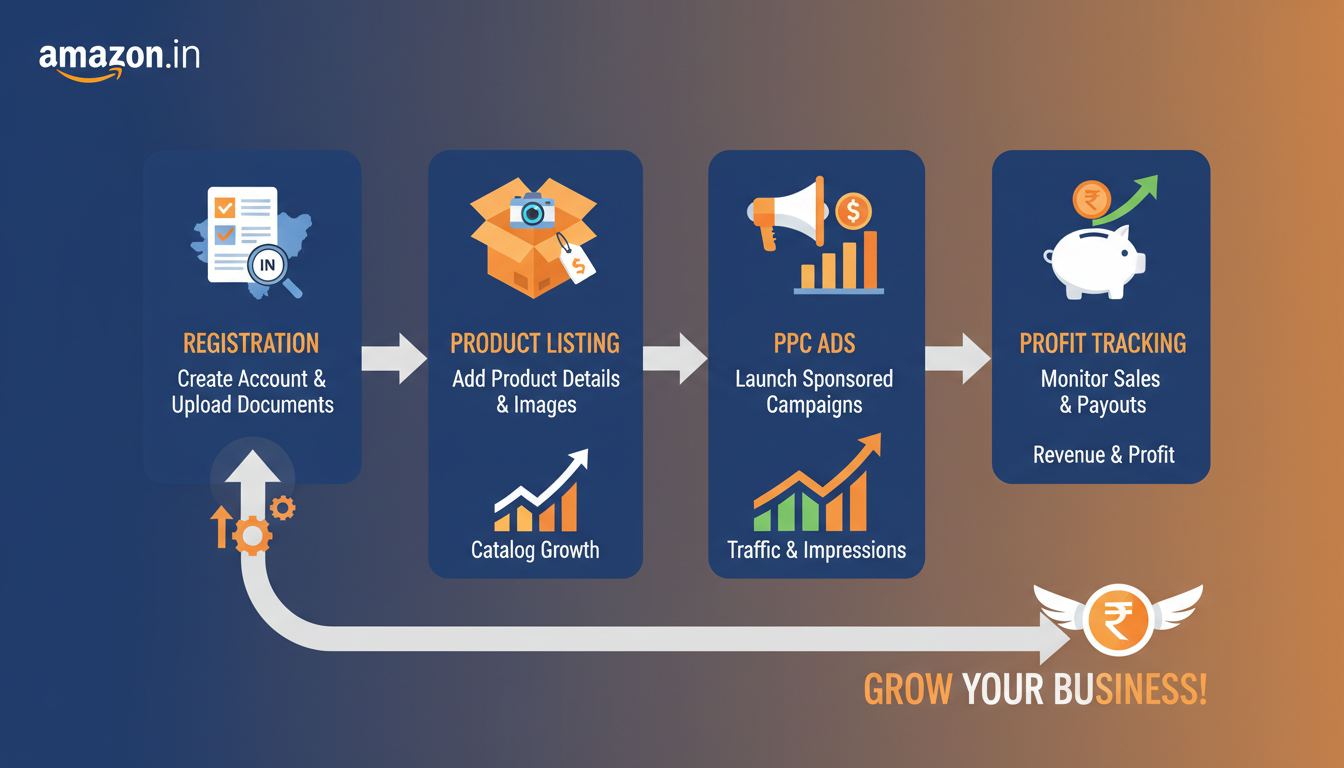
Step 1: Register as an Amazon Seller — The Right Way
Your journey begins at Amazon Seller Central India (sellercentral.amazon.in). The Amazon seller registration process is straightforward but riddled with rookie mistakes that delay approvals and cost you weeks of selling time.
To register as a seller on Amazon India, you'll need: a valid GST number, a PAN card, a bank account with IFSC code, an active mobile number, and a business email. Once verified, you'll receive access to your Amazon Seller Central account — the nerve center for your entire operation.
Individual vs. Professional Selling Plan
Amazon India offers two selling plans. The Individual plan charges ₹0/month with a per-unit fee, while the Professional plan costs ₹999/month and unlocks bulk listings, advanced reports, and eligibility for Amazon advertising. For any brand serious about growth, the Professional plan is a non-negotiable investment.
Once registered, explore the full capabilities of your Amazon brand selling toolkit on AdAstraa — built specifically to help D2C sellers hit the ground running.
Step 2: Create Listings That Actually Convert
Your Amazon product listing is your 24/7 salesperson. A weak listing wastes every rupee you spend on ads. The algorithm rewards relevance and conversion rate — so your listing must do both simultaneously.
Must-Have Listing Elements
- Title: Lead with your primary keyword, include key attributes (size, material, use case), and keep it under 200 characters.
- Bullet Points: Lead each bullet with a benefit, not a feature. Answer the buyer's question: "What's in it for me?"
- Backend Search Terms: Use all 250 bytes. Include regional language variations and synonyms that shoppers in India actually type.
- Images: Minimum 6 images including a lifestyle shot, infographic, and size-chart. High-quality visuals are the #1 driver of click-through rate.
- A+ Content: Brand-registered sellers can add enhanced content that measurably lifts conversion rates by 5–10%.
Listing optimization is an ongoing science, not a one-time task. Use buyer intent data — like what AdAstraa's Shopper OS surfaces — to continuously refine copy around what your ideal buyer is actually searching for right now.
Step 3: Enrol in Amazon Brand Registry — A Game-Changing Move
Amazon Brand Registry is one of the most underutilized, yet game-changing tools available to sellers. With a registered trademark, you gain access to A+ Content, Sponsored Brands ads, the Brand Analytics dashboard, Amazon Vine, and powerful IP protection tools.
In India's hyper-competitive categories — electronics, FMCG, personal care, and fashion — brand registry is often the difference between a winning product page and one that gets buried under competitors and counterfeiters.
For FMCG brands in particular, Brand Registry unlocks the ability to run Sponsored Brand Video ads — the format with the highest engagement rates in Amazon India advertising. This directly feeds into your performance marketing strategy and fuels long-term brand equity.
Step 4: Master Fulfillment by Amazon (FBA) to Scale Effortlessly
Fulfillment by Amazon (FBA) is the essential operating backbone for any serious Amazon India seller. By storing your inventory in Amazon's fulfillment centers, you gain Prime eligibility, Amazon-managed shipping, and customer service — removing three of the biggest operational bottlenecks from your plate.
Understanding Amazon Seller Fees & FBA Calculator
Before enrolling products in FBA, always run them through the Amazon FBA calculator (available inside Seller Central). Key fees to model include: referral fees (typically 5–15% depending on category), FBA fulfillment fees (based on weight & dimensions), and monthly storage fees.
A common mistake sellers make is ignoring the true cost-per-unit after all Amazon seller charges. A product that looks profitable on the shelf can turn margin-negative once referral fees, FBA fees, and PPC spend are stacked. Use a profit calculator for Amazon religiously — and build your pricing strategy around real margins, not hope.
Real-World Example: A D2C home-décor brand selling on Amazon India was generating ₹8L/month in revenue but barely breaking even. After a full fee audit using the Amazon revenue calculator and restructuring their FBA-to-FBM split for bulky SKUs, they unlocked ₹1.2L in monthly margin — without changing their price or ad spend.
Step 5: Launch Your First Amazon PPC Campaign — Without Burning Cash
Amazon PPC advertising is the most direct lever for immediate visibility. But most sellers launch campaigns blindly — choosing broad match keywords and leaving auto campaigns on forever — and wonder why their ACoS balloons past 40%.
A structured campaign launch looks like this: Start with an automatic ad campaign for 2–4 weeks to harvest search term data. Then migrate high-performing exact and phrase keywords into manual campaigns. Ruthlessly add non-converting search terms as negative keywords. This single step alone can cut wasted spend by 20–30%.
The Three Core Amazon Ad Types
- Sponsored Products: The workhorse — drives direct, high-intent clicks to individual ASINs. Essential for any pay-per-click campaign strategy.
- Sponsored Brands: Builds brand awareness at the top of search. Delivers strong branded advertising ROI for registered brands.
- Sponsored Display: Retargets shoppers who viewed your product or competitors' products. Powerful for FMCG repurchase cycles.
Managing these campaigns manually across dozens of ASINs is where sellers lose hours and profits simultaneously. This is precisely where AdAstraa's comprehensive Amazon PPC strategy guide and its Autopilot tool become indispensable — adjusting bids in real time, 24 hours a day, based on live conversion signals.
Step 6: The Proven Formula to Lower ACoS and Boost ROAS
ACoS (Advertising Cost of Sales) and ROAS (Return on Ad Spend) are the two metrics that define whether your Amazon advertising is an investment or a liability. Yet most sellers track them in hindsight, only reacting after the damage is done.
Setting Your Target ACoS
Your target ACoS should be derived from your gross margin — not copied from an industry benchmark. The formula is simple: Target ACoS = Net Margin %. If your gross margin is 45%, you can afford an ACoS up to 45% to break even on advertising — but you should be aiming for 20–30% to drive true profitability.
The most powerful, step-by-step levers for lowering ACoS are: eliminating non-converting search terms, segmenting branded vs. non-branded campaigns, bid scheduling by day-part, and leveraging Amazon DSP for upper-funnel retargeting that warms audiences before Sponsored Products spend is incurred.
Why Manual Bid Management Breaks at Scale
A seller managing 50 ASINs across three ad types has potentially thousands of keyword-bid combinations to monitor daily. Manually doing this is not just inefficient — it's mathematically impossible to do well. AI-powered bid optimization from tools like AdAstraa's AI Advertising platform processes every signal — conversion rate, time-of-day, competitor bids, inventory levels — and adjusts bids in real time, while you sleep.
💡 Stop Losing Money on Non-Converting Keywords
AdAstraa Autopilot eliminates ad waste and reclaims hours of manual management — automatically.
See AdAstraa Autopilot in Action →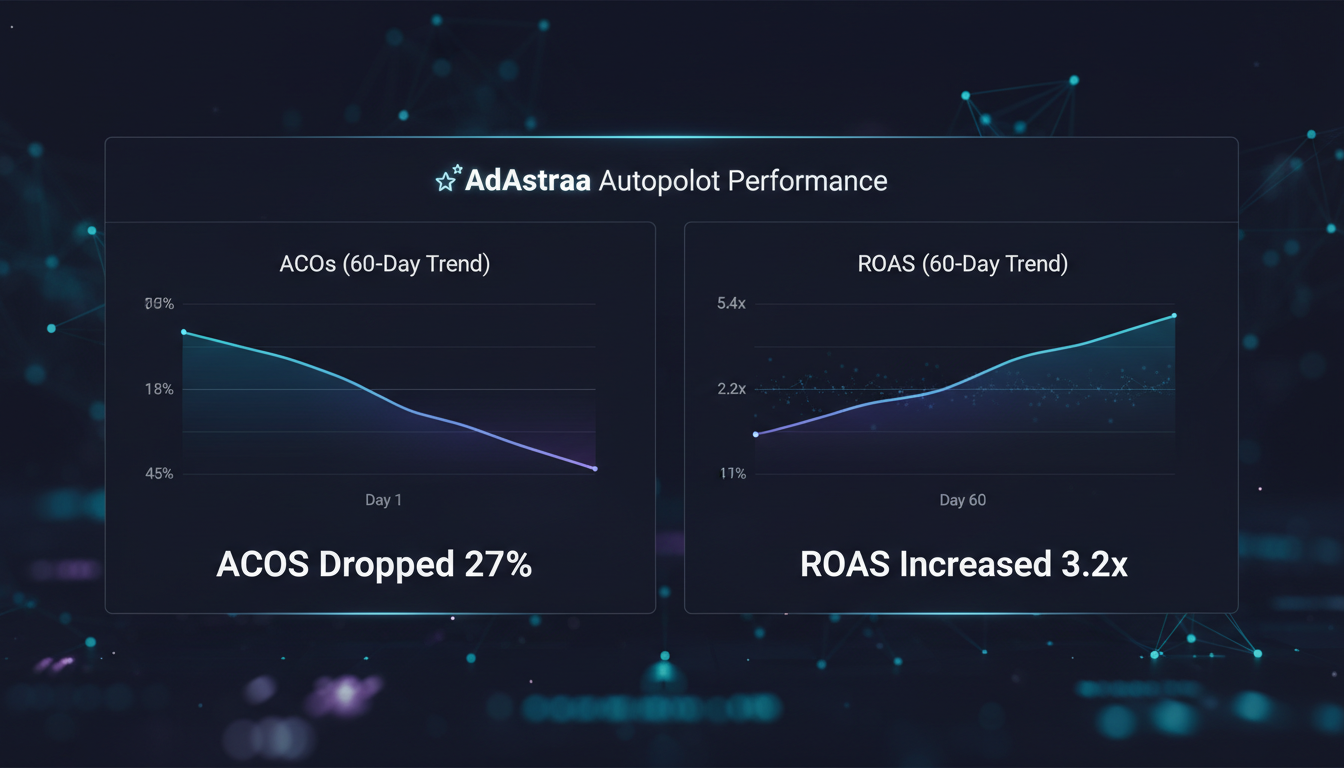
Step 7: Identify the Best-Selling Products on Amazon India with Buyer Intent Data
Knowing which products are selling is table stakes. Knowing why they're selling — the exact intent signals, search behaviors, and conversion triggers behind every purchase — is a genuine breakthrough advantage most sellers never access.
The most selling products on Amazon India in 2024 span categories like consumer electronics, personal care, home essentials, health supplements, kitchen appliances, and apparel. But category popularity alone doesn't predict profitability for your specific product. What matters is the intersection of demand volume, competitive intensity, and your margin after fees.
From Search Data to Sales Strategy
The must-know signal for any serious Amazon seller is purchase intent — not just keyword volume. A keyword with 50,000 monthly searches but 0.8% conversion rate is far less valuable than a long-tail keyword with 3,000 searches and 6.2% conversion.
AdAstraa's Shopper OS decodes buyer intent at the ASIN level — revealing which search terms are driving sales vs. just traffic. This eliminates the guesswork from product expansion decisions and ensures your ad budget flows to keywords that actually close sales.
Step 8: Build a Full-Funnel Performance Marketing Engine on Amazon
Performance marketing on Amazon is no longer just about Sponsored Products. In 2024, the sellers winning the most profitable market share are running integrated, full-funnel strategies that combine on-platform ads with external traffic, brand building, and customer retention.
Amazon DSP and Brand Advertising
Amazon DSP (Demand-Side Platform) allows brands to serve display ad advertising to audiences both on and off Amazon — including OTT video, mobile, and third-party websites. For FMCG and D2C brands focused on brand advertising, DSP is the unlock for repeat purchase rates and lifetime value growth.
Combine DSP retargeting with Sponsored Brands campaigns to create a cohesive branded marketing presence across the entire customer journey — from discovery to decision to repeat purchase.
AI-Generated Ad Creatives That Convert
Creative quality is one of the most underestimated variables in Amazon advertising performance. A compelling ad creative can lift your click-through rate by 40–60% — directly reducing your effective cost per click. AdAstraa's AdCreative+ generates high-converting, brand-consistent ad visuals in minutes, eliminating the design bottleneck that slows most sellers down. Creative ads powered by AI aren't a luxury — they're a competitive necessity in 2024.
| Ad Type | Best For | Funnel Stage | Key Metric |
|---|---|---|---|
| Sponsored Products | High-intent buyers | Bottom | ACoS / ROAS |
| Sponsored Brands | Brand awareness | Mid / Top | NTB (New-to-Brand) % |
| Sponsored Display | Retargeting | Mid | DPV / Repeat purchases |
| Amazon DSP | Audience-first brands | Full funnel | CPM / LTV |
Step 9: Track True Profit Per ASIN — Not Just Revenue
Revenue is vanity. True Profit per ASIN is the only number that tells you whether your Amazon business is actually working. Most sellers run their operations off Seller Central revenue reports — which include zero deduction for ad spend, FBA fees, COGs, return rates, or storage costs. The result? They celebrate growth quarters that are actually operating losses.
A rigorous Amazon profit tracking framework accounts for: gross revenue, minus referral fees, minus FBA fulfillment fees, minus ad spend per ASIN, minus COGS, minus storage fees, minus return-related losses. What remains is your True Profit — the only metric worth optimizing for.
Real-Time Seller Dashboard That Powers Smart Decisions
AdAstraa's Amazon seller dashboard surfaces True Profit per ASIN in real time — so you know exactly which products are your stars, which are your laggards, and which are silently destroying your margins. This eliminates the reactive spreadsheet culture that keeps most sellers from scaling confidently.
Pair profit tracking with advanced AI advertising strategies and you have a complete, self-reinforcing growth system: better data drives smarter bids, smarter bids improve ROAS, improved ROAS funds more efficient ad scaling — all without adding headcount or manual overhead.
Inside a Real Amazon India Success Story
Consider a mid-sized FMCG brand selling personal care products on Amazon India — 40+ SKUs, ₹25L/month ad spend, and an average ACoS stuck at 38%. Their team was spending 25+ hours per week on manual bid adjustments with no systematic negative keyword strategy.
After onboarding onto AdAstraa, three things changed immediately: Autopilot took over 24/7 bid management and eliminated ₹4.2L/month in non-converting keyword spend in the first 30 days. Shopper OS revealed 17 high-intent search terms they had never targeted. AdCreative+ generated new Sponsored Brand ad visuals that lifted CTR by 52%.
The outcome after 60 days: ACoS dropped from 38% to 21%, ROAS climbed from 2.6x to 4.7x, and the team reclaimed 22 hours of weekly management time. This is what guaranteed, breakthrough performance looks like when AI does the heavy lifting.
Additional Resources
Deepen your knowledge with these authoritative sources used to research and validate this guide:
- Amazon Seller Central India — Official Onboarding Hub — The official starting point for Amazon seller registration, fees, and Seller Central access in India.
- India Brand Equity Foundation — E-Commerce Industry Report — Authoritative data on India's e-commerce market growth, D2C trends, and sector projections through 2030.
- Statista — India E-Commerce Market Size 2024–2035 — Statistical analysis and forecast data on India's e-commerce market valuation and annual growth rates.
- Amazon Ads — Official Sponsored Products Guide — Amazon's own documentation for setting up and optimizing Sponsored Products pay-per-click campaigns.
- Jungle Scout — Amazon Seller Statistics 2024 — Comprehensive data on third-party seller trends, category performance, and Amazon marketplace dynamics.
Your Amazon India Growth Starts Now
Selling on Amazon India in 2024 is one of the most powerful business opportunities available to Indian brands and D2C entrepreneurs. The market is growing explosively, buyer intent is high, and the tools to compete intelligently have never been more accessible.
But the sellers who will win the next five years aren't those who work harder — they're those who systematically eliminate waste, let AI do the optimizing, and make every rupee of ad spend accountable to real, measurable profit. The 9 steps in this guide are your essential, proven path from setup to scale.
You now have the framework. The only remaining question is: will you execute it manually and slowly — or leverage AI to compress months of progress into weeks?
🎯 Transform Your Amazon India Business Today
Join hundreds of Amazon-first brands using AdAstraa to lower ACoS, boost ROAS, and reclaim their time — all on autopilot.
Get Started Free on AdAstraa — No Credit Card Needed →