




Here is an uncomfortable truth: the average Amazon seller is wasting between 30–40% of their entire advertising budget on keywords that will never, ever convert. That is not a rounding error — that is profit quietly walking out the door, click by click, every single day.
Amazon's ad revenue surpassed $56.2 billion globally in 2024 — a 20% year-over-year jump — and with CPC costs rising 10–15% annually across most categories, the margin for inefficiency has never been thinner. The brands winning right now are not simply spending more. They are spending smarter, using AI-powered Amazon PPC optimization to eliminate waste, unlock buyer intent signals, and compound their ROAS over time.
If you are still managing bids by hand, mining search term reports on weekends, and guessing which campaigns deserve more budget — this guide is your breakthrough moment. Below, you will find 9 proven, step-by-step Amazon PPC optimization strategies that are working right now for D2C brands, FMCG sellers, and high-volume agencies in 2025.
STOP BURNING AD BUDGET. START WINNING.
Let AdAstraa's AI Autopilot manage your Amazon PPC 24/7 — and watch your ACoS drop within the first 30 days.
Activate Your AI Autopilot — Free Trial →Why Manual Amazon PPC Management Is Silently Killing Your Margins
Manual PPC management made sense when Amazon had a few hundred thousand sellers. Today, with over 9.7 million seller accounts globally, the competitive velocity of the platform has transformed ad management into a near-real-time, data-intensive operation that no spreadsheet can handle at scale.
The core problem is structural. Human managers can review bids and keywords perhaps once or twice a week. The Amazon marketplace shifts hourly — competitor bids fluctuate, shopper intent signals change, and seasonal demand curves spike without warning. Every hour your bids are not optimized, you are either overpaying for clicks or going invisible in search results.
The three most expensive manual management mistakes brands make are:
- Over-bidding on broad-match keywords that generate impressions but zero conversions
- Under-bidding on high-intent exact-match keywords because of conservative default rules
- Ignoring negative keyword hygiene, allowing irrelevant search terms to drain budget daily
AI-powered AI advertising platforms eliminate all three failure modes simultaneously — processing thousands of bid decisions per hour across every ASIN, every keyword, and every match type in your catalog.
Strategy 1: Deploy 24/7 AI Bid Automation to Protect Every Dollar
The single most impactful shift any Amazon advertiser can make is replacing static bid rules with dynamic, AI-driven bid optimization. Static rules are blunt instruments — they cannot differentiate between a Monday morning shopper browsing casually and a Friday-evening buyer with purchase intent and a credit card in hand.
AI bid automation systems — like AdAstraa's Autopilot engine — analyze real-time signals including time-of-day conversion rates, competitor bid pressure, inventory levels, and ASIN-level True Profit margins before making each bid decision. The result is a system that is always bidding the right amount — not the safe amount.
How Autopilot-Style Bid Optimization Works in Practice
During high-conversion windows (often evenings and weekends in most product categories), the AI increases bids aggressively on proven converting keywords. During low-intent windows, it pulls back — protecting your daily budget for when it counts most. This day-parting intelligence alone can reduce wasted spend by 20–35% in the first campaign cycle.
Brands running on AdAstraa's Autopilot have recorded an average +41.8% lift in ROAS across Growth plan accounts — not from increasing ad spend, but from redistributing existing budget with AI precision.
Strategy 2: Build an Aggressive Negative Keyword Architecture
Negative keywords are the most underused, most powerful lever in Amazon PPC optimization. Most sellers treat them as an afterthought — a reactive cleanup task done after damage is already done. The essential shift is treating negative keyword management as a proactive, ongoing architecture built into every campaign from day one.
Every time your ad appears for an irrelevant search query, Amazon charges you for a click that statistically will not convert. Over thousands of impressions per week, these ghost clicks compound into a significant budget drain — and they silently erode your campaign's conversion signal, potentially depressing your organic ranking over time.
Negative Exact vs. Negative Phrase: The Essential Distinction
Negative Exact Match blocks ads only when a shopper types the precise term you specify. Use this for specific irrelevant queries identified in your search term report. Negative Phrase Match is broader — it blocks your ad any time the specified phrase appears within a search query, making it a powerful tool for eliminating entire categories of irrelevant traffic (e.g., adding "free" as a negative phrase removes all searches containing the word "free").
A proven workflow: review your Search Term Report weekly, apply a threshold (e.g., 3+ clicks with zero conversions), and add qualifying terms to your negative keyword list. AI tools automate this process continuously — catching wasteful terms in hours, not weeks.
Strategy 3: Use Buyer Intent Intelligence to Bid on What Converts
Not all keywords are created equal. A keyword with 10,000 monthly searches but low purchase intent is dramatically less valuable than a keyword with 500 searches and a 15% conversion rate. The game-changing insight that separates elite Amazon advertisers from average ones is bidding based on buyer intent, not just search volume.
Buyer intent intelligence tools — like AdAstraa's Shopper OS — analyze behavioral signals behind search queries to classify them by purchase proximity. High-intent signals include specific size/variant queries, comparison-style searches, and brand + product-type combinations. Low-intent signals include generic informational queries, DIY alternatives, and price-sensitivity terms.
Mapping Keywords to Funnel Stage for Maximum ROAS
A proven keyword architecture segments your campaigns into three tiers:
| Funnel Stage | Keyword Type | Bid Strategy | Goal |
|---|---|---|---|
| Bottom of Funnel | Exact-match, high-intent | Aggressive bids | Maximize conversions |
| Mid Funnel | Phrase-match, category | Moderate bids | Build consideration |
| Top of Funnel | Broad-match, auto | Conservative bids | Keyword discovery only |
Strategy 4: Optimize at the ASIN Level — Not the Account Level
One of the most common — and most costly — mistakes in Amazon advertising management is optimizing campaigns at the account or portfolio level rather than at the individual ASIN level. Your catalog contains products with wildly different margin profiles, conversion rates, and competitive contexts. Treating them all with the same bidding logic is a guaranteed path to profit leakage.
True ASIN-level optimization means understanding the True Profit per ASIN — accounting for ad spend, FBA fees, COGS, returns, and promotional discounts — before setting a target ACoS for that specific product. A high-margin ASIN can sustain a 35% ACoS profitably. A low-margin ASIN may need to stay below 12% or be deprioritized for paid traffic entirely.
Platforms that surface real-time True Profit per ASIN data — rather than vanity metrics like total ad revenue — give brand managers the clarity to make genuinely profitable bid decisions. This is the foundation of a robust Amazon advertising strategy built for sustainable growth, not just impressive dashboard numbers.
REAL-TIME PROFIT VISIBILITY PER ASIN
AdAstraa shows you exactly which ASINs are profitable, which are bleeding budget, and where to reallocate — instantly.
See Your True Profit Dashboard →Strategy 5: Generate High-Converting Ad Creatives with AI
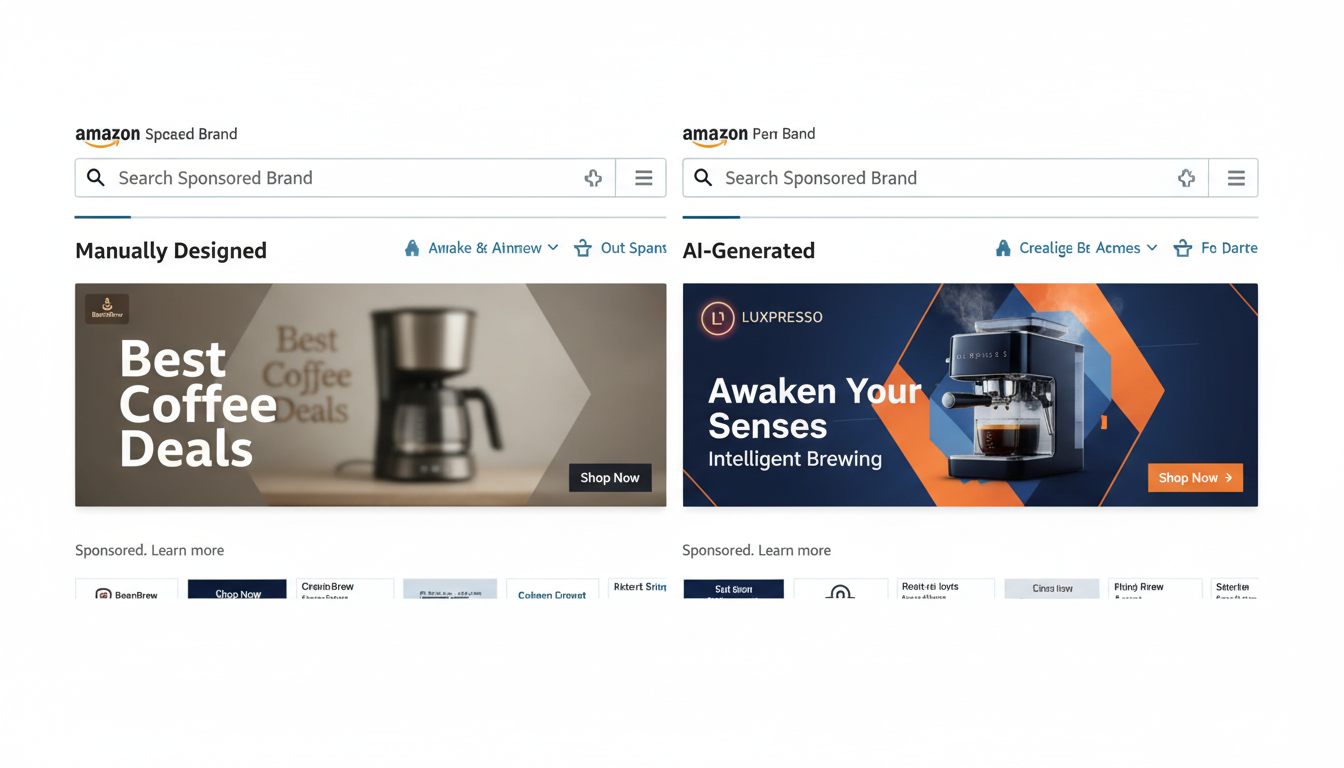
Your bids can be perfectly optimized, and your keywords meticulously curated — but if your ad creative fails to stop the scroll and compel a click, every optimization upstream goes to waste. Ad creative quality is the multiplier that makes or breaks Amazon PPC campaign ROI.
The traditional creative process — briefing a designer, waiting days for revisions, testing one or two variations — is too slow for the pace of modern Amazon advertising. AI creative tools have fundamentally changed this equation. AdAstraa's AdCreative+ generates high-converting, brand-consistent ad creatives automatically — including Sponsored Brand banners, video thumbnails, and lifestyle imagery — in a fraction of the time.
The Power of Continuous Creative Testing at Scale
AI allows you to generate and test 10, 20, or 50 creative variations simultaneously — learning which headlines, imagery styles, and CTAs generate the highest CTR and CVR for each product category. The winning creative is automatically scaled; the losers are retired. This continuous creative evolution is a breakthrough capability that was previously available only to enterprise brands with massive design teams.
Industry benchmarks show the average CTR on Amazon sits at just 0.34%. High-performing AI-optimized creatives consistently achieve 2–4x this benchmark — transforming the top-of-funnel efficiency of your entire PPC ecosystem.
Strategy 6: Build a Campaign Structure That Scales Without Chaos
Messy campaign architecture is one of the most underestimated sources of wasted ad spend on Amazon. When products are bundled into the same campaign with mismatched margin profiles, or when automatic and manual targeting compete against each other without clear budget guardrails, data becomes unactionable and optimization becomes guesswork.
The proven structural framework that scales is the 3-Campaign Model per ASIN:
- Auto Campaign (Discovery): Broad automatic targeting with a conservative daily budget. Purpose: harvest new converting keywords. Never scale this campaign's budget until performance data validates it.
- Manual Broad/Phrase Campaign (Testing): Manually selected keywords on phrase and broad match. Purpose: test keyword performance at controlled scale before committing to exact-match bids.
- Manual Exact Campaign (Performance): Proven, high-converting exact-match keywords only. Purpose: maximum ROAS delivery. This campaign receives the lion's share of budget allocation.
This structure creates a self-reinforcing keyword pipeline: Auto campaigns surface opportunities, Broad/Phrase campaigns validate them, and Exact campaigns monetize them at scale. AI automation tools maintain and optimize all three tiers simultaneously — a task that would require a full-time PPC specialist to manage manually.
Strategy 7: Expand Beyond Sponsored Products with Sponsored Display
The vast majority of Amazon sellers pour 80–90% of their PPC budget exclusively into Sponsored Products, completely ignoring the powerful retargeting and competitor-conquesting capabilities of Sponsored Display advertising. This is a massive missed opportunity in 2025.
Sponsored Display ads allow you to retarget shoppers who viewed your product page but did not purchase — re-engaging them both on and off Amazon with your product. They also allow you to appear on competitor product pages, capturing high-intent shoppers already in the buying mindset for your category.
Three Essential Sponsored Display Use Cases
- Retargeting past product page visitors (within 30-day window) — typically the highest-converting Sponsored Display audience segment
- Competitor ASIN targeting — place your ad on competitor product detail pages to intercept their consideration-stage shoppers
- Category audience targeting — reach shoppers who have browsed similar products in your category over the past 90 days
AI-powered campaign management platforms automatically allocate budget across Sponsored Products and Sponsored Display based on real-time performance signals — ensuring no channel is either starved or over-funded relative to its contribution to overall ROAS.
Strategy 8: Automate Customer Operations to Protect Conversion Rate
Here is an insight most Amazon PPC guides miss entirely: your ad optimization is only as effective as the listing it sends shoppers to. If your product page is converting at 8% when the category benchmark is 14%, you are paying full price for traffic and collecting half the revenue. The gap is almost always a customer experience problem — slow review responses, unanswered Q&A, poor listing optimization.
Automated customer operations tools — like AdAstraa's EcomGPT — handle buyer Q&A responses, review follow-ups, and listing content optimization automatically, maintaining a high-quality product page presence that maximizes the conversion value of every click your PPC campaigns deliver.
Real-World Example: A mid-sized D2C nutrition brand managing 47 ASINs across three categories was spending ₹18L monthly on Sponsored Products with an average ACoS of 38%. After deploying AI bid automation, buyer intent keyword segmentation, and automated listing Q&A management, their blended ACoS dropped to 21% within 90 days — without reducing their ad budget. The same spend was generating 81% more net revenue.
Strategy 9: Replace Vanity Metrics with AI-Powered Marketing Analytics
The most successful Amazon advertising campaigns in 2025 are not managed by the brands obsessing over impressions and click volume — they are managed by brands obsessing over profitability signals. The essential shift is from vanity metrics to value metrics: from ACoS in isolation to True TACoS, from revenue to True Profit per ASIN, from CTR to purchase-velocity per keyword.
AI-powered marketing analytics platforms aggregate these signals across your entire Amazon advertising operation and surface the insights that matter: which campaigns are profitable net of all costs, which ASINs are trending toward stockout (triggering automatic bid reductions to avoid BSR damage), and which keywords are on the cusp of a conversion breakout requiring immediate budget support.
TACoS vs. ACoS: Why the Smarter Metric Changes Everything
ACoS measures ad spend against ad-attributed revenue only. TACoS (Total Advertising Cost of Sales) measures ad spend against total revenue — including organic sales. A rising ACoS alongside a falling TACoS is actually a positive signal: your PPC investment is growing organic rank and sales velocity simultaneously. Brands that optimize purely on ACoS often cut exactly the campaigns that are building their long-term organic moat.
Explore how AI advertising strategies can transform your complete analytics stack — from keyword-level profitability to portfolio-wide budget allocation — with real-time intelligence that no manual process can replicate.
Additional Resources
Deepen your Amazon PPC and AI advertising knowledge with these authoritative external sources:
- Amazon Advertising Official Learning Console — Amazon's official guides for Sponsored Products, Sponsored Brands, and DSP campaign management best practices.
- Forbes: Small Brands Spend Three Times More on Amazon Ads Than Big Brands — Data-driven analysis of the ad spend disparity between 1P and 3P Amazon sellers.
- Triple Whale: Amazon Ads Benchmarks by Industry (2025) — Comprehensive ACoS, ROAS, CVR, and CPC benchmarks across major Amazon product categories.
- Sequence Commerce: Amazon Advertising Statistics 2025 — The Ultimate Guide — Detailed data on Amazon's ad revenue growth, platform benchmarks, and AI advertising adoption rates.
- Karooya: Amazon Ads Match Types Explained — Exact, Phrase, Broad & Auto — A thorough technical reference for mastering all Amazon keyword match types in 2025 campaigns.
The Bottom Line: AI-Powered Optimization Is No Longer Optional
Amazon's advertising ecosystem in 2025 is operating at a speed and complexity that makes manual management structurally uncompetitive. With CPC costs rising 10–15% annually, AI tools optimizing over 61% of all active Amazon campaigns, and third-party sellers spending 123% more on ads than established 1P vendors, the brands that win are those that have deployed intelligent, automated, always-on advertising systems.
The 9 strategies in this guide — from 24/7 AI bid automation and buyer intent keyword segmentation, to ASIN-level True Profit visibility and AI-generated creatives — are not theoretical. They are the operational playbook that performance-driven Amazon brands are running right now to compound their ROAS quarter after quarter.
The question is not whether AI-powered Amazon PPC optimization is worth investing in. The question is how much longer you can afford to compete without it. Explore real brand case studies that prove the impact, and take the first step toward a smarter, more profitable advertising operation today.
YOUR COMPETITION IS ALREADY AUTOMATING
Join 1,500+ Amazon brands running on AdAstraa's Autopilot.
Lower ACoS. Higher ROAS. Zero manual bid management. Starting today.
Start Your Free AdAstraa Trial — No Credit Card Needed →