


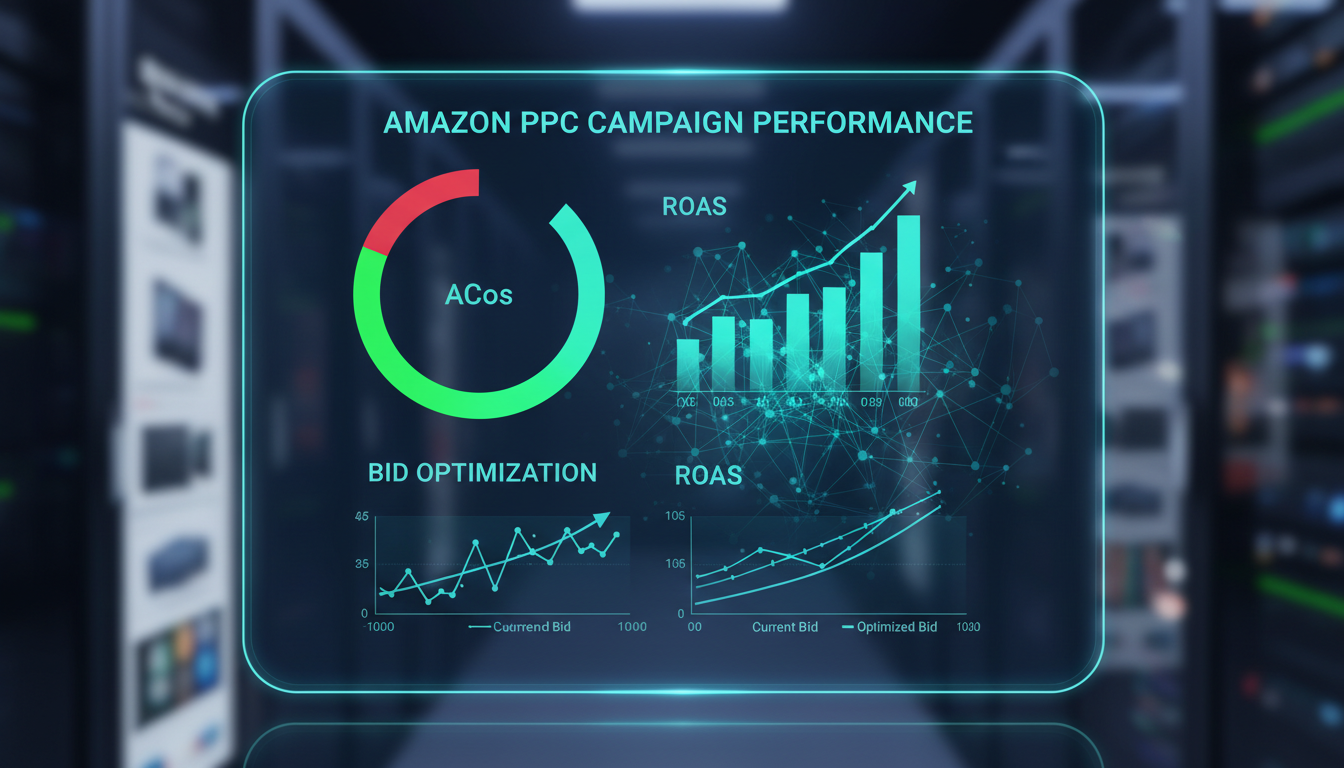
Amazon advertisers collectively waste an estimated 50% of their ad spend on non-converting keywords and poorly timed bids. Is your brand one of them?
The Amazon advertising marketplace has never been more competitive. With average cost-per-click rising 10–15% year-over-year across most categories, and Amazon's advertising revenue surpassing $56.2 billion globally in 2025, the brands winning aren't the ones spending more — they're the ones spending smarter.
That intelligence gap is now being closed by AI-powered Amazon PPC optimization. Whether you're a D2C brand hemorrhaging budget on irrelevant search terms, an FMCG seller struggling to track True Profit per ASIN, or an agency juggling dozens of client accounts, these nine proven strategies will transform how your campaigns perform.
And the best part? Every strategy below can be automated, scaled, and continuously improved — without adding headcount.
Stop guessing. Start optimizing with 24/7 AI bid management that never sleeps.
Launch Your Free AdAstraa Trial →
1. Audit Your Campaign Structure Before Touching a Single Bid
The most essential — and most overlooked — step in any Amazon advertising strategy is understanding what you already have. A bloated, unstructured account is the hidden engine of waste. Before optimizing bids, you must know which campaigns are cannibalizing each other, which match types are bleeding budget, and which ASINs are actually profitable to advertise.
A structured campaign audit should separate your Sponsored Products, Sponsored Brands, and Sponsored Display campaigns by intent tier: discovery (auto/broad), consideration (phrase), and conversion (exact match). Without this architecture in place, no amount of AI will fix the underlying inefficiency.
What to Look for in Your Audit
- Campaigns with zero sales but consistent spend over 30+ days
- Keywords with high impressions but sub-0.2% CTR
- Duplicate keywords across match types competing against each other
- ASINs with an ACoS above break-even running in always-on campaigns
- Ad groups with 50+ keywords — a structural red flag for relevance drift
Tools like AdAstraa's AI advertising platform automatically surface these inefficiencies on day one, giving you a clear picture of campaign health before your first optimization action.
2. Build a Negative Keyword Engine That Runs on Autopilot
Negative keywords are the most powerful yet underutilized lever in Amazon PPC management. Every irrelevant click you pay for is money directly subtracted from your margin. According to industry data, brands that implement systematic negative keyword harvesting reduce wasted ad spend by up to 30% within the first 60 days.
The mistake most sellers make is treating negative keywords as a one-time task. In reality, search behavior evolves constantly. New irrelevant terms surface weekly, and without a continuous harvesting workflow, your ACoS creeps back up.
The Proven Negative Keyword Workflow
- Pull your Search Term Report weekly — filter for terms with 15+ clicks and zero conversions.
- Apply negative exact match at the ad group level for intent mismatches (e.g., "free," "DIY," competitor brand names you don't want to target).
- Apply negative phrase match at the campaign level for broad category irrelevance.
- Cross-negative between match types — add your exact-match keywords as negative exact in your broad and auto campaigns to prevent budget cannibalization.
- Automate the harvest — AI tools trigger negation rules based on ACoS thresholds without requiring manual review.
This workflow, when automated through an intelligent Amazon PPC management system, eliminates the Monday-morning spreadsheet ritual entirely.
3. Replace Static Bids With Dynamic AI Bid Optimization
Setting a keyword bid and walking away is the single biggest contributor to wasted Amazon ad spend. The auction environment on Amazon shifts hourly — competitive pressure, conversion rates, and shopper intent all fluctuate in ways no human analyst can track at scale.
AI-powered bid optimization analyzes hundreds of signals simultaneously: historical conversion rates, time-of-day patterns, device type, competitor activity, inventory levels, and seasonality. It then adjusts bids in real time to ensure you're paying the minimum necessary to win high-converting placements and automatically pulling back on placements where conversion probability is low.
"AI-powered bid management tools can cut campaign management time from 15 hours per week to under 2 hours, while improving ROAS by 25–40%."
— Amazon Ad Tools Industry Analysis, 2025
AdAstraa's Autopilot module operates 24/7, making bid decisions based on your target ACoS or ROAS goal — not a set-and-forget rule that becomes stale by Thursday afternoon.
4. Systematically Harvest Converting Search Terms into Exact Match
Your auto and broad match campaigns are not just spend channels — they're keyword discovery engines. Every week, real shoppers are finding your products through search terms you never explicitly bid on. The breakthrough move is identifying which of those terms convert and promoting them to exact-match campaigns where you own the bid precisely.
This is what separates sophisticated Amazon advertising strategies from amateur ones. The top-performing Amazon brands have a continuous loop: auto campaigns surface new terms → high-converting terms graduate to manual exact → bids are precision-tuned → the original auto campaign gets the non-converter negated. Repeat, weekly, at scale.
Recommended Harvesting Thresholds
- Promote to exact match: ≥ 3 conversions within 30 days at or below your target ACoS
- Flag for review: 10–20 clicks, 1–2 conversions — watch for another week
- Negate immediately: 20+ clicks, 0 conversions
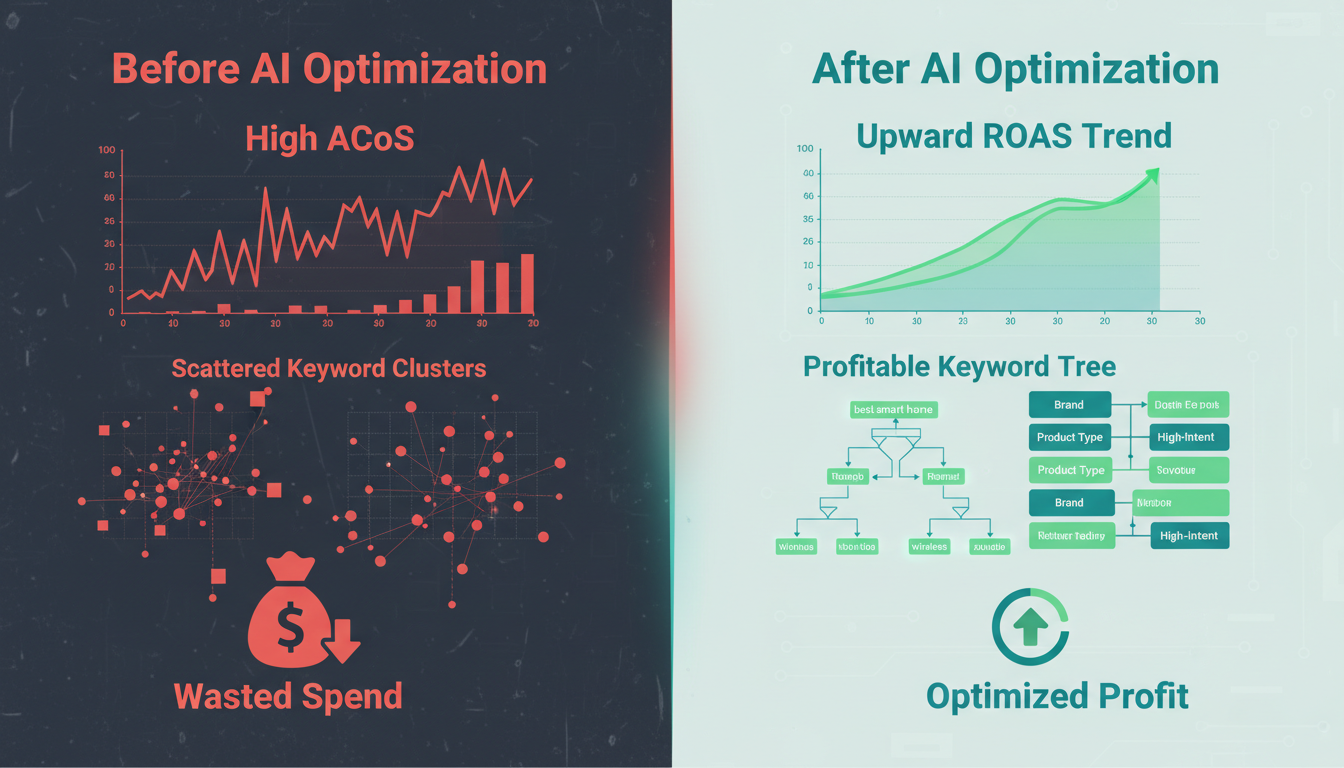
When this workflow runs automatically inside an AI marketing strategies platform, brands consistently report ACoS reductions of 15–30% within the first quarter.
5. Set ASIN-Level ACoS Targets — Not Account-Wide Averages
One of the most game-changing shifts in advanced Amazon PPC management is moving from account-level performance views to ASIN-level profit intelligence. Your account average ACoS is a vanity metric. What matters is the True Profit contribution of each individual product after ad spend, COGS, FBA fees, and returns.
A 35% ACoS on a high-margin supplement might be perfectly profitable. The same 35% ACoS on a low-margin commodity product could mean you're actively losing money on every sale. Without ASIN-level visibility, you're optimizing blind.
The True Profit Framework for Amazon Sellers
| ASIN Type | Typical Gross Margin | Break-Even ACoS | Recommended Target ACoS |
|---|---|---|---|
| Premium / High-Margin | 55–65% | 55–65% | 30–40% |
| Mid-Range / Standard | 35–50% | 35–50% | 20–30% |
| Commodity / Low-Margin | 15–30% | 15–30% | 8–18% |
AdAstraa's Shopper OS provides real-time True Profit per ASIN visibility, so every bid decision is anchored to actual profitability — not a campaign-level illusion.
6. Deploy Dayparting to Match Bids With Buyer Intent Peaks
Not all hours are equal on Amazon. Conversion rates fluctuate significantly by time of day and day of week, yet most brands serve ads — and pay for clicks — at identical bid rates around the clock. This is a silent, effortless source of budget waste that's easy to eliminate with dayparting.
Dayparting (also called ad scheduling) adjusts your bids up during high-conversion windows and pulls them down during low-performing periods. For most Amazon categories, the highest-converting windows cluster around Tuesday–Thursday evenings and Sunday afternoons — though this varies significantly by category and audience.
The critical requirement is having enough conversion data (typically 60–90 days) segmented by hour and day before drawing conclusions. AI platforms like AdAstraa analyze this automatically and apply bid multipliers in real time — no manual schedule-building required. Explore how Shopper OS buyer intent intelligence identifies the exact purchase-timing patterns for your specific audience.
7. Elevate Click-Through Rate With AI-Generated Ad Creatives
Here's a truth most Amazon sellers don't want to hear: even the most perfectly optimized bid strategy will underperform if your ad creative doesn't stop the scroll. Sponsored Brands and Sponsored Display ads live or die by their headline copy and visual execution — and most brands are running generic, untested creatives that quietly drain CTR.
AI-powered creative generation changes this equation completely. Instead of waiting weeks for a designer to produce banner variations, brands can now generate, test, and iterate on ad creatives in minutes — with headlines and visuals informed by actual shopper behavior data.
The Step-by-Step Creative Testing Playbook
- Generate 3–5 headline variants per campaign using AI — test benefit-led, social proof, and urgency-driven angles simultaneously.
- Run A/B tests for a minimum of 14 days with statistically meaningful traffic (≥500 impressions per variant).
- Measure CTR and conversion rate separately — a high-CTR ad that doesn't convert is as damaging as a low-CTR ad.
- Archive losing variants and double down on winners — then iterate again.
- Refresh winning creatives every 60–90 days to counter creative fatigue.
AdAstraa's AdCreative+ module handles the entire lifecycle — from AI generation to performance-based winner selection — slashing the time brands spend on creative iteration from weeks to hours.
Ready to generate high-converting Amazon ad creatives in minutes with AI?
Explore AdCreative+ — Start Free →8. Real-World Example: How One FMCG Brand Cut ACoS by 38% in 90 Days
Consider a mid-sized FMCG brand selling household consumables on Amazon — 47 active ASINs, $85,000/month in ad spend, and an ACoS sitting at a painful 42%. Their team was spending 20+ hours per week on manual bid adjustments, and still couldn't keep pace with auction fluctuations.
After onboarding to an AI-powered Amazon PPC automation platform and implementing the strategies outlined above, here's what their 90-day transformation looked like:
- Week 1–2 (Audit & Structure): Campaign audit revealed 312 keywords with 20+ clicks and zero conversions. All negated. 14 redundant campaigns consolidated.
- Week 3–6 (Automation Activation): AI bid optimization activated across all campaigns. Dayparting rules applied based on 90-day historical conversion data.
- Week 7–10 (Harvest & Promote): 89 high-converting search terms graduated from auto to exact-match campaigns. Creative testing launched on top 10 Sponsored Brands campaigns.
- Week 11–12 (Results): ACoS dropped from 42% to 26%. ROAS improved from 2.38x to 3.84x. Weekly management time fell from 22 hours to under 4 hours.
The compounding effect of these strategies — not any single tactic alone — is what delivered the breakthrough result. And critically, the improvements held and continued to compound into Month 4 and beyond.
9. Unify Your Entire Amazon Advertising Operation on One Intelligent Platform
The most must-know insight from analyzing top-performing Amazon advertisers in 2025 is this: fragmented tooling is killing your performance ceiling. Brands using five different tools — one for keyword research, one for bid management, one for reporting, one for creatives, one for customer operations — create data silos, workflow gaps, and compounding inefficiency.
The ultimate competitive advantage is a single, unified AI operating system that connects every layer of your Amazon advertising strategy. When your bid intelligence talks to your creative performance data, which talks to your ASIN-level profitability, which informs your keyword strategy — the compounding optimization effect is exponentially more powerful than any individual tactic.
This is exactly the architecture behind AdAstraa's platform: Autopilot for 24/7 bid management, Shopper OS for buyer intent intelligence, AdCreative+ for AI-generated creatives, and EcomGPT for automated customer operations — all unified under one roof, all feeding intelligence back into each other.
For brands and agencies ready to make the shift, explore the full AdAstraa platform overview to see how each module connects into your existing workflow.
What to Demand From Any Amazon PPC Automation Platform
- Guaranteed real-time bid adjustments (not hourly or daily batch updates)
- ASIN-level True Profit visibility inclusive of all cost layers
- Automated negative keyword harvesting with configurable thresholds
- AI creative generation with built-in A/B testing infrastructure
- Transparent, interpretable optimization logic — not a black box
- Seamless Amazon Advertising API integration with no manual data exports
The Bottom Line: Optimization Is a System, Not a Tactic
Amazon PPC optimization in 2025 is not about any single secret hack. It's about building a compounding, intelligent system where every component — campaign structure, negative keywords, bid automation, keyword harvesting, ASIN-level profitability, dayparting, creative testing — reinforces every other component.
Brands that treat these nine strategies as an interconnected framework — not a checklist of one-time tasks — consistently achieve ACoS reductions of 25–40%, ROAS improvements above 3.5x, and management time savings of 80% or more. The technology to achieve this at scale exists today. The only variable is whether you deploy it.
AI marketing strategies aren't a future consideration for Amazon-first brands — they're the present-day dividing line between brands that scale profitably and brands that plateau. The time to close that gap is now.
Ready to build your essential Amazon advertising system?
Join hundreds of Amazon-first brands using AdAstraa to lower ACoS, boost ROAS, and reclaim management hours — starting today.
Start Your Free Trial — No Credit Card Required →Additional Resources
Deepen your Amazon PPC and AI advertising knowledge with these authoritative external sources:
- 📘 Amazon Ads: How to Start and Improve Your Keyword Strategy — Official Amazon Advertising guidance on building and refining a keyword strategy for Sponsored Ads campaigns.
- 📊 Amazon Ads Benchmarks by Industry — Triple Whale — Updated industry-level ROAS, CPA, CTR, and CVR benchmarks across Amazon product categories for 2025.
- 🤖 AI Marketing Automation Statistics 2025 — WorldMetrics — Comprehensive verified statistics on AI adoption, ROI gains, and time savings across marketing automation use cases.
- 📈 Amazon Advertising Statistics 2025 — Sequence Commerce — In-depth Amazon advertising data covering revenue growth, CPC trends, performance metrics, and AI's expanding role on the platform.
- 🎯 Amazon Ads Help: Adding Negative Keywords — Amazon Official — Step-by-step official documentation for implementing negative keyword and negative product targeting in Amazon campaign manager.