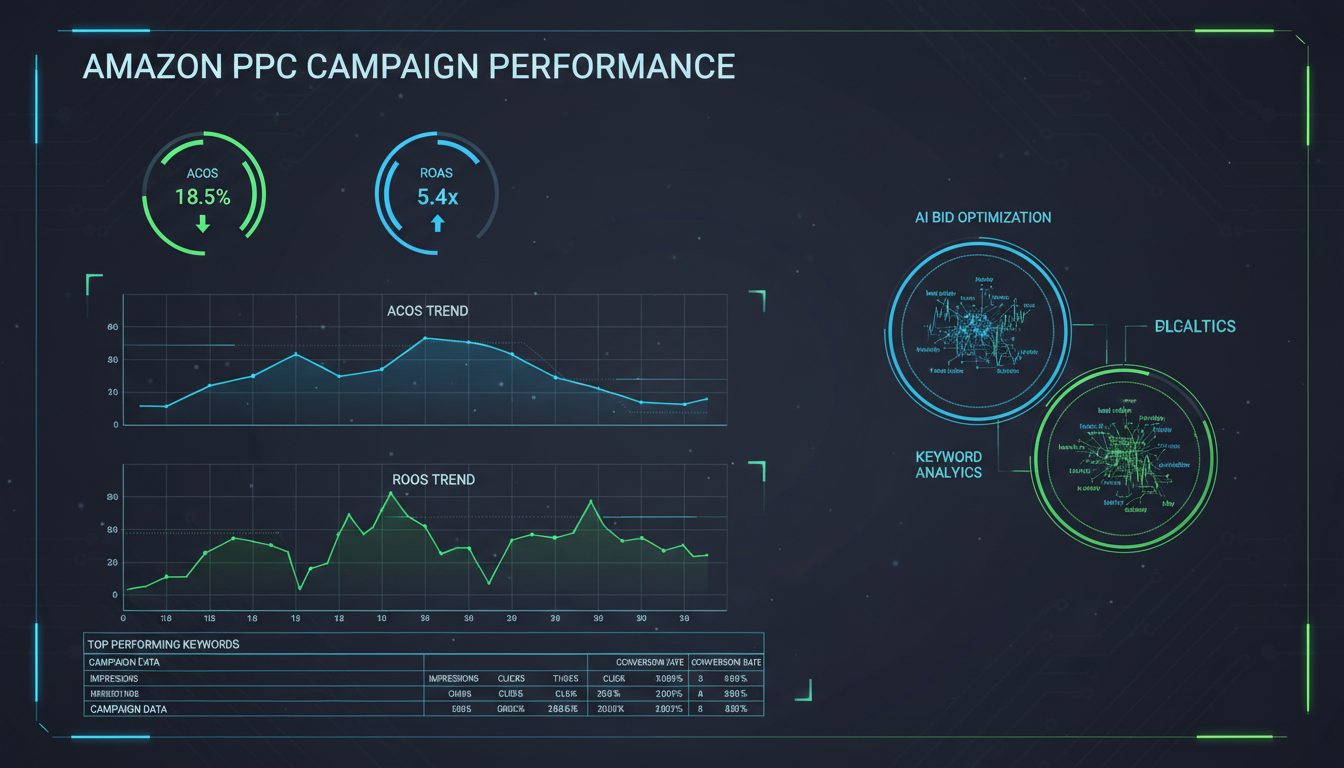
Here's a number that should stop you cold:
The average Amazon brand wastes 30–40% of its entire advertising budget on keywords that will never generate a single conversion. That's not a rounding error — that's a structural bleed that compounds every single day your campaigns run unchecked.
Amazon's advertising platform is generating $47.4 billion in annual revenue — and a significant chunk of that comes straight from brands who haven't optimized their campaigns. CPCs are rising 15% year over year. Competition is intensifying. And yet, most sellers are still making bid decisions based on last week's data.
The good news? The brands winning on Amazon right now aren't smarter — they're faster. They're using AI advertising technology to make thousands of micro-optimizations per day that no human team could replicate manually.
This guide breaks down 9 proven Amazon PPC campaign strategies — combining battle-tested fundamentals with cutting-edge AI-driven approaches — so you can cut wasted spend, lower ACoS, and build a sustainable ROAS engine.
Ready to stop the bleed?
See exactly where your Amazon ad spend is leaking — and fix it automatically.
Start Your Free Optimization Audit →
Why Most Amazon PPC Campaigns Underperform (And How to Fix It)
Before diving into the strategies, it's essential to understand the root cause of underperformance. Most Amazon PPC campaigns fail not because of bad products — but because of structural campaign errors that silently drain budget day after day.
The three most destructive patterns are: overbidding on broad match terms, neglecting negative keywords, and relying on weekly manual reviews when the market is moving hourly. Each of these can individually spike your ACoS by 10–20 percentage points.
The solution isn't just working harder. It's deploying smarter Amazon PPC management frameworks that combine disciplined campaign structure with AI-powered automation — so your ads spend less and convert more, around the clock.
The ACoS–ROAS Reality Check
According to 2025 industry benchmarks, a healthy Amazon ACoS falls in the 20–30% range depending on category, while ROAS benchmarks sit between 2.5x and 5.0x across most verticals. Top-performing brands using AI-driven optimization are regularly hitting 4x+ ROAS — but manual-only accounts frequently stagnate at 1.8–2.2x.
That gap is not a coincidence. It's the compounded result of faster bid adjustments, cleaner keyword targeting, and smarter budget allocation — all things AI ad optimization platforms handle automatically.
Strategy 1: Build a Three-Tier Campaign Architecture
The foundation of every high-performing Amazon advertising campaign is intentional structure. A three-tier architecture — Auto, Broad, and Exact — creates a self-feeding keyword pipeline that continuously discovers and harvests converting terms.
Tier 1: Auto Campaigns for Discovery
Auto campaigns serve as your net. Amazon's algorithm surfaces search terms you may never have thought of. Run these at a conservative bid — treat them as a keyword research investment, not a primary revenue channel. Review search term reports weekly and harvest any term generating 3+ clicks with a conversion.
Tier 2: Broad Match Campaigns for Reach Testing
Broad match campaigns let you test keyword variants at moderate bids. This is where you identify which keyword families drive volume. Critically, add exact-match negatives to prevent your top terms from triggering here instead of your exact-match campaign — a common structural mistake that inflates ACoS silently.
Tier 3: Exact Match Campaigns for Profitability
Your exact-match campaigns are your profit engine. Only graduate a keyword here once it has demonstrated consistent conversion data. Bid aggressively on your best performers. This is where your ACoS is directly controlled — and where AI bid optimization delivers the most dramatic, measurable impact.
Strategy 2: Aggressive Negative Keyword Management Is Non-Negotiable
Negative keywords are the single most underused lever in Amazon PPC. Most sellers add a handful of obvious negatives at setup and never revisit them. That's leaving thousands in wasted spend on the table every month.
A proven rule of thumb: any search term with 15–20 clicks and zero conversions should be immediately negated. This applies across all campaign types. The faster you identify and block non-converting terms, the faster your ACoS drops — often 5–10 percentage points within the first 30 days of disciplined negation.
Segment Your Negatives by Intent Signal
Not all non-converting terms are created equal. Segment them: terms that indicate wrong product intent (e.g., a competitor brand name), terms that indicate a DIY buyer who won't purchase a branded product, and terms with inherently low purchase intent ("free," "how to," "review"). Each segment warrants a different negation strategy — phrase-level versus exact-level.
AI-powered platforms like AdAstraa's Autopilot bid optimization engine continuously scan search term data and flag non-converting terms for automatic negation — eliminating the manual review cycle entirely and acting on bad terms within hours, not weeks.
Strategy 3: Replace Static Bids with Dynamic AI Bid Optimization
Static bids — the "set it and forget it" approach — are quietly destroying campaign performance. Amazon's marketplace is dynamic: competition shifts by the hour, conversion rates fluctuate by day part, and seasonal demand creates dramatic CPC swings. A bid that made sense at 9 AM on Monday may be wildly inefficient by Tuesday afternoon.
The breakthrough solution is AI-powered dynamic bidding. Machine learning algorithms process rolling 7–14 day conversion data for every keyword and recalculate optimal bids continuously — not just daily, but in near-real-time windows. The result: your budget flows toward high-probability-conversion moments and pulls back during low-conversion periods automatically.
Real-World Impact: A D2C Nutrition Brand's Transformation
Consider a mid-sized D2C nutrition brand running ₹42 lakhs in monthly Amazon ad spend. After switching from manual bid reviews to a 24/7 AI optimization framework, their ACoS dropped from 34% to 21% within 6 weeks — without reducing total ad spend. The AI identified 1,200+ underperforming keyword-bid combinations that human reviewers had never flagged. ROAS climbed from 2.9x to 4.7x in the same period.
This is precisely the type of outcome brands are achieving with AI advertising strategies built specifically for Amazon — not generic marketing automation, but purpose-built Amazon PPC intelligence.
Strategy 4: Target Buyers with Real Shopper Intent Intelligence
Most Amazon PPC strategies focus on keywords. The most advanced brands are now focusing on buyer intent signals — a fundamentally different and far more powerful approach.
Buyer intent intelligence goes beyond search terms. It analyzes behavioral patterns: repeat category browsing, cart-addition without purchase, comparison shopping sequences, and time-to-purchase windows. These signals reveal which shoppers are genuinely close to buying — versus those just beginning a research journey.
How Intent Data Transforms Your Targeting Precision
When you know a shopper has viewed products in your category 3+ times in the past 48 hours, the probability of conversion is dramatically higher than a first-touch search. Bidding more aggressively for these high-intent audiences while reducing bids for low-intent impressions is a game-changing shift in how PPC budget is allocated.
AdAstraa's Shopper OS layers this buyer intent intelligence directly into campaign optimization — so every bid adjustment is informed not just by past keyword performance, but by live shopper behavior signals that predict conversion probability in real time.
🔑 Pro Insight: Brands using buyer intent data alongside standard PPC optimization consistently report 25–35% higher CVR on targeted campaigns compared to keyword-only approaches. Intent signals eliminate guesswork from bid multipliers entirely.
Strategy 5: Allocate Budget by True Profit per ASIN — Not Just Revenue
Here is one of the most essential yet overlooked Amazon advertising strategies: your highest-revenue ASIN is not necessarily your most profitable one to advertise. Yet most brands allocate PPC budget proportionally to revenue — a critical mistake that silently erodes overall profitability.
True Profit per ASIN accounts for FBA fees, return rates, COGS, and ad spend — giving you a real net margin figure per unit sold through advertising. When you rank your ASINs by True Profit per advertised sale, the budget allocation picture changes dramatically. Often, a mid-tier revenue product has 3–4x the profit margin of your bestseller.
The True Profit Budget Reallocation Framework
- Calculate Net Margin After Ad Spend (NMAAS) for every actively advertised ASIN
- Rank ASINs from highest to lowest NMAAS
- Increase daily budgets for top 20% NMAAS ASINs by 30–40%
- Reduce or pause budgets on bottom 20% NMAAS ASINs
- Reinvest freed budget into proven NMAAS leaders and new product launches
- Review and rebalance monthly using refreshed fee and return rate data
This framework alone can improve your portfolio-level ROAS by 15–25% without changing a single keyword or bid — simply by redirecting spend toward ASINs where advertising is actually building profitable revenue.
Strategy 6: Use AI-Generated Ad Creatives to Instantly Boost CTR
Amazon is aggressively expanding visual ad inventory — Sponsored Brands, Sponsored Display, and video ads now dominate high-intent search pages. The quality of your creative assets directly determines your click-through rate, and CTR is directly correlated to Quality Score, which influences ad rank and effective CPC.
Yet most brands are running the same static product images across all their ad types — often the same assets that were created at product launch. In a marketplace where video ads generate up to 3x higher CTR than static image ads for certain categories, this is a massive missed opportunity.
Scale Creative Production Without Scaling Your Team
AI-powered creative tools can generate category-specific ad visuals, headline copy variations, and A/B testing assets at a fraction of the time and cost of traditional creative production. This enables effortless continuous creative testing — which is the only way to systematically improve CTR over time.
AdAstraa's AdCreative+ platform generates conversion-optimized ad creatives specifically tuned to Amazon's visual standards — giving you a steady pipeline of fresh creative assets to test without a design team bottleneck.
Unlock your full creative potential
Generate powerful AI ad creatives for your Amazon campaigns — in minutes, not days.
Try AdCreative+ Free Today →Strategy 7: Master Dayparting and Seasonal Bid Modifiers
Purchase intent on Amazon is not uniform across time. Conversion rates peak at specific hours — typically late evenings and weekend afternoons for most consumer categories — and plummet during low-activity windows like early weekday mornings. Paying peak CPCs during low-conversion hours is a guaranteed way to inflate ACoS.
Dayparting — the practice of scheduling bid adjustments based on hour-of-day and day-of-week performance data — is one of the most powerful yet infrequently used tactics in Amazon PPC management. When implemented correctly, dayparting alone can reduce wasted impressions by 20–30% while maintaining or improving total conversions.
Building Your Dayparting Playbook
Start by pulling 90 days of hourly conversion rate data from your advertising reports. Map CVR by hour and day of week. Identify your top-quartile windows (bid +20–30%) and bottom-quartile windows (bid -30–50% or pause entirely). Layer this with seasonal modifiers: Prime Day preparation, Q4 holiday surge, and post-gifting return windows all require distinct bid profiles.
Advanced AI campaign management platforms automate this process entirely — running continuous analysis of time-of-day performance and adjusting bids algorithmically so you're always capturing high-intent moments at efficient CPCs, and protecting budget during low-ROI windows.
"Friday's lowest CPC combined with highest CVR of the event — that's the dayparting opportunity most brands completely miss." — Real data observation from a 659-account Amazon PPC analysis, Prime Day 2025
Strategy 8: Build Full-Funnel Campaigns with Sponsored Brands Video
The most sophisticated Amazon advertising strategies in 2025 operate across the full purchase funnel — not just Sponsored Products campaigns at the bottom. Brands that run coordinated Sponsored Products, Sponsored Brands, and Sponsored Display campaigns together see 35–45% higher new-to-brand customer acquisition rates than those running single-format campaigns.
Sponsored Brands Video is particularly underutilized. Auto-playing within search results, video ads intercept shoppers at the consideration stage — before they've committed to a competitor listing. For categories with visual differentiation (beauty, home goods, food), video ads that demonstrate the product in use consistently outperform static ads on CTR and conversion rate.
Understanding Full-Funnel Attribution for Smarter Budget Decisions
One of the most critical challenges in multi-format advertising is attribution. A shopper may see a Sponsored Brands Video ad, return two days later via organic search, then convert on a Sponsored Products ad. If you're only measuring last-touch attribution, you'll systematically undervalue upper-funnel campaigns and underfund them.
Full-funnel attribution modeling — which credits the assist value to all touchpoints in the conversion path — gives you a dramatically more accurate picture of which campaigns are truly driving growth. This data then flows back into budget allocation decisions, creating a step-by-step optimization loop that compounds in value over time.
Strategy 9: Run an AI Ad Operating System — Not Just Tools
The final and most transformative strategy is the shift from using individual optimization tools to running a unified AI advertising operating system. Most brands cobble together separate tools for bidding, reporting, keyword research, and creative production — creating data silos, conflicting optimization signals, and enormous management overhead.
An AI ad operating system consolidates all of these functions into a single, intelligent platform where every module shares the same performance data. Bid adjustments inform creative testing priorities. Keyword performance data flows into negative keyword automation. Shopper intent signals update audience targeting in real time. The result is a guaranteed performance flywheel — each improvement amplifies the others.
What an AI Ad OS Handles Automatically — 24/7
- 24/7 bid optimization across all campaigns, ad types, and marketplaces
- Automated negative keyword harvesting with configurable ACoS thresholds
- Search term graduation from auto to exact-match based on conversion data
- Budget pacing to prevent under-spend and over-spend against daily caps
- Creative performance scoring to automatically prioritize highest-CTR assets
- True Profit per ASIN tracking with real-time alerts on margin erosion
- Shopper intent signals feeding live bid multiplier adjustments
- Automated customer operations to support post-purchase retention and reviews
This is the operational model that's allowing Amazon-first brands to scale advertising across multiple product lines and international marketplaces without proportionally scaling their ad management teams. Fewer hours spent. More intelligent decisions made. Better outcomes achieved.
📊 By the Numbers: Brands running on AdAstraa's Autopilot framework are reporting an average +41.8% ROAS lift within a single quarter, with 1,523+ brands currently optimizing in real time across 9 Amazon marketplaces. The AI makes bid adjustments every 2.1 seconds on average — a cadence no human team can match.
Putting It All Together: Your Amazon PPC Optimization Roadmap
These 9 strategies are most powerful when implemented as a coordinated system — not piecemeal. Start with campaign architecture and negative keyword hygiene (Strategies 1 and 2) to clean up your existing account structure. Layer in AI bid optimization and dayparting (Strategies 3 and 7) to eliminate moment-to-moment inefficiency. Then build toward intent-based targeting, full-funnel creative, and True Profit allocation (Strategies 4, 5, 6, and 8) for sustainable, scalable growth.
The brands crushing their Amazon PPC performance right now are not running perfect campaigns. They're running continuously improving campaigns — powered by AI that learns, adapts, and optimizes faster than any competitor managing their ads manually.
| Strategy | Primary Benefit | Impact Level |
|---|---|---|
| Three-Tier Architecture | Keyword discovery pipeline | Critical Foundation |
| Aggressive Negatives | -5 to -15% ACoS reduction | Very High |
| AI Bid Optimization | +40%+ ROAS improvement | Transformative |
| Shopper Intent Targeting | +25–35% CVR on campaigns | High |
| True Profit Allocation | +15–25% portfolio ROAS | High |
| AI-Generated Creatives | CTR uplift, reduced CPC | High |
| Dayparting | -20–30% wasted impressions | Medium-High |
| Full-Funnel Campaigns | +35–45% new-to-brand rate | Medium-High |
| AI Ad Operating System | Compound improvement loop | Transformative |
Additional Resources
Deepen your Amazon PPC knowledge with these authoritative external sources:
- Amazon Ads: AI in Marketing — How It Works and Key Applications — Official Amazon Ads guide covering machine learning applications in modern advertising campaigns.
- Triple Whale: Amazon Ads Benchmarks by Industry (Updated Data) — Comprehensive industry-by-industry ACoS, ROAS, and CVR benchmarks to measure your campaign performance accurately.
- Helium 10: How AI Campaign Management Optimizes Amazon Advertising — In-depth look at how machine learning algorithms execute bid and keyword optimization at scale.
- Amazon Advertising Resource Library — Official case studies, strategy guides, and research from Amazon Ads covering full-funnel advertising best practices.
- PPC Ninja: Amazon PPC KPIs Explained — ACoS, ROAS, TACoS & More — The complete breakdown of every Amazon PPC metric that matters, with formulas and breakeven calculation frameworks.
The Bottom Line: Your Amazon PPC Campaign Performance Is a Choice
Every day you manage Amazon PPC with static bids, infrequent negative keyword reviews, and gut-feel budget decisions is a day your competitors are pulling ahead. The strategies in this guide aren't theoretical — they're the exact operational playbook that high-growth Amazon brands are using right now to cut ACoS, build ROAS, and scale profitably.
The difference between a 2.2x ROAS and a 4.7x ROAS isn't budget size. It's the speed and intelligence of optimization. And that's a gap AI closes permanently — not in months, but in weeks.
You now have the roadmap. The only question is how fast you're ready to move.
AdAstraa — AI Ad OS for Amazon Brands
Stop losing money on ads that don't convert.
Join 1,500+ brands already running smarter Amazon campaigns with Autopilot, Shopper OS, AdCreative+, and EcomGPT — the complete AI ad operating system built for Amazon-first growth.
Launch Your AI-Powered Amazon Campaigns →