



The Amazon Advertising Playbook
Here's a number that should stop you cold: 23 to 35 percent of your Amazon ad spend is going to clicks that will never convert. Not because your products aren't good. Because your campaigns aren't set up to stop the bleed.
Advertising on Amazon has become one of the most powerful levers in modern ecommerce — and one of the most mismanaged. With Amazon's advertising segment now accounting for over 8% of the company's $716 billion in annual revenue, the platform is an undeniable engine for discovery and sales. But for sellers logging into their Amazon Seller Central account every morning, that power comes with a cost: complexity, waste, and the relentless grind of manual optimization.
This guide breaks down 8 proven, essential strategies to transform your Amazon ads from a budget drain into a compounding growth machine — whether you're running Sponsored Products, Sponsored Brands, or Sponsored Display campaigns.
🚀 Stop guessing. Start compounding. Let AI find your wasted ad spend instantly.
Find My Wasted Spend for Free →
Why Amazon Advertising Is Now Non-Negotiable for Sellers
The organic reach that sellers enjoyed five years ago is gone. Today, the top four positions on most high-intent Amazon search results are paid ads. If you're not advertising on Amazon, you're invisible to the buyers who are actively ready to purchase.
Amazon ads — formally known as Amazon Advertising — give sellers access to three core ad types through their Amazon Seller Central account: Sponsored Products (the most widely used, appearing directly in search results), Sponsored Brands (banner-style ads that feature your logo and multiple products), and Sponsored Display (retargeting ads that follow shoppers across Amazon and beyond).
Each ad type serves a distinct purpose in the buyer's journey. Running them in isolation — or failing to connect their performance data — is where most brands leak budget without realizing it.
Understanding ACoS and ROAS: The Two Numbers That Define Success
ACoS (Advertising Cost of Sale) is the percentage of ad revenue spent on advertising. Lower is generally better, though an acceptable ACoS varies by margin. ROAS (Return on Ad Spend) is the inverse: how many dollars you earn for every dollar spent. A ROAS of 4× means four dollars in revenue for every one dollar in ads.
Most brands focus on one metric and ignore the other — or worse, optimize for revenue without understanding true profit per ASIN. That's the game-changing insight that separates scaling brands from stuck ones.
"Revenue is vanity. Profit per ASIN is the only number that tells you whether your Amazon ads are actually working." — AdAstraa Platform Intelligence
Strategy 1: Build a Bulletproof Campaign Structure from the Start
A poor campaign structure is the single biggest source of wasted ad spend in Amazon advertising. Most sellers run everything in one or two campaigns, mixing match types, ASINs, and bid strategies — then wonder why their ACoS won't budge.
The proven approach is to separate campaigns by intent tier: one campaign per product category at the broad/auto level for discovery, and separate exact-match campaigns for your highest-converting keywords. This gives you surgical control over where the budget flows.
Auto vs. Manual Targeting: Use Both Strategically
Automatic campaigns are essential for keyword discovery. Amazon's algorithm surfaces search terms you haven't thought of — some of them gold. Run auto campaigns at a conservative bid, harvest converting terms weekly, and promote them to your manual exact-match campaigns.
Manual campaigns give you control over bids and placement. Use broad match for mid-funnel discovery, phrase match for intent signals, and exact match for your proven converters with aggressive bids. Never mix them in the same campaign.
- Broad Match: Casts a wide net — good for new products
- Phrase Match: Captures intent-rich variations of your core keyword
- Exact Match: Maximum control — reserve for proven, high-converting terms
- Negative Match: The most underused tool — blocks irrelevant searches that drain budget
Strategy 2: Aggressively Eliminate Non-Converting Keywords
This is the most instantly impactful change most sellers can make. Negative keywords are your first line of defense against wasted spend — and most Amazon seller accounts have hundreds of them lurking in their search term reports, quietly burning budget every day.
Pull your Search Term Report from Amazon Seller Central at least twice a week. Sort by spend descending, then filter for any term with more than 10 clicks and zero conversions. Add those terms as negative exact or negative phrase matches immediately.
The Step-by-Step Search Term Audit Process
- Download the Search Term Report from your Amazon Seller Central account (Reports → Advertising Reports → Search Term)
- Sort by spend, highest to lowest
- Flag every term with spend but zero orders over 14 days
- Cross-reference with your product — ask: would a buyer of this product use this phrase?
- Add clear mismatch terms as negative exact; add loose mismatch terms as negative phrase
- Repeat weekly, building a master negative keyword library across your account
Brands that run this audit rigorously typically recover 15–25% of their monthly ad spend within 30 days — without touching a single bid.
Strategy 3: Move Beyond Manual Bids with Intelligent Optimization
Manual bid management is a time trap. Amazon's auction system changes thousands of times per day — bids that were optimal at 9 AM may be wildly over-priced by 3 PM. Manually adjusting bids weekly (or even daily) is a guaranteed way to miss peak conversion windows and overspend during low-intent periods.
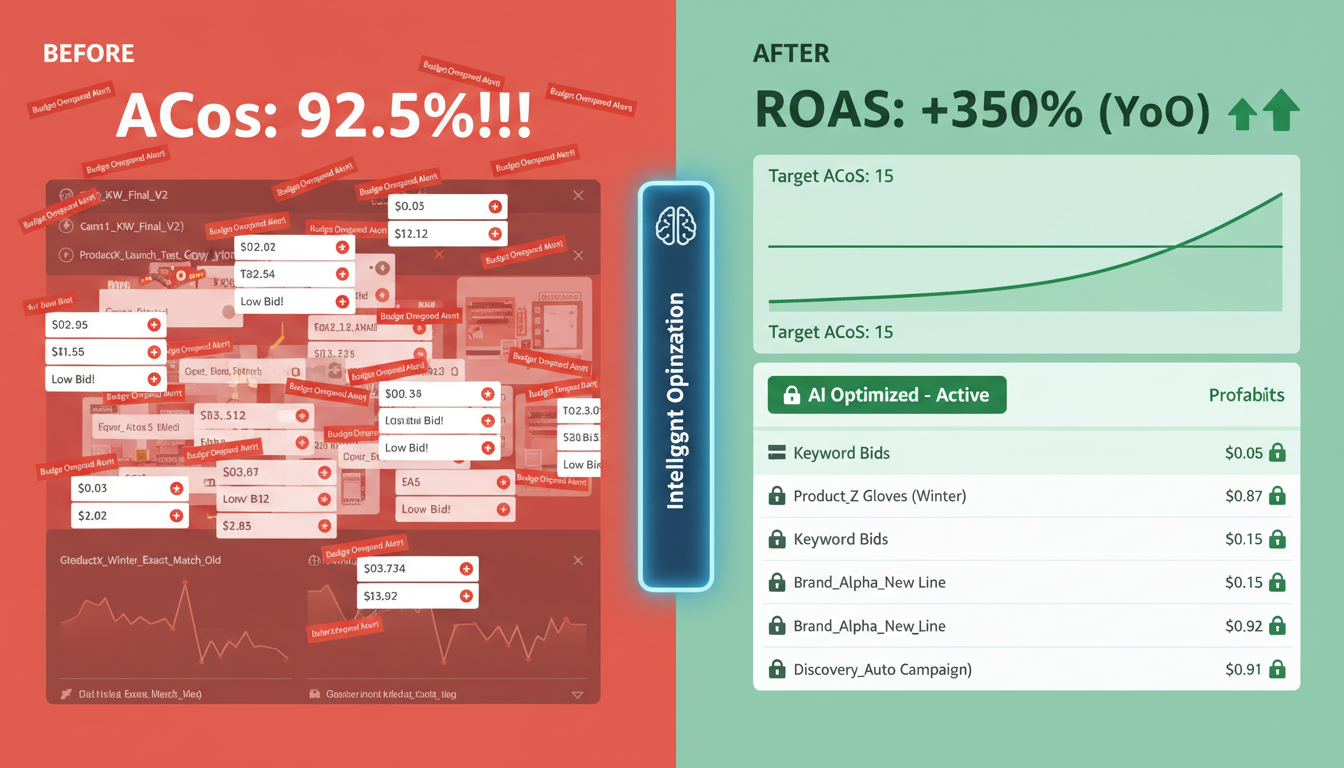
This is where automated bid optimization becomes a genuine breakthrough. Tools like AdAstraa's Autopilot run continuous, 24/7 bid adjustments based on real conversion data, dayparting signals, and your defined ACoS target — eliminating the manual grind entirely.
Amazon's Native Dynamic Bidding vs. AI Optimization
Amazon offers three native bid strategies: Dynamic Bids — Down Only, Dynamic Bids — Up and Down, and Fixed Bids. Each has a role, but they operate on limited data. AI-powered optimization layers on top of these settings, incorporating your full account history, ASIN-level profitability, and real-time auction signals to make micro-adjustments that compound over time.
The result: lower ACoS, higher conversion rate on the same budget, and an average of 11 hours per week reclaimed from manual ad management tasks.
| Bid Method | Speed of Adjustment | Data Used | Best For |
|---|---|---|---|
| Manual | Weekly / Monthly | Human review | Very small accounts |
| Amazon Dynamic | Real-time | Amazon auction data | Baseline control |
| AI Autopilot | 24/7 continuous | Full account + ASIN profit + intent signals | Scaling brands |
Strategy 4: Use Buyer Intent Intelligence to Find High-Value Keywords First
Most brands are reactive with keywords — they discover what's working after they've already spent on it. A powerful, proactive approach is to surface buyer intent signals before you allocate budget, so your campaigns launch already aimed at high-converting searches.
Buyer intent intelligence tools analyze real-time search behavior, competitor keyword gaps, and category-level trend shifts to identify the searches that correlate most strongly with purchase decisions. This is what AdAstraa's Shopper OS is purpose-built to deliver — giving brands a head start on demand before competitors even see it in their reports.
The Must-Know Keyword Tiers for Amazon Ads
- Tier 1 — Core Product Terms: High-volume, high-competition searches. Your brand must appear here, even at elevated ACoS.
- Tier 2 — Category Long-Tail: Lower volume but extraordinary conversion rates. Often 40–60% lower CPCs than core terms.
- Tier 3 — Competitor Brand Terms: Bidding on competitor ASINs and brand names for conquest. High risk, high reward — requires close profit monitoring.
- Tier 4 — Emerging Intent Signals: New searches surging in volume before they become competitive. The biggest ROI opportunity for brands with real-time intelligence.
Strategy 5: Invest in Ad Creatives That Actually Convert
Your bid wins the auction. Your creative wins the click. And your listing wins the sale. All three links in the chain matter, but most brands treat creatives as an afterthought — uploading one image, writing one headline, and letting it run for six months untouched.
The essential approach is continuous creative testing: testing main images, lifestyle shots, A+ content modules, and Sponsored Brands video against each other. Brands running four or more creative variants simultaneously consistently outperform single-creative campaigns — often by 20–30% in CTR alone.
AI-generated creative tools, like AdAstraa's AdCreative+, dramatically accelerate this by generating on-brand variants trained on what converts in your specific category — compressing weeks of A/B testing into a single afternoon.
Sponsored Brands Video: The Underutilized Conversion Weapon
Amazon Sponsored Brands video ads auto-play in search results and have been shown to deliver significantly higher CTR than static ads in competitive categories. Yet fewer than 15% of brand-registered sellers actively run video campaigns.
A 15–30 second product demo video — even a simple one — showing the product in use beats a white-background image in almost every category test. If you're brand-registered and not running video, you're leaving guaranteed performance gains on the table.
Strategy 6: Segment Campaigns by Product Lifecycle Stage
Not all ASINs in your Amazon Seller Central account deserve the same advertising strategy. A new product launch requires aggressive early spend to build rank and reviews. A mature, top-selling ASIN can run at a tighter ACoS. A declining product may not justify ad spend at all.
The game-changing insight is to treat your ad budget as an investment portfolio — allocating capital based on the growth potential and profitability of each ASIN, not distributing it evenly across all campaigns.
- New Launch: Aggressive bids, broad/auto targeting, accept higher ACoS to build organic rank. Target break-even or slight loss for 30–60 days.
- Growth Phase: Shift toward exact match, harvest top keywords, begin tightening ACoS target as organic rank improves.
- Mature/Established: Run lean on proven keywords. Let organic do the heavy lifting. Protect top placements with exact match only.
- Declining/Clearance: Pause most advertising or run only if margin supports it. Redirect budget to growth-phase ASINs.
Strategy 7: Measure True Profit, Not Just Revenue
Here's the brutal truth about Amazon advertising: a campaign can look profitable in Seller Central and be destroying your margins in reality. Amazon's reporting shows ad revenue and ACoS — but it does not show you what you actually made after FBA fees, referral fees, storage charges, returns, and cost of goods.
Sellers who optimize purely on ACoS often scale campaigns that are net-negative on a true-profit basis. This is one of the most common and most expensive mistakes in ecommerce advertising.
The solution is a True Profit dashboard that subtracts every cost — ad spend, fees, COGS, storage, returns — from revenue, at the ASIN level, in real time. This gives you a single, trustworthy number to optimize toward. When a campaign's true profit contribution turns negative, you know immediately — not at month-end when the damage is done.
Using the Amazon Seller Calculator to Set Profitable Ad Targets
Before you set a single bid, calculate your break-even ACoS for each ASIN. The formula is straightforward: Break-Even ACoS = Net Margin Before Ads ÷ Sale Price × 100. Any campaign running at a higher ACoS is losing money on every ad-attributed sale.
Amazon's own Amazon Seller Calculator can help estimate FBA fees and net margins — but for real-time, post-fee profit tracking across your entire catalog, you need a dedicated profit intelligence layer built on top of your Seller Central data.
💡 Real-World Mini Case Study
Northwind Home, an Amazon-first home goods brand, was running campaigns at a reported ACoS of 22% — seemingly healthy. After connecting to AdAstraa's True Profit dashboard, they discovered that two of their top three advertised ASINs were net-negative after returns and storage fees. By reallocating budget to the profitable third ASIN and pausing the others, they cut overall ACoS from 34% to 18% in six weeks while growing total account profit by 41%.
Read More Case Studies →Strategy 8: Connect Amazon Ads to Your Broader Electronic Marketing Ecosystem
Amazon doesn't exist in a marketing vacuum. Electronic marketing — encompassing email, social media, display advertising, and influencer campaigns — feeds the top of your funnel, while Amazon ads capture and convert demand at the bottom. The most effective brands treat these as a single, integrated system.
When you run a social media campaign or a Google Shopping ad that drives branded search volume on Amazon, your Sponsored Brands ads benefit from the increased search frequency. Your organic rank improves. Your ad relevance score climbs. And your cost-per-click decreases because Amazon rewards consistently converting keywords with better placement at lower bids.
The Proven Off-Site to Amazon Conversion Funnel
Build a deliberate attribution loop: use Amazon Attribution links in your off-Amazon marketing campaigns to track which external channels are actually driving Amazon conversions. This data is available directly in your Amazon Seller Central account under Brand Analytics — and most sellers never look at it.
Brands that integrate off-Amazon traffic with Amazon attribution report 15–30% better organic ranking velocity for new products compared to Amazon-only strategies — because the external traffic signals to Amazon's A9 algorithm that your listing is relevant and converting.
Pair this with an AI-powered customer operations platform that handles post-purchase messaging, review requests, and customer inquiries — so every shopper your ads bring in is nurtured into a loyal repeat buyer and a positive review contributor.
How to Apply All 8 Strategies Without Burning Out Your Team
Reading eight strategies is one thing. Executing them simultaneously, while also managing inventory, customer service, product development, and everything else that comes with running an Amazon business, is a different challenge entirely.
The ultimate leverage point is automation. Brands that implement AI-powered ad management tools handle the bid optimization, keyword elimination, profit tracking, and creative testing on autopilot — freeing the human team to focus on strategy, sourcing, and growth decisions that actually require judgment.
A practical implementation sequence:
- Week 1: Audit your current campaigns. Run the search term report. Add 20–50 negative keywords. Restructure campaigns by match type.
- Week 2: Calculate true profit per ASIN. Identify net-negative campaigns and pause or reduce their budgets. Set accurate break-even ACoS targets per ASIN.
- Week 3: Activate automated bid optimization on your top-spending campaigns. Let it shadow-run for 72 hours before going live.
- Week 4: Launch creative testing on your top 3 ASINs. Set up buyer intent monitoring for your core keyword tiers.
- Month 2+: Review True Profit dashboard weekly. Scale budgets on positive-profit ASINs. Continue negative keyword hygiene. Watch ROAS compound.
⚡ Ready to stop the bleed and start compounding?
Connect your Amazon Seller Central account to AdAstraa in under 2 minutes. No credit card. No dev work. See your wasted spend on day one.
Start My Free Account →Additional Resources
Deepen your knowledge of Amazon advertising and ecommerce growth with these authoritative external sources:
- Amazon Ads Official: Sponsored Products Best Practices Guide — Amazon's own documentation on setting up, targeting, and optimizing Sponsored Products campaigns for professional sellers.
- Amazon Seller Central: Advertising Overview — The official entry point for understanding all Amazon Ads tools available to professional sellers and brand-registered accounts.
- The Complete Amazon Advertising Guide 2025 — Sequence Commerce — A comprehensive, practitioner-level overview of Amazon's full advertising ecosystem, ad types, and campaign strategy for scaling brands.
- Jungle Scout: The Ultimate Amazon Advertising Guide for Sellers — A well-researched guide covering PPC ad types, campaign setup, and targeting strategies from one of the leading Amazon research platforms.
- Amazon Advertising Console — Official Platform — The official Amazon Ads console where sellers manage all campaign types, access Brand Analytics, and review performance reporting directly.
The Bottom Line: Advertising on Amazon Rewards Systems, Not Effort
The brands winning on Amazon in 2025 aren't the ones working hardest on their ads. They're the ones who built the most intelligent, disciplined systems — and then let those systems compound.
The 8 strategies in this guide — from campaign structure and negative keyword hygiene to buyer intent intelligence, true profit tracking, and AI bid optimization — form a complete, step-by-step framework for transforming your Amazon Seller Central account into a precision growth engine.
You don't have to implement everything overnight. Start with the single most impactful move: pull your search term report today and add the non-converting terms as negative keywords. That one action alone recovers meaningful budget for most accounts within the first week.
Then, when you're ready to stop managing ads manually and start running them on autopilot — explore the full suite of AI advertising strategies that are helping 1,500+ brands compound their ROAS while reclaiming their time.
AdAstraa — The AI Operating System for Amazon-First Brands
Stop managing ads. Start compounding them.
Connect your Amazon Seller Central account in under 2 minutes. Free to start. No credit card required.
Launch AdAstraa Free →✓ Free account · ✓ No credit card · ✓ Cancel anytime