


Here's a number that should stop you cold:
On average, Amazon sellers waste up to 30% of their ad budget on non-converting keywords every single month. That's not a rounding error — that's profit vanishing in real time while you sleep.
If you've ever stared at a climbing ACoS and wondered where your margin went, you already know the pain. Managing an Amazon advertising campaign manually in 2025 is the equivalent of navigating rush-hour traffic with a paper map — possible, but painfully inefficient.
The brands winning on Amazon today aren't just outspending the competition. They're outsmarting it — using AI advertising platforms, smarter campaign structures, and real-time bid optimization to extract maximum return from every dollar spent. This guide gives you the exact, step-by-step playbook to do the same.
🚀 Stop Guessing. Start Winning.
AdAstraa's AI Autopilot runs 24/7 bid optimization, eliminates wasted spend, and delivers real-time True Profit visibility per ASIN — all without manual intervention.
Activate Your AI Autopilot — Free →
Understanding the Amazon Advertising Ecosystem
Before you optimize, you must understand what you're working with. Amazon's advertising platform offers three core PPC ad formats, each serving a distinct role in your funnel:
Sponsored Products — Your Conversion Engine
Sponsored Products are the workhorses of any Amazon PPC advertising strategy. They appear directly in search results and on product detail pages, targeting shoppers with high purchase intent. For most brands, these campaigns should command the largest share of budget because they drive the most direct, measurable conversions.
According to Amazon Ads, niche brands like Made for Locs have achieved 10x ROAS using strategic Sponsored Products campaigns paired with targeted testing — a result that proves the power of focused, intent-matched advertising.
Sponsored Brands — Your Awareness Multiplier
Sponsored Brands place your logo, a custom headline, and multiple products in a prominent banner at the top of search results. These campaigns are essential for building brand recognition, defending your branded search terms, and driving consideration among new-to-brand shoppers.
Think of Sponsored Brands as the billboard above your storefront — not every viewer buys immediately, but consistent visibility builds the trust that converts later.
Sponsored Display — Your Retargeting Powerhouse
Sponsored Display extends your reach both on and off Amazon, retargeting shoppers who viewed your listing, competitor listings, or similar products. Unlike keyword-driven formats, Sponsored Display uses audience and product targeting — making it an indispensable tool for recapturing lost buyers and defending your product detail pages against competitor conquest.
"Each ad type maps to a stage in the customer journey: Sponsored Products = conversions, Sponsored Brands = awareness, Sponsored Display = re-engagement. Ignoring any one of them leaves money on the table."
Most sellers default to running all three formats in isolation. The essential shift is treating them as a unified, AI-orchestrated system — which is exactly what AdAstraa's AI advertising platform enables at scale.
Step 1 — Build a Campaign Structure That Scales
A chaotic campaign structure is one of the most guaranteed ways to inflate ACoS. The most effective Amazon advertising strategy begins with a clean, logical architecture that gives your AI tools clean data to work with.
The Auto-to-Manual Funnel
Start with automatic targeting campaigns to discover which search terms actually convert. Every week, review your Search Term Report and graduate high-converting terms into manual exact-match campaigns where you have full bid control. This is the foundation of intelligent keyword harvesting — and it's the workflow that AI PPC automation software like AdAstraa's Autopilot handles continuously, without you lifting a finger.
Single-Keyword Ad Groups (SKAGs) for Power Keywords
For your top-performing, high-revenue keywords, isolate them into their own ad groups. This gives you granular bid control, cleaner performance data, and the ability to scale spend on proven winners without contaminating results with low-performers sharing the same budget.
Brands that implement SKAG structures alongside smart PPC management practices consistently see ACoS improvements of 15–25% within the first 60 days.
Step 2 — Deploy a Keyword Strategy That Eliminates Waste
Keywords are the single biggest lever in your Amazon PPC optimization toolkit. The difference between a brand bleeding budget and one scaling profitably often comes down to two lists: the keywords you're targeting and the keywords you're blocking.
The Power of Negative Keywords
Negative keywords are the unsung heroes of profitable Amazon ads campaigns. When a shopper searches for something irrelevant to your product, clicks your ad, and bounces — you pay for that click and earn nothing. Scaled across thousands of impressions, these irrelevant clicks represent a massive drain on your budget.
Every search term with 20+ clicks and zero conversions should be added as a negative exact-match keyword immediately. This alone can recover thousands of dollars in wasted monthly spend. Platforms built with AI-driven advertising strategies automate this negation process in real time — no weekly audits required.
Using Match Types Strategically
Running only broad match keywords is like casting a net with holes — you'll catch traffic, but not necessarily customers. The proven framework is to use:
- Broad match in auto campaigns to discover new converting terms
- Phrase match in manual campaigns for category-level targeting
- Exact match for your proven, highest-ROAS keywords with aggressive bids
This three-tier structure gives you discovery without sacrificing control — and forms the basis of intelligent Amazon PPC campaign management.
Step 3 — Master Bid Optimization with AI
Manual bid management is a full-time job. Amazon's auction prices fluctuate by the hour based on competitor activity, seasonality, day of week, and hundreds of other signals. No human — and no simple rules engine — can process that volume of data fast enough to respond optimally.
This is where AI-powered bid optimization becomes a genuine game-changer. Machine learning algorithms analyze rolling conversion data, impression share, click-through rates, and historical performance to calculate the precise optimal bid for every keyword — not once a week, but continuously, around the clock.
Setting Your Target ACoS the Right Way
Your target ACoS should be derived from your product's profit margin — not guessed. The formula is straightforward:
Break-Even ACoS = (Profit Margin %) × 100
If your margin is 35%, your break-even ACoS is 35%. A profitable target ACoS should sit 5–10 percentage points below that threshold. Running ads above your break-even ACoS is not advertising — it's subsidizing clicks.
AdAstraa's Autopilot ingests your margin data per ASIN and automatically calibrates bids to hit your target ACoS, adjusting in real time as market conditions shift. Explore how Shopper OS buyer intent intelligence further refines bid decisions using real purchase-signal data.
Dayparting: Spend When Buyers Are Ready
Not all hours are created equal. Data consistently shows that conversion rates on Amazon peak during specific windows — typically evenings and weekends for most consumer categories. Dayparting (scheduling higher bids during peak conversion windows and reducing spend during low-conversion hours) can meaningfully improve your effective ROAS without increasing total budget.
Step 4 — Scale Budgets Like a Strategic CFO, Not a Gambler
Budget scaling is where most brands get burned. The instinct — pour more money into ads and watch revenue grow — ignores the non-linear relationship between ad spend and conversion efficiency. Overspending on a campaign before it's fully optimized is the fastest way to balloon your ACoS.
The proven approach: increase campaign budgets by no more than 10–20% per week, and only after confirming that the prior week's performance held its target ACoS. Monitor for at least seven days before the next increase. This measured escalation preserves algorithm learning and prevents the budget-shock that triggers inflated CPCs.
Prioritize Profitable ASINs, Not Just Popular Ones
Not every product deserves equal advertising investment. Use your True Profit per ASIN data — accounting for ad spend, COGS, FBA fees, and returns — to identify which products generate real margin at scale. Pour budget into proven performers; apply conservative budgets to test new ones.
This is precisely the insight AdAstraa's real-time True Profit dashboard delivers, giving brand managers and ad management platform users the financial clarity to make confident scaling decisions instead of gut-feel guesses.
Step 5 — Generate High-Converting Ad Creatives at Scale
A perfectly optimized bid on a weak creative is still money wasted. Your ad's ability to stop a scrolling shopper and compel a click is the first conversion event — and it happens before they even reach your listing.
In 2025, the bar for creative quality has risen dramatically. Amazon has introduced video creative formats for Sponsored Products, and early data shows video ads generate 3–5x higher engagement rates compared to static image ads in competitive categories.
AI-Generated Creatives That Actually Convert
Creating compelling, on-brand ad creatives at scale has historically been a bottleneck — expensive, slow, and dependent on creative teams who may not understand Amazon's specific shopper psychology. AI ad creative generators have fundamentally changed this equation.
AdAstraa's AdCreative+ uses AI to generate high-converting ad visuals, headlines, and copy variations tailored specifically to Amazon's formats and your target audience's purchase signals. Test multiple creative variants simultaneously and let performance data determine the winner — not opinions.
Your Listing Is Your Landing Page
No amount of advertising brilliance can save a weak product listing. Your main image, title, bullet points, and A+ content must convert the traffic your ads send. A listing with a sub-3% conversion rate will always deliver a painful ACoS — regardless of how perfectly optimized your bids are. Treat listing optimization as integral to your Amazon advertising management workflow, not as a separate activity.
Step 6 — Use Marketing Analytics AI for Decisions, Not Just Reports
Most sellers look at their advertising reports and see numbers. The essential skill is seeing decisions. Clicks, impressions, ACoS — these are lagging indicators. The brands pulling ahead are using marketing analytics AI to surface predictive insights: which keywords are trending toward profitability, which campaigns are approaching budget exhaustion, and which ASINs are about to run out of inventory (triggering wasted ad spend on out-of-stock listings).
Move Beyond ACoS: Understand True Profit
ACoS is useful, but it's an incomplete metric. A 15% ACoS on a product with 12% margins is not a win — it's a loss disguised as performance. True Profit per ASIN — which factors in all costs including ad spend, fulfillment, returns, and COGS — is the only metric that tells you whether your advertising is actually building a business or subsidizing a beautiful ACoS number.
Real-time True Profit visibility is baked into AdAstraa's all-in-one advertising platform, giving every team member — from the CMO to the ad manager — a single source of truth for performance decisions. Explore how AdAstraa's full platform overview connects campaign data to bottom-line profitability.
📊 Key Metrics Every Amazon Advertiser Must Track:
| Metric | What It Tells You | Target |
|---|---|---|
| ACoS | Ad cost as % of ad revenue | Below break-even margin |
| ROAS | Revenue per $1 of ad spend | Category dependent (3x–8x) |
| CVR | % of clicks that convert | > 10% (Sponsored Products) |
| TACoS | Ad spend vs. total revenue | < 10% for mature brands |
| True Profit/ASIN | Net margin after all costs | Positive and growing |
Step 7 — Implement Full-Stack PPC Automation (and Reclaim Your Time)
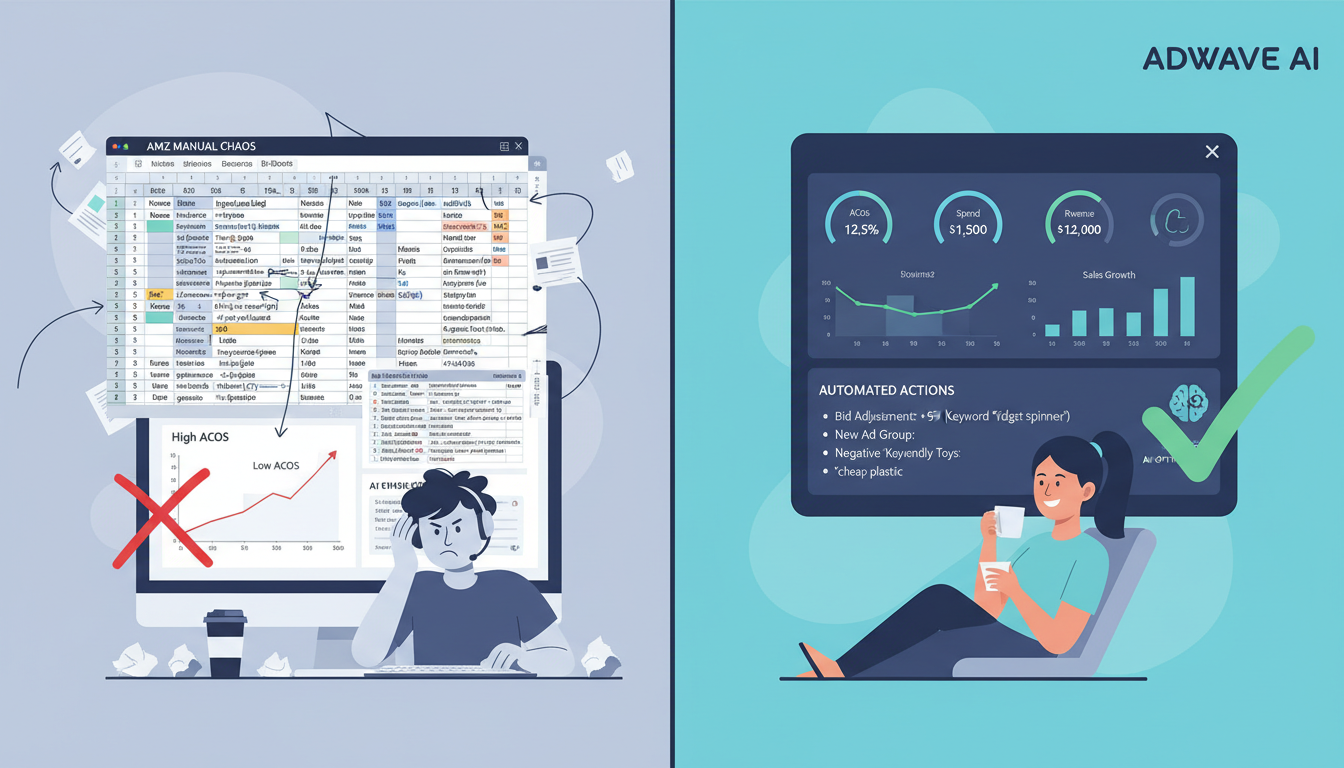
Here's the uncomfortable truth: if you're still manually managing your Amazon PPC campaigns in 2025, you're not just working harder than necessary — you're working at a structural disadvantage. Your competitors using AI PPC management tools are making more optimization decisions per hour than you can make in a week.
A mid-sized fashion eCommerce brand spending $75,000/month on ads plateaued at 1.8x ROAS under manual management. After implementing AI-driven ad optimization, they saw ROAS improve by 280% within months — a result that underscores what automated ad campaign management unlocks at scale.
What to Automate First
Not all automation is created equal. The highest-impact tasks to hand over to an AI advertising platform first are:
- Bid adjustments — hourly recalibration based on rolling conversion data
- Negative keyword harvesting — auto-negation of zero-conversion search terms
- Keyword graduation — moving converting auto terms into exact-match manual campaigns
- Budget pacing — preventing budget exhaustion during peak hours
- Performance alerts — instant notification when any campaign breaches ACoS thresholds
These five workflows, fully automated, eliminate the majority of manual campaign management hours while delivering measurably superior results. AdAstraa's Amazon PPC automation software handles all of them simultaneously across every campaign and every ASIN in your catalog.
⚡ Your Competitors Are Already Automating
AdAstraa's Autopilot runs 24/7 bid optimization across every keyword in your catalog. Shopper OS surfaces real buyer intent signals. AdCreative+ generates high-converting ad visuals on demand. See it live.
Explore the AdAstraa Platform →Step 8 — Leverage Buyer Intent Intelligence for a Breakthrough Edge
The most powerful brands on Amazon don't just react to market data — they anticipate it. Understanding why a shopper is searching, what stage of the buying journey they're in, and which signals indicate genuine purchase intent is what separates a 3x ROAS from an 8x ROAS.
Traditional Amazon PPC tools show you what happened. Buyer intent intelligence platforms show you what's about to happen. This includes tracking rising search volume on adjacent keywords before competitors discover them, identifying seasonal demand shifts weeks in advance, and understanding which audience segments are converting at premium price points.
Shopper OS: Intent at the ASIN Level
AdAstraa's Shopper OS is built specifically to decode this buyer intent layer. It ingests behavioral data across your catalog, identifies high-intent audience clusters, and feeds those signals directly into bid strategy — ensuring your budget flows toward shoppers with the highest probability of converting at your target margin.
This is AI and marketing working as a true operating system, not just a reporting tool. When paired with Autopilot's continuous bid optimization and AdCreative+'s intent-matched visuals, the result is an effortless, self-improving advertising engine.
Real-World Results: From Wasted Spend to Scalable Profit
Consider the journey of a mid-market FMCG brand selling across 40+ ASINs on Amazon. Before adopting an AI-powered campaign management platform, their team was spending 25+ hours per week on manual bid adjustments, keyword analysis, and budget reallocation — with an average ACoS of 38% that was eating deep into already-thin margins.
After implementing a full-stack Amazon PPC automation tool — with 24/7 bid optimization, automated negative keyword harvesting, and AI-driven creative testing — the results within 90 days were striking:
- ACoS dropped from 38% to 22% — a 42% reduction
- ROAS improved by 3.1x on their top 10 SKUs
- Manual management hours reduced by 18 hours per week
- Wasted spend on non-converting terms eliminated by over $12,000 per month
This is not a hypothetical outcome. It's the direct result of replacing reactive, manual management with a step-by-step AI advertising strategy. Explore real results in the AdAstraa case studies library.
Must-Know Mistakes That Are Silently Killing Your Campaigns
Even experienced Amazon advertisers fall into these traps. Recognizing them is the first step to eliminating them:
- Ignoring TACoS (Total ACoS): ACoS measures ad revenue only. TACoS — ad spend divided by total revenue including organic — reveals the true impact of advertising on your entire business. A healthy brand has a TACoS trending downward as organic rank improves.
- Running the same bids for 30 days: Amazon's auction environment changes daily. Static bids from last month are almost certainly wrong today. AI bid optimization exists precisely because humans cannot recalibrate fast enough.
- Advertising out-of-stock ASINs: Spending ad budget on products that can't be purchased is pure waste. Real-time inventory integration with your advertising management platform should pause campaigns automatically when stock drops below a threshold.
- No A/B testing on creatives: Running a single ad creative with no variation removes your ability to improve. Even small changes — a different main image angle, a headline reframe — can shift CTR by 20–40%.
- Conflating high spend with high performance: A campaign spending $10,000/month at 5x ROAS is infinitely more valuable than one spending $50,000 at 1.2x ROAS. Always measure efficiency, not just absolute revenue.
Additional Resources
Deepen your expertise in Amazon advertising and AI-driven marketing with these authoritative external resources:
- Amazon Ads — Sponsored Products Best Practices Guide — Official guidance from Amazon on targeting, bidding, budgeting, and campaign optimization for Sponsored Products.
- Amazon Ads — Understanding ACoS and ROAS — Amazon's official explainer on Advertising Cost of Sales, how it's calculated, and how to optimize for it.
- Helium 10 — How AI Campaign Management Helps Brands Optimize Amazon Advertising — In-depth analysis of how machine learning transforms PPC management for multi-product Amazon sellers.
- Omnisend — AI Marketing Statistics 2025 for Ecommerce — Data-backed benchmark report covering AI adoption, ROI impact, and channel performance across ecommerce marketing.
- RiiThink — Maximizing Amazon PPC for Higher ROI in 2025 — Expert strategic breakdown of the latest Amazon PPC updates and data-driven tactics for long-term profitability.
The Bottom Line: AI-Powered Campaigns Are No Longer Optional
The eight steps laid out in this guide are not theoretical recommendations — they are the proven operational framework of the Amazon brands winning market share right now. Winning on Amazon in 2025 requires a disciplined campaign structure, a keyword strategy that eliminates waste, AI-driven bid optimization that works around the clock, and the analytical clarity to see True Profit, not just vanity metrics.
The question is no longer whether to adopt AI advertising tools for your Amazon campaigns. It's how quickly you can get them deployed before your competitors do.
Every day without intelligent ad automation is a day of wasted spend, missed opportunities, and hours of manual work that compounds against you. The most effortless path from where you are to where you want to be runs directly through a purpose-built AI advertising platform that handles the complexity so you can focus on growing your brand.
Ready to Transform Your Amazon Advertising?
Join thousands of Amazon brands that have reclaimed wasted ad spend, slashed ACoS, and scaled ROAS with AdAstraa's AI-powered operating system. Your first step is one click away.
Start Your Free AdAstraa Trial Today →