
Amazon Advertising
Here's a number that should stop you cold: the average Amazon seller wastes 30–40% of their entire ad budget on keywords that will never convert a single sale. With Amazon's advertising revenue surging past $47.4 billion in 2024 — up 24% year-over-year — competition is fiercer, CPCs are rising 15% annually, and manual campaign management is no longer a viable strategy for brands that want to grow profitably.
The brands breaking through the noise aren't just spending more. They're spending smarter — powered by AI advertising tools that optimize bids around the clock, eliminate non-converting keywords instantly, and surface buyer intent signals no human analyst could catch in time.
This guide breaks down 8 proven, battle-tested AI advertising strategies that Amazon-first brands — from lean D2C startups to large FMCG houses — are using right now to slash ACoS, maximize ROAS, and reclaim dozens of management hours every week. Whether you're running a handful of SKUs or thousands, these strategies will transform the way you think about Amazon PPC.
🚀 Stop burning budget on non-converting keywords.
AdAstraa's Autopilot makes 24/7 AI bid adjustments so you never lose ground — even while you sleep.
Start Your Free Trial Today →
Why AI Advertising Has Become Essential for Amazon Brands
Amazon's ad auction runs millions of micro-decisions per second. Bids shift based on time of day, device type, competitor budgets, seasonal demand, and a hundred other live variables. A human checking campaigns twice a week simply cannot compete with an AI that recalibrates every keyword bid every hour based on rolling conversion data.
According to McKinsey, 53% of companies report measurable revenue increases from AI use in marketing and sales — and the global AI marketing market hit $47.3 billion in 2025, projected to reach $107.5 billion by 2028. The brands still relying on manual bid management or rigid rule-based automation are already being outpaced.
AI advertising platforms like AdAstraa don't just automate the tedious stuff. They learn from every impression, click, and conversion — building predictive models that anticipate demand shifts before they hit. That's the essential edge in a marketplace where a 1% ACoS improvement can mean thousands of dollars recovered per month.
Explore how AI advertising works for Amazon brands and the specific mechanisms that make it so much more powerful than conventional PPC tools.
Strategy 1: Deploy 24/7 Autonomous Bid Optimization
Manual bid management has a fatal flaw: it's reactive. You look at last week's data, make adjustments, and by the time your changes go live, the market has already moved. AI bid optimization flips this dynamic entirely.
AdAstraa's Autopilot engine processes 7-day rolling conversion data, dayparting signals, device-level performance, and competitor bid pressure simultaneously — making granular bid adjustments at the keyword and product level, 24 hours a day, across all your campaigns. The result: your ads appear at the right auction price at the exact moment a high-intent shopper is searching.
How to implement this strategy
- Set a clear target ACoS for each campaign based on your true profit margin (not just revenue)
- Enable automated bid adjustments at the ad group level, not just campaign level, for maximum precision
- Use a 7-day lookback window for conversion data — shorter windows create noise; longer windows miss momentum shifts
- Allow the AI at least 2–3 weeks to accumulate enough signal data before evaluating performance
Brands running on AdAstraa's Autopilot see an average +41.8% ROAS lift across their Growth plan portfolios — not because they're spending more, but because every rupee is placed more intelligently.
Strategy 2: Eliminate Non-Converting Keywords with AI Intelligence
The single fastest way to improve your ACoS is to stop paying for clicks that will never become sales. Yet most sellers either don't review their search term reports regularly enough, or they apply arbitrary rules like "negate after 25 clicks" — which ignores the product-level context entirely.
AI-powered keyword intelligence identifies non-converting keywords by building product-level benchmarks — your specific clicks-to-conversion ratio, your cost-per-acquisition, your margin thresholds. It then negates wasteful terms automatically, before they drain your budget, and harvests converting search terms from auto campaigns to promote them into precise exact-match manual campaigns.
The proven keyword pruning framework
- Mine your Search Term Reports weekly — identify any term with 15+ clicks and zero conversions
- Separate brand vs. non-brand traffic — they have fundamentally different conversion profiles and should never compete in the same ad group
- Apply negative exact match for irrelevant terms; use negative phrase match for broader exclusion patterns
- Graduate top auto-campaign converters to manual exact-match campaigns with controlled, higher bids
AdAstraa's Shopper OS takes this further — surfacing buyer intent signals at the ASIN level so you understand not just which keywords are converting, but why, and which audience segments are driving repeat purchases on your catalog. Learn more about Shopper OS and buyer intent intelligence for Amazon brands.
Strategy 3: Build a True Profit-First Campaign Architecture
Here's a hard truth most sellers don't want to face: ACoS is a misleading metric if you're not accounting for all your costs. You can have a 20% ACoS and still be losing money on every sale once FBA fees, Amazon commissions, cost of goods, and return rates are factored in.
The breakthrough strategy top brands now use is True Profit-First campaign architecture — designing your entire PPC structure around your actual profit margin per ASIN, not your revenue targets. This requires calculating your breakeven ACoS (your profit margin before advertising) for each product and setting your campaign targets accordingly.
Step-by-step profit-first campaign setup
- Calculate your Breakeven ACoS = (Selling Price − Total Costs) ÷ Selling Price × 100
- Set your Target ACoS 5–8 percentage points below your breakeven to preserve a profit buffer
- Segment campaigns by margin tier — high-margin products can tolerate higher ACoS during launch or ranking phases
- Use TACoS (Total Advertising Cost of Sale) as your north-star metric — it reveals the true advertising drag on your total revenue, not just ad-attributed sales
AdAstraa's True Profit dashboard gives you real-time visibility into profit per ASIN after every fee, commission, and ad spend deduction — the game-changing intelligence that lets you make confident bidding decisions instead of guessing. Dive deeper into how AdAstraa's platform calculates True Profit for your catalog.
Strategy 4: Leverage AI-Generated Ad Creatives That Actually Convert
In 2025, Amazon's ad formats have expanded dramatically — Sponsored Brands video, lifestyle imagery, custom storefronts, and interactive creatives all compete for shopper attention. Yet most brands are still using generic product shots and boilerplate headlines that blend into the background.
AI ad creative generation is the must-know breakthrough that lets brands produce dozens of high-converting ad variants in hours rather than weeks. By analyzing top-performing creatives in your category, AI tools identify the visual patterns, color palettes, headline structures, and call-to-action phrases that drive the highest click-through rates for your specific audience.
AI creative strategy best practices
- A/B test at least 3 creative variants per ad format — headline, lifestyle image, and benefit-focused copy each perform differently by category
- Use AI to auto-generate seasonal creative variants (festivals, sale events, new launches) without briefing a designer each time
- Align your Sponsored Brands creative with your Sponsored Products messaging for a cohesive shopper journey from first impression to product page
- Prioritize mobile-first designs — over 70% of Amazon searches happen on mobile devices
AdAstraa's AdCreative+ module generates on-brand, conversion-optimized creatives powered by AI — helping D2C brands ship campaign-ready assets in a fraction of the time, without sacrificing quality or brand consistency.
Strategy 5: Use Shopper Intent Data to Target High-Value Audiences
Most Amazon sellers target keywords. The most sophisticated brands target intentions. There's a profound difference. A keyword like "protein powder" attracts millions of searchers at every stage of the buying funnel — from casual browsers to shoppers who know exactly which product they want. Bidding the same on all of them is an effortless way to bleed budget.
Buyer intent intelligence maps the behavioral signals — search query patterns, repeat purchase behavior, market basket co-purchases, time-to-conversion — that indicate which shoppers are most likely to buy your product, today. Armed with this data, your AI advertising platform can prioritize spend toward high-probability converters and pull back from low-intent traffic.
Actionable intent-based targeting tactics
- Analyze repeat purchase patterns to identify your highest-loyalty customer segments and bid aggressively on keywords that attract them
- Use market basket data to find products frequently bought together with yours — then target those ASINs with Sponsored Display campaigns
- Segment by purchase stage: use broad match for top-of-funnel discovery, exact match for high-intent bottom-funnel capture
- Build custom audience retargeting campaigns for shoppers who viewed your product detail page but didn't convert
“Understanding why a shopper converts is more valuable than knowing that they converted. Intent data answers the 'why' — and it's the foundation of every truly profitable Amazon advertising strategy.”
Strategy 6: Automate Campaign Management Across Your Full Catalog
Managing Amazon PPC for 5 products is challenging. Managing it for 50, 200, or 1,000 SKUs is practically impossible without automation. Each product requires individual bid optimization, negative keyword refinement, budget allocation decisions, and performance review — on an ongoing basis.
Full-catalog AI campaign management solves this scalability problem by applying intelligent automation at every layer of your account. The AI manages individual keyword bids, pauses underperforming ad groups, redistributes budget toward top-performing campaigns, and even triggers new campaign creation when it identifies an untapped keyword opportunity — all without requiring manual intervention.
Essential catalog-scale automation setup
- Group ASINs into performance tiers — star products, growing products, and declining products each need different automated strategies
- Set portfolio-level budget caps to prevent runaway spend on auto campaigns discovering new territories
- Create standardized campaign templates for new product launches so automation is ready the moment a new ASIN goes live
- Use automated alerts for ACoS spikes, CTR drops, or campaign budget exhaustion — so you know when human review is genuinely needed
With ₹218Cr in ad spend optimized last quarter alone, AdAstraa's campaign management tools are built for catalog-scale brands that need the power of a full PPC team without the headcount. See proven AI advertising strategies used by top Amazon brands managing hundreds of SKUs.
Strategy 7: Implement AI-Driven Seasonal and Daypart Bidding
Every product category has conversion rhythms — peak hours, peak days, peak seasons. A kitchen appliance brand sees conversion rates spike on Sunday mornings. A fitness supplement brand converts best in January and post-summer. A festive gifting brand has a guaranteed window around Diwali, Christmas, or Valentine's Day.
Predictive seasonal and daypart bidding uses historical performance data combined with machine learning to forecast these windows — and automatically amplify bids during high-conversion periods while pulling back during low-intent hours. This is one of the most powerful yet most underutilized strategies in Amazon PPC management.
Step-by-step seasonal bidding implementation
- Pull 12 months of historical campaign data and identify your top conversion hours and days by category
- Set bid multipliers (+20% to +50%) for peak hours and key shopping events (Prime Day, festive season, etc.)
- Create dedicated event-specific campaigns with separate budgets — don't let event traffic cannibalize your evergreen campaigns
- Pre-load creatives and keyword lists for major shopping events at least 3–4 weeks in advance — early launch gives the AI time to optimize before peak traffic hits
- After each major event, run a post-event performance review and feed learnings back into your AI model
📊 Real-World Example
A mid-size D2C personal care brand running 85 ASINs used daypart bidding to identify that 73% of their conversions happened between 8PM–11PM. By concentrating 60% of their daily budget in this window via AI automation, they dropped ACoS from 38% to 22% within six weeks — without changing a single product listing.
Strategy 8: Close the Loop with AI-Powered Customer Operations
Most brands treat advertising and customer operations as separate domains. This is a costly strategic mistake. Your post-purchase experience — reviews, Q&A responses, return handling, re-engagement — directly impacts your organic ranking, conversion rate, and ultimately the efficiency of every ad dollar you spend.
A product with hundreds of recent positive reviews converts at significantly higher rates, meaning your cost-per-click yields a higher return. Conversely, an unaddressed negative review or an unanswered customer question can silently drain your ad efficiency for months. AI-powered customer operations close this loop — handling post-purchase communications, review follow-ups, and customer queries at scale, at 2.1-second response times, 24/7.
How to integrate AI customer ops with your advertising strategy
- Automate post-purchase email sequences to drive authentic review velocity on your highest-advertised ASINs
- Monitor Q&A sections on advertised products and respond within 24 hours — unanswered questions kill conversion rates silently
- Analyze negative reviews for product insight — recurring complaints about a feature or packaging are keyword intelligence for your negative keyword lists
- Use AI to identify high-repeat-purchase customers and create lookalike audience targeting for your DSP campaigns
AdAstraa's EcomGPT platform delivers fully automated, brand-voice-consistent customer operations across all channels — so your advertising efficiency compounds through stronger reviews, higher conversion rates, and better organic visibility over time.
Mid-Article CTA
Ready to put all 8 strategies to work — effortlessly?
AdAstraa combines Autopilot, Shopper OS, EcomGPT, and AdCreative+ into one intelligent operating system for Amazon-first brands.
Explore the AdAstraa Platform →AI Advertising vs. Manual PPC: The Definitive Comparison
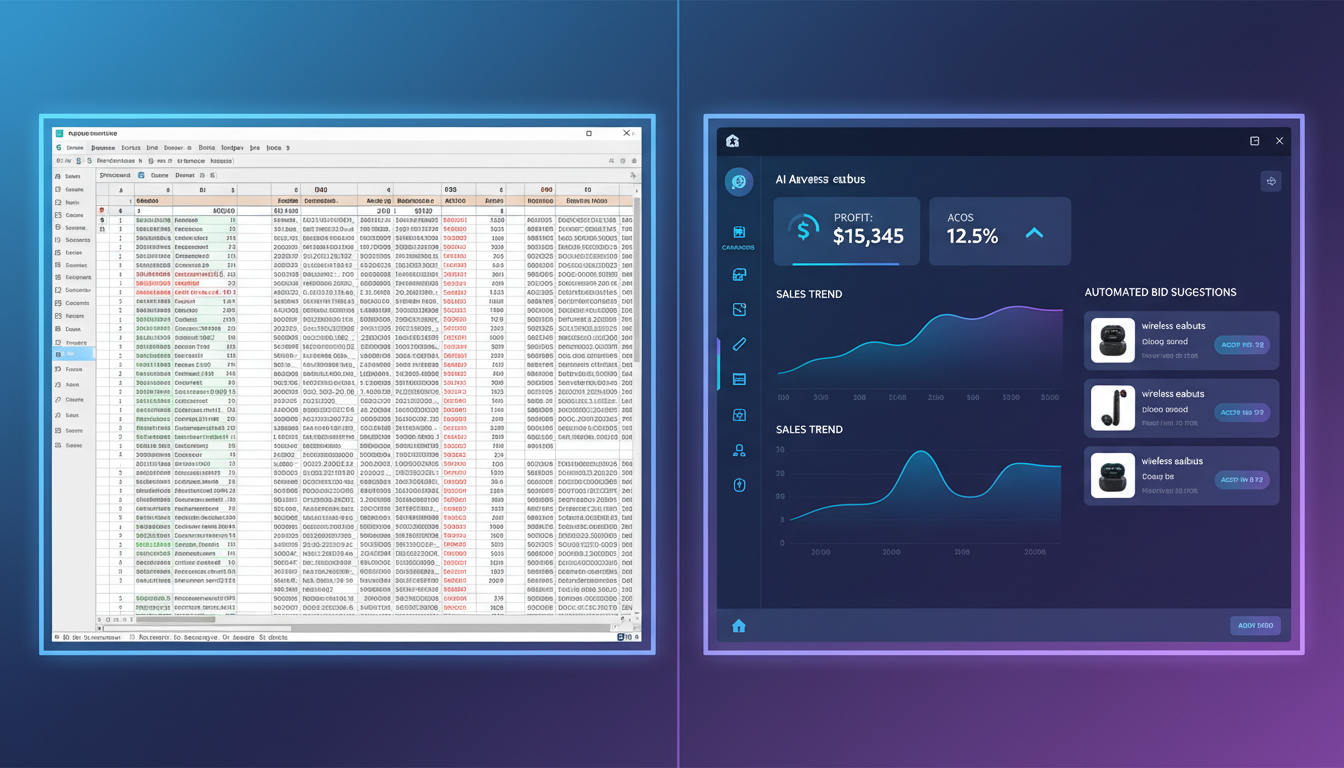
Still on the fence about making the switch? Here's the step-by-step breakdown of how AI advertising stacks up against traditional manual campaign management across every key dimension that matters for Amazon brands.
| Dimension | Manual PPC Management | AI Advertising (AdAstraa) |
|---|---|---|
| Bid Adjustments | 1–2x per week, human-reviewed | Continuous — every hour, every keyword |
| Keyword Discovery | Monthly search term review | Automated daily harvesting & negation |
| Scalability | Breaks down above ~50 SKUs | Handles thousands of SKUs seamlessly |
| Seasonal Adaptation | Reactive — spotted after the fact | Predictive — proactive bid uplift |
| Profit Visibility | ACoS/ROAS only (incomplete) | True Profit per ASIN in real time |
| Creative Production | Manual briefing, weeks of lead time | AI-generated, campaign-ready in hours |
| Management Time | 15–30+ hours/week per account | 2–4 hours/week strategic oversight |
Additional Resources
Deepen your understanding of AI advertising, Amazon PPC optimization, and marketing automation with these authoritative external sources:
- Amazon Advertising Resource Hub — Official guides, playbooks, and best practices from Amazon's advertising team, covering Sponsored Products, Sponsored Brands, and DSP strategy.
- McKinsey: AI in Marketing & Sales — Research-backed insights on how AI adoption drives revenue growth across marketing and sales functions, including measurable ROI benchmarks.
- Search Engine Land: Reduce Amazon Ads Wasted Spend — Tactical deep-dive on audience targeting, keyword strategy, and campaign segmentation to maximize Amazon ad ROI.
- Triple Whale: Amazon Ads Benchmarks by Industry — Updated data on Amazon ROAS, CPA, CVR, and CPM benchmarks segmented by product category — essential for setting realistic campaign targets.
- Amazon Seller Central: Advertising Policies & Guidelines — Official Amazon documentation on sponsored ads eligibility, creative guidelines, and compliance requirements for all ad formats.
The Bottom Line: AI Advertising Is No Longer Optional
The 8 strategies outlined in this guide — from autonomous bid optimization and intelligent keyword pruning to True Profit-First architecture, AI-generated creatives, and closed-loop customer operations — represent the new standard for competitive Amazon advertising in 2025 and beyond.
The brands winning on Amazon today aren't necessarily the ones with the biggest budgets. They're the ones with the smartest systems. They've replaced hours of manual campaign management with AI that never sleeps, never misses a conversion signal, and compounds performance improvements week after week.
You don't need to implement all 8 strategies overnight. Start with the highest-leverage move for your catalog right now — whether that's deploying Autopilot bid optimization, running a deep negative keyword audit, or calculating your True Profit per ASIN. Each step makes the next one more powerful.
The guaranteed outcome of continuing with manual management is falling further behind competitors who've already made the switch. The step-by-step path to sustainable, profitable Amazon growth starts with one decision: choosing the right AI advertising platform to power it.
Take Action Now
1,523+ brands are already running on AdAstraa Autopilot.
Your ACoS transformation starts today.
Join them — and stop leaving profit on the table with every campaign you run manually.
Start Your Free AdAstraa Trial →