


Over 30% of Amazon ad spend goes to search terms that never generate a single sale.
Read that again. Nearly a third of your advertising budget — gone. Not diverted. Not underperforming. Completely wasted on irrelevant clicks that never convert into revenue. If you are managing Amazon PPC campaigns manually in 2025, this number likely describes you right now.
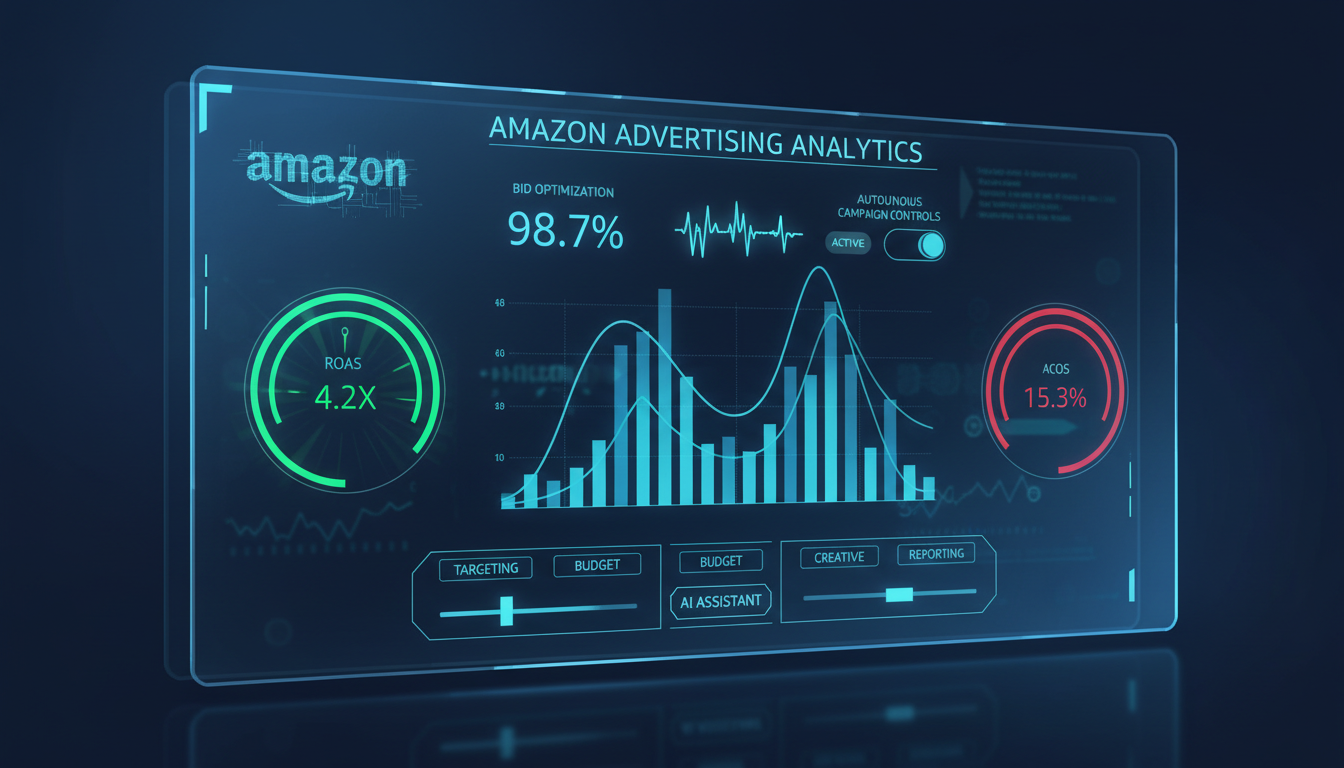
The good news? This is entirely preventable. The brands that have made the leap to AI advertising are not just saving money — they are pulling ahead of competitors who are still adjusting bids in spreadsheets. Brands leveraging AI-powered Amazon PPC management are reporting ACoS reductions of 20–35% and ROAS improvements of up to 41.8% within a single quarter.
This article breaks down 8 game-changing AI advertising strategies that Amazon-first brands are using right now to eliminate waste, dominate search results, and scale profitably — without drowning in manual campaign management.
🚀 Stop guessing. Start winning on Amazon with 24/7 AI-powered bid optimization.
Launch Your AI Advertising Engine → Free TrialWhy AI Advertising Is No Longer Optional for Amazon Brands
Amazon's advertising ecosystem has exploded in complexity. In 2025, sellers contend with Sponsored Products, Sponsored Brands, Sponsored Display, and DSP — each with its own bidding logic, targeting layers, and optimization levers. The average mid-size brand manages hundreds of campaigns, thousands of keywords, and millions of data points every single week.
No human team can process this at scale without making costly errors. Bids go stale overnight. Budgets burn through on low-intent keywords. High-converting search terms get overlooked. The result is a bloated ACoS and a frustrated marketing team.
AI advertising platforms solve this at the root level. They ingest real-time performance data, identify patterns invisible to the human eye, and make micro-adjustments around the clock — all without you lifting a finger. This is not theoretical; it is the operational reality for thousands of Amazon brands using AI-powered ad management tools today.
Manual PPC vs. AI-Powered Advertising: The Essential Difference
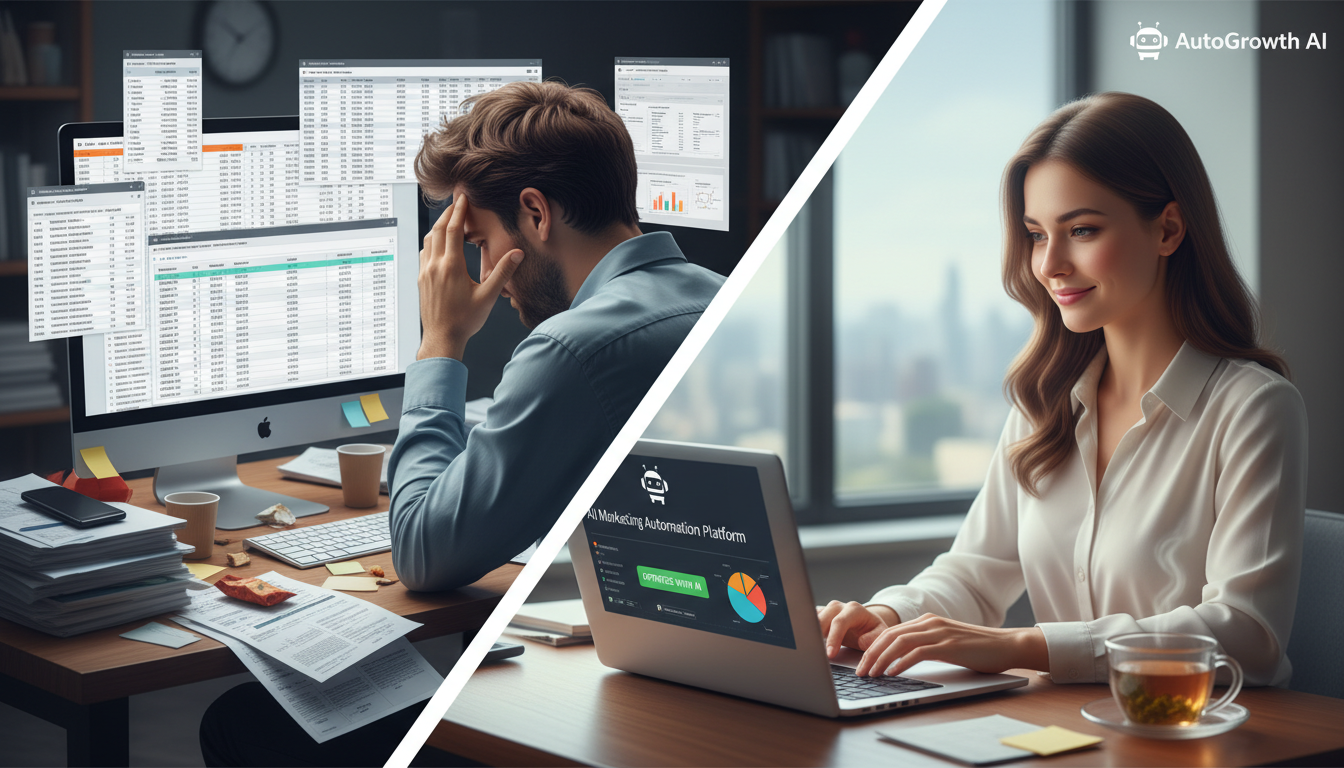
Manual management means you are always reacting to yesterday's data. By the time you pull a search term report, analyze it, and make bid adjustments, the market has already moved. Competitors have shifted budgets, conversion rates have changed, and your ad dollars have been spent on the wrong clicks.
AI advertising operates in the present tense. It monitors every impression, click, and conversion in real time, adjusting bids and budgets based on live signals — not last week's report. The outcome is not just efficiency; it is a fundamentally more profitable advertising operation.
| Factor | Manual Management | AI Advertising Platform |
|---|---|---|
| Bid adjustment frequency | Weekly / bi-weekly | 24/7, real-time |
| Negative keyword discovery | Manual audits | Automated, continuous |
| Campaign management time | 10–20 hours per week | Under 2 hours per week |
| Average ACoS impact | High and volatile | Reduced by 20–35% |
| Scale potential | Limited by headcount | Unlimited |
Strategy 1: Deploy Autopilot Bid Optimization for Round-the-Clock Performance
The most powerful shift any Amazon brand can make is moving from scheduled bid reviews to continuous, AI-driven bid optimization. Traditional PPC software offers rule-based automation — if ACoS exceeds X%, reduce bid by Y%. It is rigid, backward-looking, and only as smart as the rules you write.
True AI bid optimization, like the kind delivered by AdAstraa's Autopilot engine, uses machine learning to predict the optimal bid for every keyword at every moment — factoring in time of day, day of week, competitor activity, conversion probability, and inventory levels simultaneously.
What Autopilot Delivers in Practice
Consider a home goods brand managing 47 active campaigns across Sponsored Products and Sponsored Brands. Before AI automation, their team spent 15 hours per week on bid management and still carried a 38% ACoS. After deploying AI-powered bid automation, their management time dropped below 3 hours weekly and ACoS fell to 23% within six weeks — without reducing ad spend.
The key is granularity at scale. An AI system can simultaneously optimize 50,000 keyword bids with a precision that no human team can match. Every bid adjustment is informed by your specific ROAS targets, profit margins, and campaign goals — not a generic algorithm.
"Brands running on AI-powered PPC automation see an average 41.8% ROAS lift — not because they spent more, but because every dollar finally went to the right keyword at the right time."
Strategy 2: Use Buyer Intent Intelligence to Target High-Converting Shoppers
Not all clicks are equal. A shopper searching "protein powder" is browsing. A shopper searching "vanilla whey protein powder 5lb unflavored" is ready to buy. The breakthrough that separates elite Amazon advertisers from the rest is their ability to prioritize high-intent, purchase-ready shoppers over generic browsers.
AI-driven buyer intent tools analyze search patterns, purchase history signals, and behavioral data to distinguish between discovery-phase shoppers and conversion-ready buyers. This intelligence powers your targeting decisions, ensuring your highest bids are reserved for keywords and audiences most likely to convert.
Applying Shopper Intelligence to Campaign Architecture
AdAstraa's Shopper OS maps buyer intent signals across your entire product catalogue. It identifies which ASINs attract window shoppers versus serious buyers, then recommends campaign structures that allocate budget where conversion probability is highest.
In practice, this means dramatically increasing bids on proven, high-intent exact-match keywords while pulling spend from broad-match terms that generate impressions but not revenue. The result is a leaner, more profitable campaign structure that converts a higher percentage of every ad dollar spent.
Strategy 3: Automate Negative Keyword Harvesting to Instantly Eliminate Waste
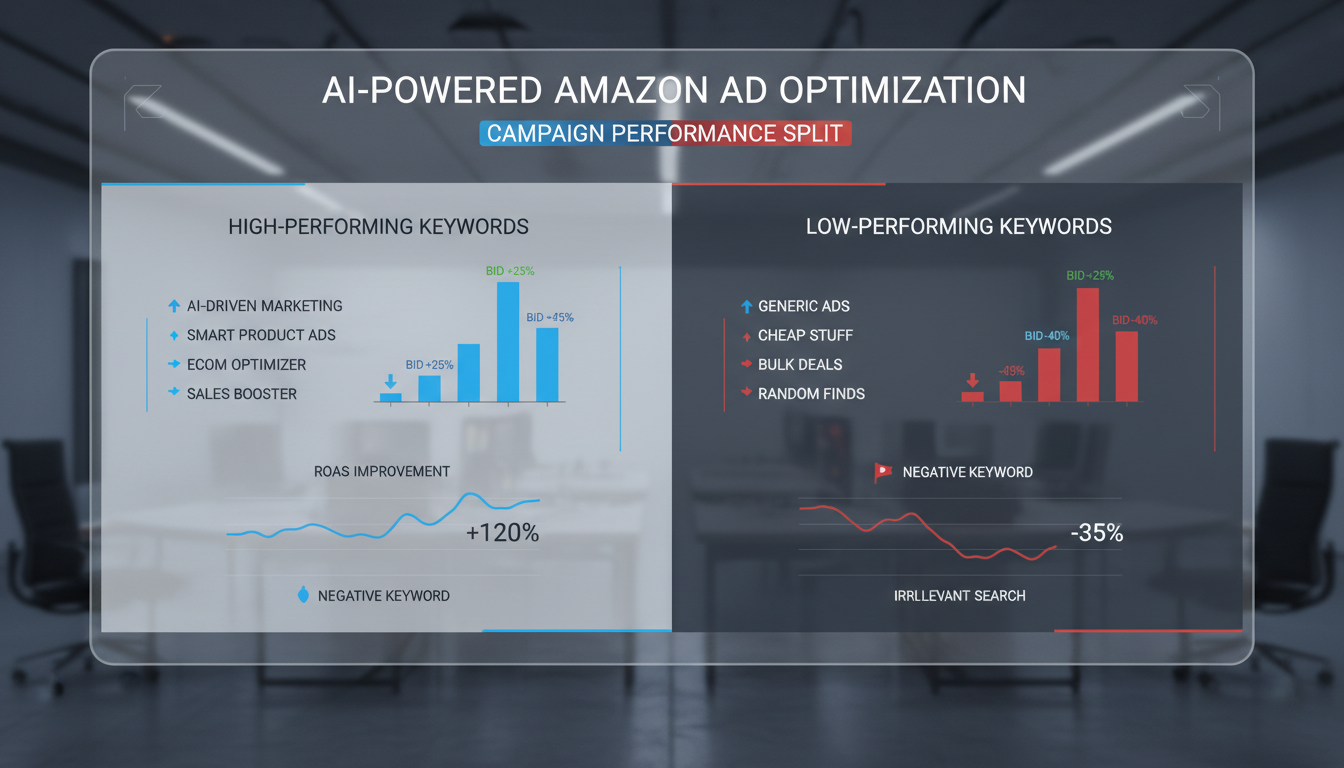
If there is one must-know tactic in Amazon PPC management, it is aggressive negative keyword strategy. Campaign audits consistently reveal that 30–40% of total ad spend goes to search terms that have never generated a single sale. This is not a marginal inefficiency — it is a structural problem that compounds daily.
Manual negative keyword management requires pulling search term reports, sorting by spend with zero conversions, and manually adding negatives across every campaign and ad group. For a brand running 50+ campaigns, this is a multi-hour task that most teams perform monthly at best — meaning weeks of wasted spend between reviews.
How AI Transforms Negative Keyword Management
AI advertising platforms automate this entire process in real time. They continuously scan every search term triggering your ads, identify patterns of spend without return, and automatically add negative keywords — often within 24 to 48 hours of a problematic term appearing.
The standard benchmark for AI-powered negative keyword automation is that any search term reaching 20 clicks with zero conversions gets automatically negated. This single step alone typically recovers 15–25% of wasted ad spend within the first 30 days of implementation.
- Exact-match negatives — block specific irrelevant terms with surgical precision
- Phrase-match negatives — eliminate entire categories of off-target searches
- Campaign-level vs. ad group-level — AI assigns negatives at the right structural level
- Continuous monitoring — new wasteful terms are caught within days, not months
Strategy 4: Generate High-Performance Ad Creatives with AI-Powered Tools
Creative quality is one of the most underrated performance levers in Amazon advertising. Brands that invest in compelling ad creatives see dramatically higher click-through rates, better Quality Scores, and ultimately lower cost-per-click. Yet most brands treat creative as an afterthought, running the same banner for months without testing alternatives.
AI ad generators change this dynamic entirely. According to Forrester research, 63% of enterprise brands using AI-generated creatives reported ROAS improvements between 45% and 58%. AI-generated ads have also demonstrated a consistent 12% higher CTR compared to standard human-produced alternatives across large-scale dataset analyses.
Scaling Creative Testing Without Scaling Your Team
AdAstraa's AdCreative+ uses AI to generate multiple high-converting creative variants from a single product image and brief. Instead of briefing a designer and waiting a week for three variations, you can produce 20 tested variants in minutes — each optimized for a specific audience segment or placement type.
The most proven approach is to run these AI-generated variants against each other in structured A/B tests, then automatically allocate more budget toward the winning creative. This creates a continuous creative optimization loop that most brands previously could only dream of at their budget level.
💡 Pro Tip: The Creative-Keyword Connection
Align your AI-generated ad creative messaging directly with your highest-converting exact-match keywords. When the ad copy mirrors the shopper's search intent, conversion rates increase substantially — and Amazon's relevancy algorithm rewards you with lower CPCs over time.
Strategy 5: Build an AI-Optimized Campaign Architecture That Scales Effortlessly
The structural foundation of your campaigns determines how effectively any AI optimization layer can perform. A poorly architected account — campaigns with mixed match types, ad groups stuffed with unrelated ASINs, or no separation between auto and manual campaigns — will produce inconsistent results even with the best AI tools applied on top.
An essential starting point is the auto-to-manual pipeline. Run auto campaigns to discover converting search terms, then graduate those terms into tightly controlled manual exact-match campaigns where you can bid with precision. AI advertising platforms automate this graduation process, continuously mining your auto campaigns for new winners and moving them to manual campaigns without requiring manual intervention.
The Three-Layer Campaign Framework
- Discovery Layer (Auto Campaigns): Low bids, broad targeting — designed to find new converting search terms. AI monitors performance and flags winners automatically.
- Scale Layer (Phrase & Broad Manual): Mid-range bids on category and product-type terms. AI balances volume against efficiency, adjusting bids based on conversion data.
- Profit Layer (Exact Match Manual): Highest bids reserved for your proven, high-intent exact-match keywords. AI maximizes impression share on these terms while protecting your target ACoS.
This step-by-step architecture, managed by an intelligent platform, ensures every campaign level serves a distinct purpose and feeds data into the next. Learn how to implement this through AdAstraa's AI advertising strategies framework.
Strategy 6: Unlock True Profit Visibility Per ASIN with AI Analytics
Most Amazon sellers make advertising decisions based on ACoS alone — a metric that measures advertising cost relative to ad revenue. But ACoS ignores return rates, fulfillment costs, Amazon fees, and contribution margin. Optimizing purely for ACoS can actually destroy profitability if your best-selling ASIN has a razor-thin margin.
True Profit per ASIN is the only metric that matters. This means accounting for every cost associated with an advertised sale: product cost, FBA fees, returns, ad spend, and Amazon referral fees — all attributed to a specific ASIN and campaign. Brands that operate with this level of clarity make fundamentally better advertising decisions.
How AI Marketing Analytics Changes Your Decision-Making
AI-powered marketing analytics platforms aggregate data from multiple sources — Seller Central, advertising APIs, and inventory systems — to surface real profitability at the ASIN level in real time. Instead of a spreadsheet you build once a month, you have a live profitability dashboard that updates as campaigns run.
This visibility is game-changing for budget allocation. When you can see that ASIN A generates ₹4.20 True Profit per unit after all costs, while ASIN B generates ₹0.60, the right advertising strategy becomes obvious. Scale ASIN A aggressively. Pause or restructure ASIN B until its economics improve.
📊 See your True Profit per ASIN — in real time — with AdAstraa's AI analytics dashboard.
Get Full Visibility → Start Free TrialStrategy 7: Automate Customer Operations to Protect Your Advertising Investment
This strategy surprises many brands — but hear it out. Your advertising investment is only as valuable as the conversion rate and review velocity it generates. If customers are buying after clicking your ads but then receiving slow responses to queries, leaving negative reviews, or churning before becoming repeat purchasers, your true ad ROI is far lower than your dashboard shows.
AI-powered customer operation tools address this leak in the revenue funnel. AdAstraa's EcomGPT delivers AI-assisted customer responses with a median response time of 2.1 seconds — faster than any human team, at any scale. This reduces negative reviews, improves seller metrics, and protects the organic ranking of the very ASINs your ad budget is pushing.
The Link Between Customer Experience and Ad Performance
Amazon's algorithm rewards ASINs with strong review velocity and positive seller metrics with better organic placement — which directly lowers the cost required to achieve a given level of visibility through paid ads. A product with 4.7 stars and 500 reviews converts at a dramatically higher rate from the same ad placement than a comparable product with 3.9 stars and 80 reviews.
By automating customer service through AI, you free up team capacity while simultaneously protecting your conversion rate and review health — two factors that multiply the effectiveness of every advertising dollar you spend.
Strategy 8: Build a Unified AI Marketing Workflow Across All Ad Campaign Operations
The most powerful shift happens when you stop treating each AI tool as an isolated solution and start operating them as a unified system. Bid optimization, creative testing, buyer intent intelligence, customer operations, and profit analytics all feed into each other. The brands winning on Amazon in 2025 are not those with the best individual tool — they are those with the most integrated AI advertising platform.
A unified workflow looks like this: AI identifies a high-intent search cluster → Shopper OS surfaces the most purchase-ready buyer segments within that cluster → AdCreative+ generates creatives tailored to that audience's intent signals → Autopilot optimizes bids across the campaign 24/7 → EcomGPT ensures every buyer gets instant, accurate post-click support → the analytics layer attributes True Profit back to every ASIN and adjusts budget accordingly.
Why All-in-One Beats Patchwork Solutions
Many brands stitch together five or six point solutions — a bid tool here, a creative tool there, a reporting dashboard somewhere else. The problem is that disconnected tools cannot share data intelligence. Your bid optimizer does not know that the creative just changed. Your reporting tool does not know that a batch of negative reviews just dropped your conversion rate.
An integrated AI advertising platform like AdAstraa eliminates these blind spots. Every tool within the ecosystem shares the same data layer, meaning every optimization decision is informed by the complete picture — not a siloed view. Explore the full platform capabilities in the AdAstraa platform overview or see real-world outcomes in our brand case studies.
- ✅ Autopilot — 24/7 AI bid optimization across 9 Amazon marketplaces
- ✅ Shopper OS — buyer intent intelligence at the ASIN level
- ✅ AdCreative+ — AI-generated ad creatives built for conversion
- ✅ EcomGPT — instant AI-powered customer operations
- ✅ True Profit Analytics — real-time profitability per ASIN, per campaign
Real-World Impact: How an FMCG Brand Transformed Its Amazon Advertising Results
A fast-growing personal care brand was spending ₹42 lakh per month on Amazon ads with a 44% ACoS and limited visibility into which campaigns were actually profitable. Their three-person marketing team spent 60% of their time on manual bid adjustments and reporting — leaving almost no bandwidth for strategy.
After integrating an AI advertising platform with full bid automation, buyer intent intelligence, and True Profit analytics, the results within 90 days were significant:
- ACoS dropped from 44% to 26.8% — a 39% reduction
- ROAS improved by 38% — same ad spend, dramatically better returns
- 18% of ad spend recovered in the first 30 days through automated negative keyword management
- Campaign management time cut by 71% — freeing the team for growth-focused strategy
- Three new top-performing ASINs identified through True Profit analytics, now receiving scaled budgets
This is not an outlier result. It is what happens when you replace reactive, manual advertising management with an intelligent, always-on AI advertising system.
How to Get Started with AI Advertising on Amazon Today
You do not need to overhaul your entire operation overnight. The most effortless entry point is to start with one high-spend campaign and deploy AI bid optimization on it first. Measure the ACoS and ROAS impact over 30 days. Once you see the results — and you will — scaling the approach to your full account becomes an obvious next step.
Here is a practical step-by-step implementation sequence:
- Audit your current account — identify your highest-spend campaigns with the worst ACoS. These are your biggest opportunities.
- Deploy AI bid optimization on your top three campaigns. Set conservative ACoS targets and let the AI find the optimal bid floor and ceiling.
- Enable automated negative keyword harvesting immediately — this generates fast wins and offsets any platform cost within weeks.
- Connect True Profit analytics to your Seller Central account and identify your most and least profitable ASINs.
- Reallocate budget to your most profitable ASINs and launch AI-generated creative variants for your top performers.
- Integrate customer operations automation to protect conversion rate and review velocity as you scale ad spend.
Additional Resources
Deepen your understanding of AI advertising, Amazon PPC strategy, and marketing automation with these authoritative references:
- 📘 Amazon Advertising: Official Sponsored Products Resource Guide — Amazon's own documentation on Sponsored Products campaign setup, targeting types, and bidding strategies.
- 📘 FTC: Navigating Advertising Disclosures for AI-Generated Content — Federal Trade Commission guidance on compliant use of AI tools in advertising and disclosure requirements.
- 📘 Harvard Business Review: How to Design an AI Marketing Strategy — A research-backed framework for building AI-first marketing strategies within enterprise and mid-market organizations.
- 📘 McKinsey & Company: AI-Powered Marketing Reaches New Heights — McKinsey's analysis of generative AI impact on marketing ROI and sales performance across industries.
- 📘 Shopify Enterprise: Ecommerce Marketing Automation in 2025 — Practical deep-dive into marketing workflow automation strategies for ecommerce brands scaling across platforms.
The Brands That Win on Amazon in 2025 Are Already Using These Strategies
The gap between brands that are leveraging AI advertising and those still managing PPC manually is widening every quarter. AI-powered brands are recovering wasted ad spend in real time, bidding with precision at scale, generating high-converting creatives instantly, and making budget decisions based on True Profit — not vanity metrics.
The 8 strategies outlined in this guide are not theoretical best practices. They are operational realities for brands already running on intelligent, unified AI advertising platforms. Every day you delay implementing these strategies is another day your competitors pull further ahead — and another day of preventable ad spend going to zero-converting keywords.
The starting point is simpler than you think. One campaign. One AI-powered optimization layer. Thirty days to see the difference. The transformation is guaranteed to begin the moment you let data intelligence replace manual guesswork.
Ready to Transform Your Amazon Advertising Performance?
Join 1,500+ Amazon brands running smarter campaigns with AdAstraa's AI-powered advertising platform. Lower ACoS. Higher ROAS. Zero manual guesswork.
Start Your Free Trial Today →