


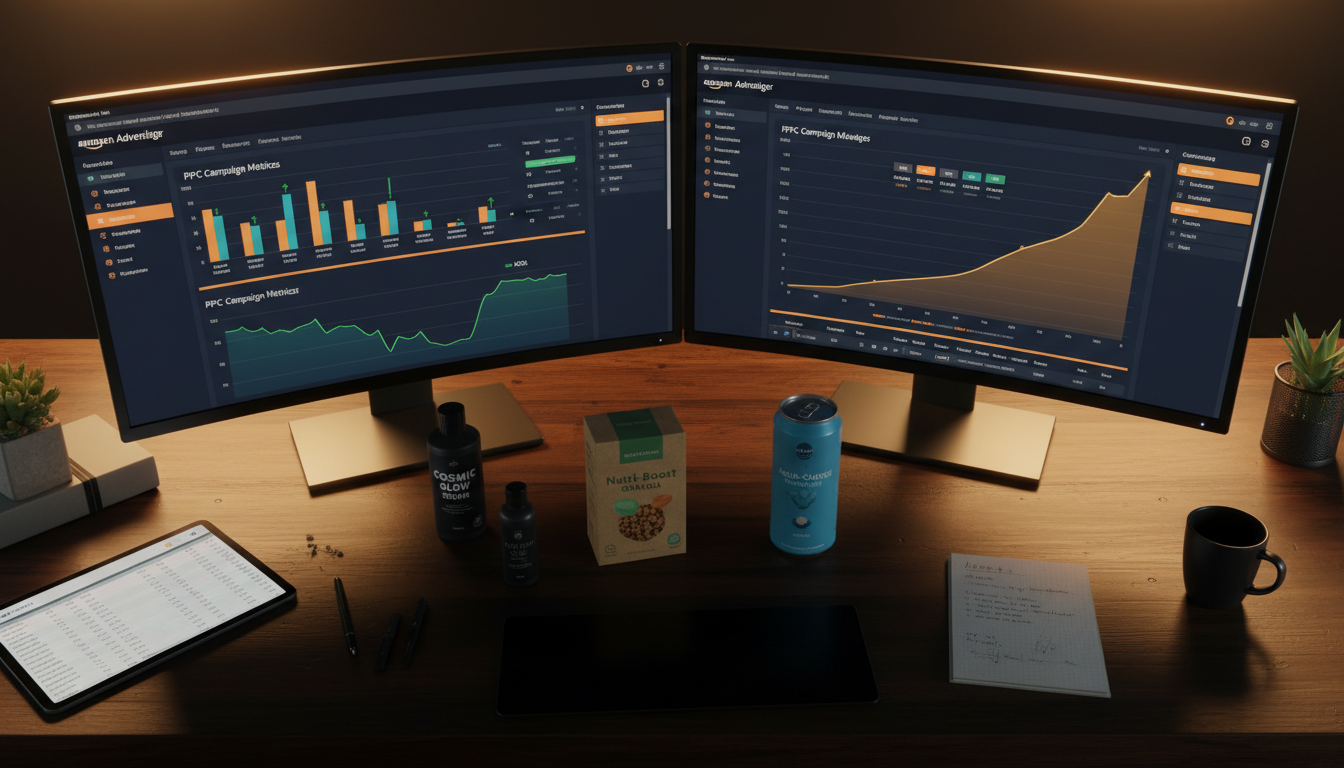
Research shows that sellers waste between 30% and 50% of their Amazon ad spend without even realizing it. That's not a rounding error — that's your margin disappearing into irrelevant clicks, bloated bids, and campaigns that were never built to convert.
If you're running Amazon pay-per-click ads and watching your ACoS creep up quarter after quarter, you already know the pain. Every dollar that funds a non-converting keyword is a dollar that didn't restock inventory, fund a product launch, or hit your bottom line.
The good news? Amazon advertising campaign optimization isn't rocket science — but it does require a step-by-step system built around data, not guesswork. This guide gives you exactly that: seven battle-tested strategies that Amazon-first brands are using right now to lower ACoS, reclaim wasted spend, and scale with confidence.
Stop Burning Ad Budget — Start Optimizing Intelligently
AdAstraa's AI engine optimizes your Amazon campaigns 24/7 — no manual babysitting required.
Start Your Free Trial Today →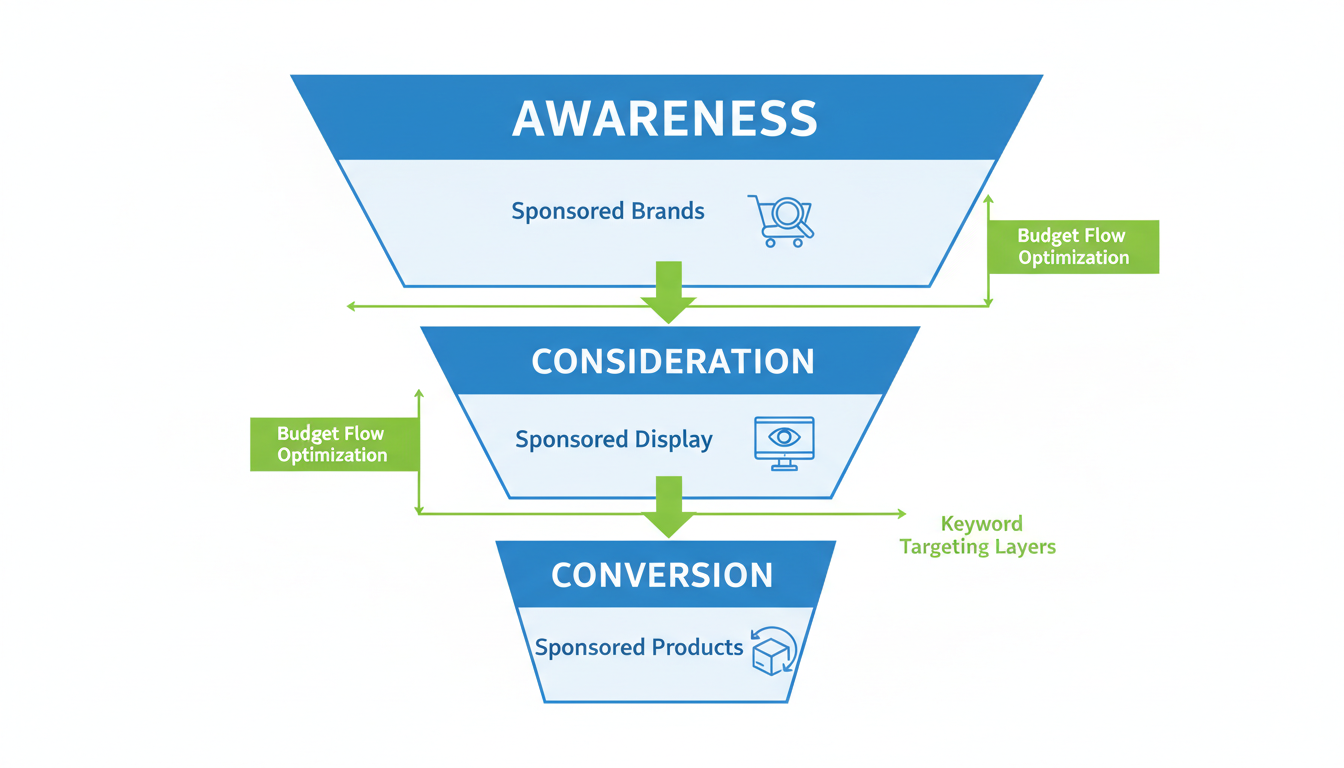
Why Most Amazon Ad Campaigns Fail Before They Start
Amazon's advertising platform has never been more competitive. With Amazon's advertising revenue hitting $47.4 billion in 2024 — a 24% year-over-year increase — and average cost-per-click rising 10–15% annually, the margin for error is razor-thin. Brands that rely on outdated "set it and forget it" tactics aren't just leaving money on the table; they're actively losing ground to competitors who have adopted smarter systems.
The three most common failure points we see across Amazon advertising campaigns are:
- No campaign architecture: Lumping all products into a single auto campaign and hoping the algorithm figures it out.
- Ignored search term reports: Allowing irrelevant, low-intent keywords to silently drain budgets for weeks or months.
- Reactive bid management: Adjusting bids once a week based on stale data, missing real-time conversion windows entirely.
The brands winning on Amazon in 2025 aren't spending more — they're spending smarter. Let's break down the exact strategies they use.
Strategy 1: Build a Bulletproof Campaign Architecture
Before you touch a single bid, your campaign structure must be airtight. A powerful architecture separates your campaigns by purchase intent, not just by product. Think in three buckets: Branded (shoppers searching your brand name), Competitor (shoppers searching rival ASINs), and Generic (high-volume, category-level keywords).
Each bucket has a different ACoS target, a different bidding posture, and a different optimization cadence. Mixing them together is one of the most destructive things you can do to your campaign performance — it's the data equivalent of mixing signal with noise.
Use Single-ASIN Ad Groups for Surgical Control
The gold standard in 2025 is a structure built around one product per ad group. This gives you clean, ASIN-level data on which keywords convert for which product — eliminating the guesswork that plagues multi-product ad groups. You can't optimize what you can't measure, and this structure makes every optimization decision defensible.
Pair this with AdAstraa's Shopper OS buyer intent intelligence to map high-intent search terms to your top-revenue ASINs automatically, so you're bidding where it matters most without spending hours in spreadsheets.
Strategy 2: Master Negative Keywords to Eliminate Wasted Spend Instantly
If there's one essential optimization action that pays dividends immediately, it's aggressive negative keyword management. Sellers waste 30–50% of ad spend targeting irrelevant search terms. Adding the wrong keyword as a negative can reduce visibility, but not adding the right negatives is guaranteed budget hemorrhage.
Your process should be weekly and systematic:
- Download your Search Term Report and sort by spend descending.
- Flag any term with significant spend but zero orders — these are your guaranteed budget leaks.
- Add them as negative exact match at the ad group level, or negative phrase match at the campaign level if the theme is broadly irrelevant.
- Move high-converting search terms from auto campaigns into targeted manual campaigns to capture that intent at controlled bids.
The Auto-to-Manual Harvesting Loop
Think of your auto campaigns as discovery engines, not profit centers. They exist to surface converting search terms at a controlled budget. Once a term proves itself with a strong conversion rate and acceptable ACoS, graduate it to a manual exact-match campaign where you own the bid entirely.
This loop — auto discovers, manual scales — is the foundation of every high-performing Amazon PPC advertising strategy we've seen deliver consistent ROAS improvement.
Strategy 3: Implement Real-Time AI Bid Optimization
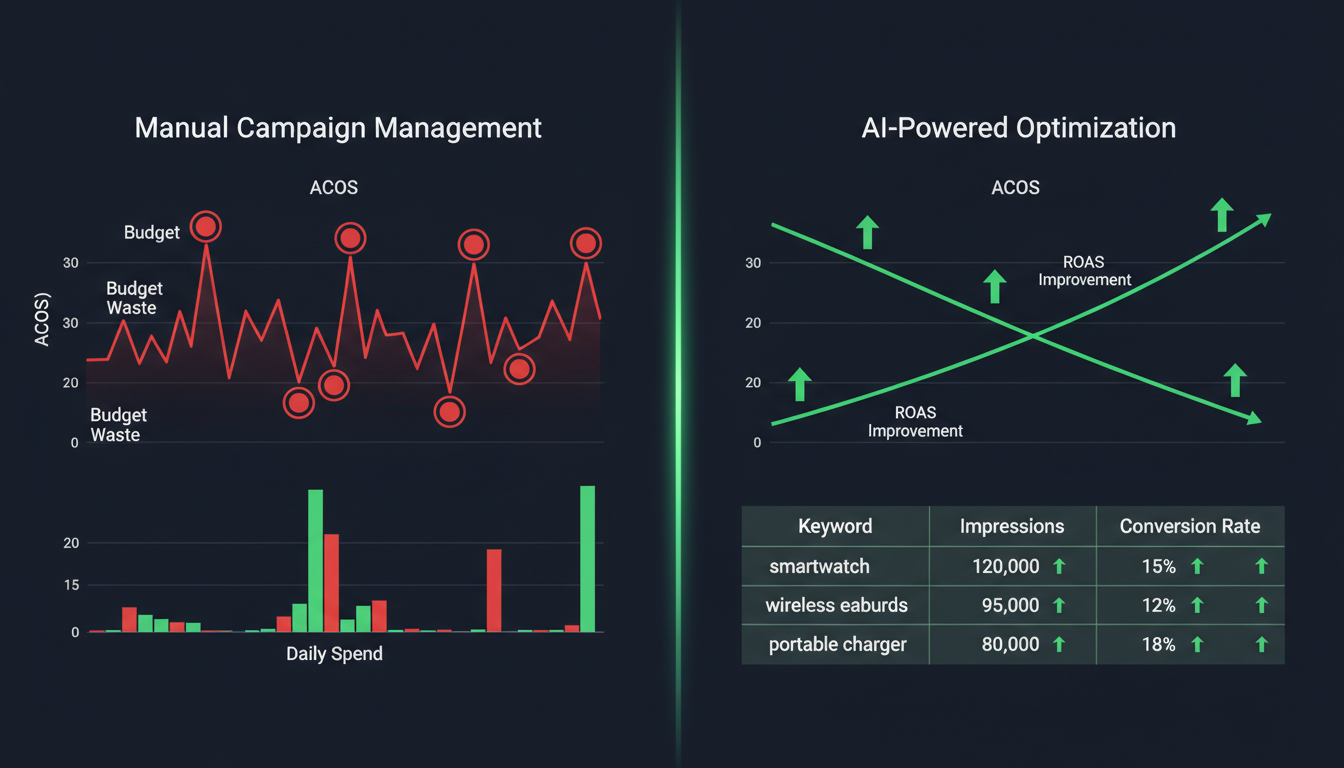
Manual bid management is the single biggest time sink in Amazon advertising — and also the most error-prone. When a human reviews bids once a week, they're optimizing on data that's already 7 days stale. Conversion rates, competition, and placement dynamics change by the hour.
This is where AI-powered bid optimization delivers a breakthrough advantage. An intelligent system like AdAstraa's Autopilot tool continuously analyzes real-time signals — impression share, conversion rate by time of day, competitor bid pressure, and placement performance — and adjusts bids within minutes, not weeks. The result is capturing your most profitable conversion windows while pulling back on high-spend, low-return timeframes.
Use Dayparting and Placement Modifiers Strategically
Amazon allows bid modifiers for placements: top of search (first page), rest of search, and product detail pages. Each placement has a dramatically different conversion rate and cost profile depending on your product category. Running a blanket bid across all placements is like paying penthouse prices for a basement view.
Test placement modifiers by adjusting top-of-search bids upward for proven high-converting keywords, while reducing product detail page bids for categories where purchase intent is lower. This alone can lower your effective ACoS by 5–10 percentage points on competitive keywords.
"Brands that adopted AI-based bid automation saw average ACoS improvements of 20–35% within the first 90 days, compared to those managing bids manually."
— Amazon PPC industry benchmark data, 2024–2025
Strategy 4: Deploy a Match Type Matrix for Smarter Keyword Targeting
Most sellers either go too broad (automatic and broad match everywhere) or too narrow (only exact match). Neither approach is optimal. The proven answer is a match type matrix — a deliberate mix of broad, phrase, and exact match that balances discovery with control.
| Match Type | Best Use Case | ACoS Profile | Bid Posture |
|---|---|---|---|
| Broad Match | Keyword discovery & reach expansion | Higher (acceptable) | Conservative |
| Phrase Match | Mid-funnel, qualified traffic capture | Moderate | Moderate |
| Exact Match | Proven converters, profit maximization | Lowest (targeted) | Aggressive |
| Auto Campaign | Harvest new converting terms | Variable | Capped budget |
The key insight is that exact match campaigns should get the majority of your budget — but only after broad and phrase match have proven which terms actually convert. This sequencing is how elite sellers build a self-reinforcing keyword funnel that gets more efficient month over month.
See Your Keyword Efficiency Score
AdAstraa's AI instantly identifies which keywords are bleeding your budget and which are hiding profit potential — across every match type.
Discover Your Profit Leaks Now →Strategy 5: Set Dynamic ACoS Targets Based on Product Lifecycle Stage
One of the most powerful — yet most overlooked — Amazon advertising strategies is assigning different ACoS targets to products based on where they are in their lifecycle. Industry benchmarks show that current ACoS across categories ranges from 20–40%, with ROAS benchmarks of 2.5x–5.0x. But those are averages — applying them uniformly is a mistake.
Here's how to think about it:
- New product launch: Accept a high ACoS (40–60%+) to build velocity, reviews, and organic rank. You're buying data and ranking, not immediate profit.
- Growth stage: Gradually tighten ACoS targets as organic rank improves and conversion rate stabilizes. Target 25–40% ACoS depending on margin.
- Mature product: Ruthlessly optimize toward your break-even ACoS. Every percentage point below break-even is pure incremental profit.
- Seasonal/promotional: Temporarily loosen ACoS targets during peak demand windows to capture maximum share of voice at the moments that matter.
Why True Profit Per ASIN Changes Everything
ACoS alone is not a complete profitability picture. A product with a 25% ACoS might be deeply unprofitable if it has high fulfillment costs, heavy returns, and low average order value. This is why AdAstraa surfaces True Profit per ASIN — a real-time view of what each product is actually earning after all costs, not just a ratio of ad spend to ad revenue.
Explore how AdAstraa's all-in-one advertising platform gives you full-funnel profitability visibility so you can make strategic, data-driven decisions in real time.
Strategy 6: Elevate Your Ad Creative to Drive Breakthrough Click-Through Rates
The current average click-through rate on Amazon sits at just 0.34%. That means for every 1,000 impressions your ad receives, fewer than 4 shoppers click through. At that ratio, your creative is the ultimate multiplier — even a 50% CTR improvement transforms your campaign economics entirely.
For Sponsored Brands and Sponsored Display campaigns, your creative must do three things instantly: stop the scroll, communicate the value proposition, and establish trust. Lifestyle imagery consistently outperforms pure product shots for high-consideration categories. Benefit-led headlines outperform feature-led headlines almost universally.
Use AI-Generated Creatives to Test at Scale
The game-changing advantage of AI-powered ad creation is volume and speed. Instead of waiting 2–3 weeks for a designer to produce 3 ad variants, an AI creative tool can generate dozens of high-quality, on-brand variants in hours — each optimized for a different audience segment, placement type, or seasonal angle.
AdAstraa's AdCreative+ tool generates performance-ready Amazon ad creatives at scale, using your brand guidelines and product data to produce scroll-stopping visuals that are tested and refined continuously against live CTR data.
Real-World Example: FMCG Brand Cuts CPC by 31% with Creative Rotation
Consider a mid-sized personal care brand selling on Amazon with a Sponsored Brands campaign running a single static banner for six months. CTR had stagnated at 0.22% and CPC was rising month over month as competitors entered the category.
By implementing a systematic creative rotation — testing lifestyle vs. product-first imagery, benefit-led vs. social-proof headlines — the brand improved CTR to 0.41% within 60 days. Higher CTR directly improved quality score signals, which reduced their effective CPC by 31% and lowered ACoS by 8 percentage points. The budget didn't change. Only the creative system did.
Strategy 7: Use Shopper Intent Data to Predict and Outbid Conversion Moments
The most sophisticated Amazon advertising strategies in 2025 go beyond keywords — they work on shopper intent signals. Buyer intent intelligence means understanding why a shopper is searching, not just what they're searching for. Are they in research mode? Price-comparing? Ready to buy right now?
This distinction is worth everything in bid strategy. A shopper who has viewed your product detail page twice in 48 hours and compared it against two competitors has a radically higher purchase probability than a first-time category browser. Bidding the same amount for both is an enormous missed opportunity.
Retargeting and DSP as Force Multipliers
Amazon DSP (Demand-Side Platform) allows you to retarget shoppers who viewed your products but didn't convert — both on and off Amazon. For brands with established catalog depth, DSP retargeting can deliver some of the most efficient ROAS numbers in the entire advertising mix, because you're re-engaging a warm, already-qualified audience at a fraction of the cost of cold acquisition.
AdAstraa's Shopper OS platform maps real-time buyer intent signals across your catalog, surfacing which ASINs are in active consideration by high-probability buyers — so you can concentrate your most aggressive bids exactly where conversion is most imminent. Learn more about our AI advertising strategies built for Amazon-first growth.
The Essential Tools Powering These Strategies at Scale
Executing all seven of these strategies manually — even for a mid-sized catalog of 50 ASINs — would require a team of dedicated specialists working around the clock. The practical reality is that most brands can't afford that. The efficient answer is purpose-built Amazon PPC automation software that handles the execution layer while you focus on strategy.
The best Amazon PPC automation tools share several must-know characteristics:
- Real-time bid adjustment — not rule-based, but machine learning-driven responses to live auction dynamics.
- Automatic negative keyword identification — surfacing and acting on waste signals without manual report reviews.
- ASIN-level profitability tracking — connecting ad performance to true margins, not vanity metrics.
- Cross-campaign budget intelligence — dynamically shifting budget to the highest-performing campaigns in real time.
- Creative performance analytics — measuring CTR and CVR at the ad variant level to guide creative iteration.
AdAstraa was purpose-built around exactly these capabilities. Unlike general-purpose marketing automation platforms, every feature in the AdAstraa suite is engineered for the unique dynamics of Amazon's advertising ecosystem — where auctions happen in milliseconds and the difference between a 22% and 28% ACoS can be the difference between a profitable quarter and a painful one.
Additional Resources
Deepen your Amazon advertising knowledge and stay ahead of platform changes with these authoritative external sources:
- Amazon Advertising Official Sponsored Products Guide — The definitive official resource for understanding Sponsored Products campaign setup, targeting types, and best practices from Amazon directly.
- FTC Endorsement and Advertising Guidance — Essential compliance reference for brands running advertising campaigns that include influencer or review-based creative assets.
- Harvard Business Review: How AI Is Changing Marketing — A rigorous, research-backed look at how AI is reshaping advertising strategy and marketing decision-making across industries.
- eMarketer: Amazon Advertising Research & Data — Up-to-date market share data, spend forecasts, and competitive analysis reports on the Amazon advertising ecosystem.
- Jungle Scout: The Complete Guide to Amazon ACoS — A comprehensive, practical guide to calculating, benchmarking, and systematically reducing ACoS across your Amazon advertising campaigns.
The Bottom Line: Strategic Execution Beats Bigger Budgets Every Time
The seven strategies outlined above aren't theoretical — they're the proven execution playbook that separates Amazon brands stuck at a painful 35% ACoS from those compounding their profits at 18–22%. The difference isn't budget size. It's the intelligence and discipline applied to every layer of the campaign.
To recap: build a surgical campaign architecture, eliminate waste with aggressive negative keyword management, implement real-time AI bid optimization, deploy a match type matrix, set dynamic ACoS targets by lifecycle stage, invest in breakthrough ad creative, and harness shopper intent data to concentrate your bids at the exact moments buyers are ready to convert.
The brands that implement these strategies and back them with the right AI advertising technology are the ones scaling profitably in 2025 and beyond. The window to gain a durable competitive advantage on Amazon is open — but it won't stay open forever as more sellers level up.
Ready to Reclaim Your Ad Spend?
See exactly where your Amazon advertising budget is being wasted — and fix it in 24 hours.
AdAstraa's Autopilot, Shopper OS, AdCreative+, and EcomGPT work together as a unified Amazon operating system — giving you effortless campaign control, real-time profit visibility, and AI-driven optimization that runs 24/7.
Launch Your Free AdAstraa Account →