
AI Advertising · Amazon PPC · Strategy Guide
Here is a number that should stop you cold: the average Amazon seller wastes between 30 and 40 percent of their entire advertising budget on keywords that will never convert. That is not a rounding error. That is a structural problem — and it is being solved right now by brands that have switched to AI advertising.
AI is not just making Amazon PPC faster. It is making it fundamentally smarter — reading buyer intent signals before they trend, adjusting bids in real time across every daypart, and generating high-converting ad creatives in minutes instead of weeks. The brands running on AI-powered Amazon PPC management are not just saving money. They are compounding their ROAS quarter over quarter while their competitors are still pulling Excel reports on a Friday afternoon.
This guide breaks down six essential, proven AI advertising strategies that are working for Amazon-first D2C brands and FMCG sellers right now. Whether you manage campaigns in-house or through an agency, these are the step-by-step frameworks you need to lower ACoS, reclaim wasted spend, and build a durable advertising advantage.

Why AI Advertising Is Now the Essential Standard for Amazon Brands
Amazon's advertising ecosystem has become brutally complex. There are Sponsored Products, Sponsored Brands, Sponsored Display, DSP placements, video ads, and a constant algorithm update cycle that changes what works every quarter. Manual campaign management — the kind where you log in, pull reports, adjust bids, add negatives, and repeat — was always inefficient. In 2025, it is commercially unsustainable.
Studies show that AI advertising platforms can reduce campaign management time from fifteen hours per week to under two — while simultaneously improving ROAS by 25 to 40 percent. The reason is not magic. It is the speed and scale of data processing. A human can review a handful of keywords per session. An AI engine can process millions of bid signals per hour, adjusting in real time to purchase probability, time of day, device, placement, and competitor activity.
The global retail AI market is expected to grow from $4.84 billion in 2021 to over $31 billion by 2028. The brands that build their AI advertising muscle now will hold a compounding structural advantage over brands that wait. This is not a trend to monitor. It is a game-changing capability shift you need to be inside of today.
Manual vs. AI-Powered Amazon PPC: The Real Difference
Manual PPC gives you control, but it also gives you bottlenecks. Every bid adjustment requires your time. Every keyword harvest requires a report pull. Every budget reallocation requires a decision. The moment you sleep, your campaigns stop improving.
AI-powered Amazon PPC management removes the bottlenecks without removing your strategic control. You set the goals — target ACoS, ROAS floor, daily budget — and the AI executes around the clock. It makes thousands of micro-decisions per day that collectively move the needle in ways no human operator can match at scale.
Strategy 1: Deploy 24/7 Automated Bid Optimization — Not Just Rules
The most impactful single change any Amazon advertiser can make is replacing manual bid schedules with a true AI bid optimization engine. Not rules. Not scheduled adjustments. A live, predictive system that reads purchase probability signals and adjusts bids before the conversion opportunity passes.
AdAstraa's Autopilot engine does exactly this — running 24/7 bid adjustments across 9 marketplaces, processing signals like time of day, device type, placement position, competitor activity, and historical conversion rates at the keyword level. Brands using this approach have recorded an average ROAS lift of +41.8% across Growth plan accounts.
How to Implement Intelligent Bid Automation Correctly
The common mistake brands make is deploying automation on top of a poorly structured campaign. You need clean campaign architecture first — separate campaigns for branded vs. non-branded keywords, single ASIN ad groups, and a clear bid policy per keyword intent tier. Only then should automation take the wheel.
- Segment by intent: Separate high-intent transactional terms from broader discovery keywords. Your bidding logic and target ACoS should differ by segment.
- Set profit-aware targets: Configure your automation against True Profit per ASIN, not just ACoS. A low-ACoS keyword that eats margin on a high-COGS product is still a loser.
- Allow a learning period: Give the AI two to three weeks of data before evaluating performance. The system is building a probability model, not executing a static rule.
- Review weekly, not daily: Micro-managing an AI bid engine defeats its purpose. Set goals, monitor weekly trend lines, and intervene only on structural issues.
Strategy 2: Use Buyer Intent Intelligence Before Keywords Trend
Every Amazon advertiser is working from the same keyword playbook — because they are all pulling from the same historical reports. The breakthrough advantage in modern Amazon PPC advertising comes from acting on forward-looking buyer intent signals before competitors have even seen the data.
AdAstraa's Shopper OS intelligence layer indexes 42 million queries per week across 9 marketplaces, tagging each query by intent type — commercial, informational, comparative, navigational — and detecting velocity spikes up to 6 hours before Amazon's own reporting catches up. That 6-hour head start is enough to place a winning bid, update a listing, or launch a bundle before competitors respond.
Real-World Impact: How Intent Intelligence Changes the Game
“Shopper OS showed us a category climbing six hours before Amazon's own report. We launched a bundle on Friday. By Monday, we owned the top three organic spots.”
Ananya V. — VP Category, Crompton · +41% Organic SOV · 312 new keywords / month
This is the essential power of AI-based marketing automation applied to keyword strategy. You are not just harvesting what already converted. You are surfacing what is about to convert — and positioning your bids, creative, and listing copy to capture it first.
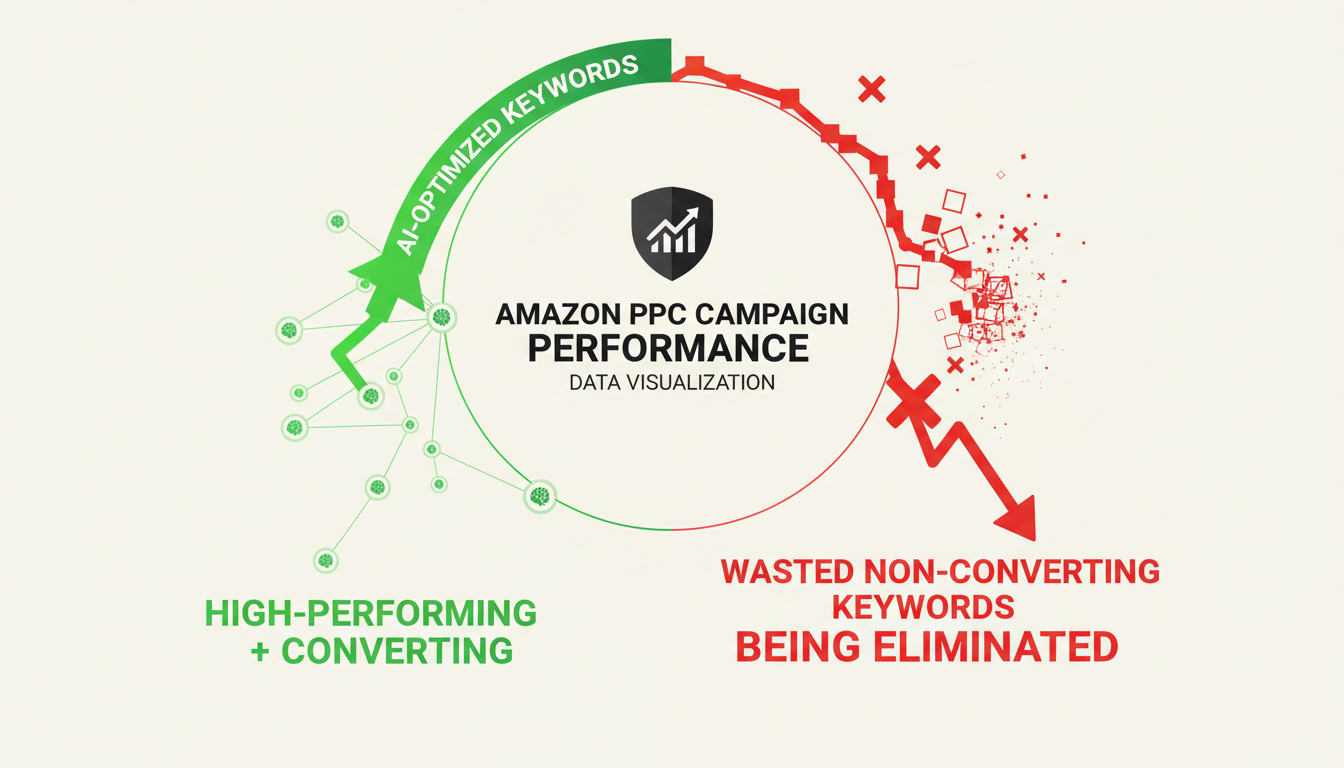
Strategy 3: Systematically Eliminate Non-Converting Keywords at Scale
One of the most powerful — yet most consistently neglected — levers in Amazon PPC optimization is aggressive negative keyword management. Most brands add negatives reactively, once per month, based on a manual search term report review. Meanwhile, irrelevant terms drain budget every single day.
AI-powered PPC automation software like AdAstraa's Autopilot engine continuously analyzes search term performance and automatically adds negative keywords when a term crosses a statistically significant threshold for spend-without-conversion. This is not a weekly task. It is a guaranteed ongoing process that compounds savings over time.
The Step-by-Step Negative Keyword Framework
- Set a spend threshold rule: Any search term that has spent 1x your target CPA without a conversion should be flagged for negative review. At 2x CPA spend with no conversion, it should be automatically negated.
- Use phrase and exact match negatives strategically: Broad match negatives can inadvertently block converting variations. Use phrase-match negatives for category mismatches and exact-match for proven non-converters.
- Build a shared negative keyword list: Maintain a brand-wide negative list — competitor names, irrelevant categories, price-point mismatches — and apply it across all campaigns to prevent the same waste from recurring.
- Automate the review cycle: The best Amazon PPC automation tools handle this nonstop. If you are still doing it manually, you are budgeting for waste by design.
Strategy 4: Scale Ad Creative Testing With AI-Generated Variants
Most Amazon brands are severely under-testing their ad creatives. The average seller ships two or three creatives per campaign, waits weeks for enough data, then makes a single tweak. By the time a winning creative is confirmed, the seasonal window is closed and the budget is spent.
This is where AI-powered ad creative generation delivers a breakthrough advantage. AdAstraa's AdCreative+ generates 40 on-brand creative variants — across headline angles, visual treatments, and ad formats — in under six minutes. Every variant is trained on what converts on Amazon specifically, by category and price point, not generic internet copywriting patterns.
Building a High-Velocity Creative Testing System
The goal is not just more creatives. It is a systematic process that reaches statistical confidence faster, kills underperformers before they cost you, and scales winners automatically. Tusk Audio's performance lead reported that switching to this model delivered a 3.8% CTR on the winning variant, a 2.4x ROAS lift, and a 91% reduction in time-to-winner.
- Brief by goal, not by format: Tell the AI the conversion goal (purchase, brand awareness, reorder) and the audience intent signal (commuter, gifting, budget-conscious). Let it handle format and copy variation.
- Test in batches of 6 to 10 variants: A meaningful test requires enough variation to find signal. Two variants is not a test — it is a coin flip.
- Set auto-pause rules for underperformers: Any variant with a CTR below your category baseline after reaching 200 impressions should be automatically paused. Protect budget for the top performers.
- Feed winner insights into the next brief: The winning creative's angle, framing, and visual treatment tells you something important about your buyer. Use that intelligence to brief the next round smarter.
Strategy 5: Measure True Profit per ASIN — Not Just ACoS
ACoS is the metric Amazon sellers obsess over. It is also deeply misleading on its own. A campaign running at a 15% ACoS looks excellent in Seller Central. But if the ASIN has a 45% COGS, FBA fees, return rates, and storage costs, that campaign may be generating a net loss on every sale.
The most powerful shift an Amazon advertiser can make is moving from ACoS-centric to True Profit per ASIN as the primary optimization target. This means pulling all cost variables — product cost, fees, returns, ad spend — into a single profit view per ASIN, and configuring your AI advertising platform to bid against that number rather than a generic ACoS target.
How to Set Up Profit-Aware Campaign Management
The 70-20-10 budget allocation framework is a must-know starting point: 70% of budget to proven winners (campaigns consistently hitting your profit-aware target), 20% to testing and optimization, and 10% to brand defense. Most sellers do the opposite — they over-invest in underperforming campaigns hoping they will turn around, and they never will without structural changes.
AdAstraa's platform provides real-time True Profit per ASIN visibility across your entire catalog — making it effortless to identify which ASINs deserve more aggressive bidding, which need creative refreshes, and which should be paused entirely until the economics improve.
Strategy 6: Automate Customer Operations With AI to Protect Ad Efficiency
This is the strategy most brands overlook entirely, yet it has a direct impact on ad performance. Your ACoS does not exist in isolation from your reviews, seller rating, and listing quality. An ASIN with a 3.2-star rating and unanswered Q&A questions will underperform even the most perfectly optimized campaign because Amazon's algorithm deprioritizes poorly-rated listings in sponsored placements.
AdAstraa's EcomGPT automates customer operations — answering buyer questions, managing review requests, and handling routine seller support interactions — with a 2.1-second median response time. This is the kind of marketing workflow automation that feeds directly into your organic ranking and sponsored ad quality score, making every advertising rupee or dollar work harder.
The Full-Funnel AI Flywheel: How Everything Connects
The most powerful Amazon advertising strategies in 2025 are not individual tactics — they are interconnected systems. Shopper OS surfaces a trending keyword. Autopilot bids on it 24/7. AdCreative+ generates a high-converting creative using that keyword's intent signal. EcomGPT handles the post-purchase experience to protect the review score. True Profit visibility ensures every ASIN being advertised is profitable at the campaign level.
This is the flywheel that 1,523 brands are currently running on AdAstraa's Autopilot — and it compounds over time. The more the AI learns about your ASIN economics, your buyer intent signals, and your creative performance, the more precise every subsequent decision becomes.
How to Choose the Right AI Advertising Platform for Amazon Brands
Not all AI advertising tools are equal. Many offer automated bid rules dressed up as machine learning. A few offer genuine AI-powered optimization. When evaluating any Amazon PPC software, ask these must-know questions:
- Does it optimize against True Profit, or just ACoS? Rule-based tools optimize ACoS. AI platforms optimize for the outcome that actually matters — profit per ASIN.
- Is the bid adjustment truly real-time? Many platforms claim automation but execute adjustments only once or twice per day. Ask for the actual update frequency.
- Does it include buyer intent intelligence? Bid optimization without forward-looking keyword discovery leaves half the opportunity on the table.
- Is creative generation integrated? The best Amazon PPC campaigns combine intelligent bidding with high-converting creative. Platforms that handle both eliminate the gap between strategy and execution.
- Can it scale across multiple ASINs and marketplaces simultaneously? If the platform requires manual setup per ASIN, it is not truly scalable for serious brands.
AdAstraa is purpose-built to meet all five criteria — an all-in-one advertising platform that covers bid automation, buyer intelligence, creative generation, customer operations, and profit analytics in a single integrated system. See how real brands have scaled with AdAstraa's platform →
Additional Resources
Deepen your understanding of AI advertising, Amazon PPC management, and marketing automation with these authoritative external sources:
- Amazon Advertising — Official ACoS Guide — Amazon's own guide to understanding Advertising Cost of Sale and how it relates to campaign performance benchmarks.
- MDPI — The Impact of Artificial Intelligence Marketing on E-Commerce Sales — Peer-reviewed academic research on how AI marketing strategies drive measurable improvements in e-commerce conversion rates and customer acquisition.
- Gauss — AI eCommerce Statistics for 2025 — A comprehensive, cited data report on AI adoption in ecommerce, retail AI market growth projections, and AI-driven revenue benchmarks.
- Bloomreach — 7 Ways AI in Ecommerce Is Revolutionizing Shopping in 2025 — Strategic breakdown of how AI is transforming ecommerce across recommendations, personalization, logistics, and advertising.
- ResearchGate — The Impact of AI-Powered Marketing Automation in E-Commerce — Academic research on how marketing automation using AI reshapes campaign personalization, efficiency, and revenue outcomes for ecommerce brands.
The Bottom Line: AI Advertising Is How Amazon Brands Win in 2025 — and Beyond
The six strategies outlined in this guide — 24/7 automated bid optimization, buyer intent intelligence, systematic negative keyword elimination, AI-powered creative testing, True Profit per ASIN measurement, and automated customer operations — are not theoretical. They are the proven, operational playbook of the brands currently winning on Amazon.
The critical insight is that these strategies work best as a connected system, not as isolated tactics. An AI advertising platform that integrates bidding, intelligence, creative, and analytics into one workflow is worth dramatically more than six separate tools bolted together. The signal loss between disconnected systems is where most brands silently bleed performance.
AdAstraa was built from the ground up to be that connected system — an AI-powered advertising operating system specifically for Amazon-first brands. With over ₹218 Crore in ad spend optimized last quarter, 1,523 brands on Autopilot, and a +41.8% average ROAS lift for Growth plan clients, the results speak for themselves.
You have read the strategies. Now it is time to run them. Start today — your competitors are not waiting.