



Amazon sellers are collectively wasting billions. According to industry data, the average Amazon brand loses 20–40% of its ad budget on keywords that never convert — every single month. Yet most sellers keep running the same campaigns, hoping the numbers will somehow turn around.
They won't. Not without a fundamentally smarter approach to AI advertising.
In 2025, Amazon's advertising revenue surpassed $56.2 billion globally, cementing it as the third-largest digital ad platform behind Google and Meta. Competition is fierce, cost-per-click rates are rising 10–15% year-over-year across most categories, and manual campaign management is no longer a viable strategy for brands that want to scale profitably.
The good news? AI has changed the rules. Brands that embrace AI-powered advertising strategies are not only cutting waste — they're unlocking breakthrough ROAS improvements, reclaiming dozens of management hours per week, and building campaigns that compound over time.
In this guide, we break down 5 proven AI advertising strategies that are transforming Amazon PPC management in 2025, and show you exactly how to implement them for maximum impact.
Stop bleeding budget on non-converting keywords. Let AI do the heavy lifting — 24 hours a day, 7 days a week.
Start Your Free Trial with AdAstraa →
Why Traditional Amazon PPC Management Is Broken
Before diving into the strategies, it's essential to understand why the old way of managing Amazon ads is failing brands at scale. The problem is structural, not tactical.
Manual Amazon PPC management requires a campaign manager to review search term reports, adjust bids, add negative keywords, and reallocate budget — typically once or twice per week. But Amazon's ad auction runs millions of micro-decisions every hour. A human reviewing data weekly simply cannot compete with an algorithm that optimizes in real time.
The result? Budgets drift toward high-impression, low-conversion keywords. Bids go stale. Winning search terms get starved of spend while losing ones drain the account. ACoS climbs. ROAS falls. And the brand manager spends their Friday afternoon deep in spreadsheets instead of building strategy.
The Real Cost of Doing Nothing
Consider a brand spending $20,000 per month on Amazon ads. If just 25% of that spend is going to non-converting keywords — a conservative estimate — that's $5,000 per month, or $60,000 per year, evaporating into clicks that never become customers.
AI advertising platforms solve this by operating at machine speed, processing thousands of data signals simultaneously and making bid adjustments that no human team could replicate manually. The brands leveraging these tools aren't just saving money — they're gaining a genuine competitive moat.
Let's get into exactly how they do it.
Strategy 1: Deploy 24/7 AI Bid Optimization — Never Sleep on Your Bids Again
The single most impactful shift any Amazon brand can make is replacing scheduled manual bid reviews with continuous, AI-driven bid optimization. This is where the efficiency gains become immediately visible.
AI bid optimization systems analyze performance data in real time — factoring in time of day, day of week, competitor activity, conversion rate trends, and keyword-level profitability — and adjust bids automatically to keep each campaign within its target ACoS or ROAS threshold.
Autopilot Bidding: The Step-by-Step Advantage
AdAstraa's Autopilot feature runs bid optimization around the clock, processing signals that human managers would never catch — like a sudden surge in competitor bids at 2 AM on a Tuesday, or a dip in conversion rates on specific keywords during a peak traffic window.
Rather than setting a static bid and hoping for the best, Autopilot dynamically raises bids on keywords showing strong purchase intent signals and pulls back on those trending toward wasted spend. The outcome is a campaign that self-corrects continuously rather than degrading between review cycles.
For Amazon-first brands, this translates to a measurably lower ACoS within weeks — not months — of deployment. Industry benchmarks show that AI-powered bid management can reduce wasted ad spend by up to 30% while maintaining or improving overall sales velocity.
"The brands winning on Amazon in 2025 aren't necessarily the ones with the biggest budgets — they're the ones whose bids are smartest at any given moment."
Strategy 2: Use Buyer Intent Intelligence to Target Shoppers Who Are Ready to Buy
Most Amazon advertising strategies focus on keywords. The essential evolution is to focus on intent.
Not every shopper searching for a keyword is in the same stage of the buying journey. Someone searching "protein powder" is browsing. Someone searching "chocolate whey protein 5lb unflavored no artificial sweetener" is ready to buy. Treating these two search queries the same way with the same bid is a guaranteed recipe for wasted spend.
Decoding High-Intent Shopper Signals
AdAstraa's Shopper OS goes beyond surface-level keyword data to analyze buyer intent signals across search patterns, browsing behavior, and purchase history. It identifies the specific combinations of signals that predict a high-probability conversion — and prioritizes ad spend toward those moments.
This approach is game-changing for Amazon PPC campaign management because it shifts the optimization logic from "how much does this keyword cost?" to "how likely is this particular shopper to buy right now?" — a fundamentally more profitable question.
The practical result is that brands using intent-based targeting routinely see higher click-through rates, better conversion rates, and lower effective ACoS — all without increasing total ad spend. It's not about spending more; it's about spending smarter.
Eliminating Non-Converting Keywords with AI Precision
One of the most underutilized tactics in Amazon advertising management is aggressive negative keyword deployment. AI platforms analyze search term reports at scale and automatically identify patterns in non-converting queries — flagging them as negatives before they drain more budget.
Manual sellers typically review search term reports weekly or bi-weekly. AI systems do this continuously, catching waste in hours rather than days. For a brand running 50+ active campaigns, this difference is worth thousands of dollars per month in recovered spend.
Strategy 3: Generate AI-Powered Ad Creatives That Convert at Scale
Here's a powerful truth most brands overlook: even a perfectly optimized bid on a mediocre creative is still a loss. Ad creative quality is a direct driver of click-through rate — and CTR directly impacts your ad's Quality Score, placement, and effective cost-per-click.
The challenge for most Amazon brands is producing high-quality, tested creative at scale. Running split tests across multiple product lines, ad formats, and audience segments is time-consuming and expensive when done manually.
How AI Ad Creative Generation Changes the Game
AdAstraa's AdCreative+ uses AI to generate, test, and optimize ad creatives across formats — reducing the time from concept to live ad from days to minutes. The platform analyzes top-performing creative patterns within your category and generates variations engineered to outperform your current baseline.
For FMCG brands with large product catalogs, this is an especially breakthrough capability. Instead of manually producing creatives for each ASIN, AI generates optimized assets in bulk — ensuring every product has compelling ad creative rather than the same generic template applied across the entire catalog.
The compounding effect is significant: better creatives drive higher CTR, which improves campaign relevance scores, which lowers effective CPC, which stretches the same budget further. It's a virtuous cycle that manual approaches simply cannot replicate at scale.
See how AdCreative+ generates high-converting Amazon ad creatives in minutes — and watch your CTR climb.
Explore AdCreative+ — Try It Free →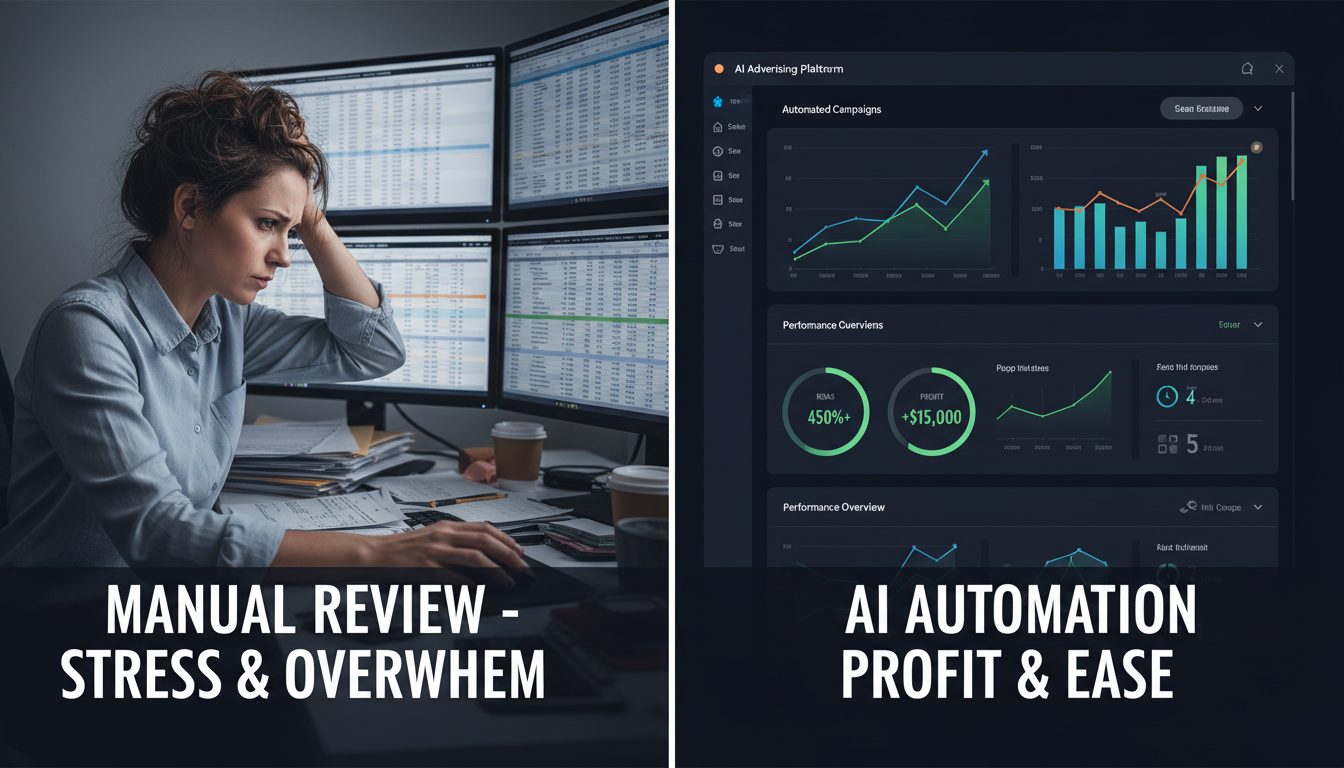
Strategy 4: Track True Profit Per ASIN — Not Just Surface-Level ROAS
One of the most dangerous illusions in Amazon advertising is a healthy-looking ROAS that masks unprofitable unit economics. A campaign can show a 4x ROAS while the underlying ASIN is still losing money — once you factor in COGS, FBA fees, returns, and storage costs.
This is the must-know distinction between revenue optimization and profit optimization. And it's where most Amazon brands, even sophisticated ones, are flying blind.
Why True Profit Per ASIN Changes Every Decision
When you know the actual profitability of every ASIN — after all costs are accounted for — your advertising strategy transforms. You can confidently increase bids on high-margin products because you know exactly how much you can pay per click before a sale becomes unprofitable. Conversely, you can deliberately throttle spend on low-margin ASINs that are generating revenue but eroding your bottom line.
AdAstraa's operating system dashboard provides real-time True Profit per ASIN visibility, integrating advertising costs, FBA fee structures, and COGS data into a single profit-first view. This is the foundation of genuinely intelligent Amazon advertising campaign management — every bid decision is anchored in actual unit economics, not vanity metrics.
Real-World Impact: A Mini Case Study
Consider a mid-sized FMCG brand selling 35 SKUs on Amazon, with a monthly ad budget of $30,000. Prior to implementing profit-per-ASIN tracking, their campaign manager was allocating spend based on ROAS alone. Three of their top-ROAS products were actually their lowest-margin items — FBA fees and high return rates were eating the profit.
After switching to a profit-first optimization model, the brand reallocated 40% of its budget toward its five highest-margin ASINs. Within 60 days, total revenue held steady while net profit increased by 22% — without adding a single dollar of additional ad spend. That's the power of optimizing for the right metric.
Strategy 5: Automate Customer Operations to Reinvest Hours Into Growth Strategy
Effective AI marketing strategies don't stop at the ad click. The post-purchase experience — review management, customer Q&A, listing optimization, and seller feedback — plays a direct role in organic rank, conversion rate, and ultimately, how efficiently your paid ads perform.
A listing with 4.7 stars and strong review velocity converts at a meaningfully higher rate than an identical listing at 4.1 stars. That difference compounds through your entire advertising funnel: the same bid, the same keyword, the same creative — but one listing converts 30% better, effectively making every ad dollar stretch further.
Automating the Operational Layer with EcomGPT
AdAstraa's EcomGPT handles the operational layer of Amazon selling — automating customer communication, review responses, Q&A management, and listing content updates — so your team can focus entirely on strategy and growth rather than operational firefighting.
This matters for advertising performance because every hour your team spends on manual operational tasks is an hour not spent analyzing campaign structure, testing new ad creative angles, or identifying emerging keyword opportunities. Effortless automation of the operational layer is, in effect, an advertising performance multiplier.
For Amazon agencies managing multiple brand accounts, this efficiency gain is especially significant. EcomGPT enables agencies to scale their client portfolios without proportionally scaling their headcount — a fundamentally better business model for all parties involved.
How These AI Advertising Strategies Work Together as a Unified System
The most important insight in this guide is this: these five strategies are not independent tactics. They are interconnected layers of a single, intelligent advertising operating system. Each layer reinforces the others.
- 24/7 bid optimization ensures your budget is always deployed at peak efficiency.
- Buyer intent intelligence ensures your budget is targeting the right shoppers at the right moment.
- AI creative generation ensures those shoppers encounter a compelling, conversion-optimized ad.
- True profit-per-ASIN tracking ensures every spend decision is rooted in actual economics.
- Operational automation ensures the post-click experience drives reviews and conversion rates that make your ads more efficient over time.
Brands that implement all five layers simultaneously don't see additive improvements — they see exponential ones. This is why the gap between AI-native Amazon advertisers and traditional manual managers is widening every quarter.
To see exactly how this integrated approach works in practice, explore our complete AI advertising strategies guide or review real performance results in our brand case studies.
The Best Time to Implement AI Advertising Was Yesterday. The Second Best Is Today.
Every week you delay implementing these strategies is another week of wasted ad spend, missed conversion opportunities, and competitive ground ceded to brands that have already made the switch. The technology is proven, the tools exist, and the ROI is documented.
The question isn't whether AI advertising will transform your Amazon performance. It's how quickly you're willing to let it.
Additional Resources
Deepen your understanding of AI advertising, Amazon PPC optimization, and marketing automation with these authoritative external resources:
- Amazon Advertising Resource Center — Official best practices, campaign guides, and performance benchmarks directly from Amazon Ads.
- FTC Report: Artificial Intelligence in Advertising — Federal Trade Commission guidance on responsible AI use in digital advertising and marketing.
- Harvard Business Review: How to Design an AI Marketing Strategy — Research-backed framework for integrating AI into marketing operations from HBR's editorial team.
- McKinsey & Company: The Power of AI in Marketing — Enterprise-level analysis of AI's quantifiable impact on marketing performance and ROI.
- Triple Whale: Amazon Ads Benchmarks by Industry — Updated performance benchmarks across ACoS, ROAS, CVR, and CPA segmented by Amazon product category.
Final Takeaway: AI Advertising Isn't the Future — It's the Present Standard
The brands that will dominate Amazon in 2025 and beyond share one essential characteristic: they've stopped treating advertising as a manual operational task and started treating it as an intelligent, always-on growth system.
The five strategies outlined in this guide — AI bid optimization, buyer intent targeting, AI-generated creatives, profit-per-ASIN tracking, and operational automation — are not theoretical. They are proven, actively deployed capabilities that separate high-performance Amazon brands from those perpetually stuck optimizing the wrong metrics.
The average Amazon brand wastes $60,000+ per year in non-converting ad spend. You don't have to be average.
AdAstraa is built specifically for Amazon-first brands, D2C sellers, and agencies that are ready to stop manually managing campaigns and start deploying intelligent systems that win. Explore the full AdAstraa AI advertising platform or see our transparent pricing plans to find the right fit for your brand.
Ready to eliminate wasted ad spend and build an unstoppable Amazon advertising engine?
Join hundreds of Amazon brands already scaling profitably with AdAstraa's AI-powered platform.
Get Started Free — No Credit Card Required →