
Here's a number that should stop you cold:
Amazon's advertising revenue surpassed $56 billion in 2024 — growing 20% year-over-year. Meanwhile, the average seller is running campaigns where a significant chunk of that spend produces zero attributable revenue. Manual bid reviews happen weekly at best. Irrelevant search terms drain budgets silently. And most brands don't discover the damage until it shows up in their month-end P&L.
If you've been managing your Amazon advertising campaign the same way you did two years ago, you're not just leaving money on the table — you're actively funding your competitors' growth.
This guide breaks down five essential, proven strategies for transforming how you build, manage, and optimize your Amazon advertising campaigns. Whether you're a D2C brand owner, an FMCG marketer, or an agency managing dozens of accounts, these frameworks will help you eliminate waste, lower ACoS, and build a sustainable ROAS engine — especially when powered by the right AI advertising platform.
Ready to stop guessing and start scaling? AdAstraa's AI Autopilot optimizes your bids 24/7 — automatically.
Start Your Free Trial Today →
Strategy 1: Build a Bulletproof Campaign Architecture from Day One
The single most overlooked root cause of runaway ACoS is a broken campaign structure. When Sponsored Products, Sponsored Brands, and auto-targeting campaigns are thrown together without clear intent segmentation, your data becomes noise — and every optimization decision you make downstream is built on sand.
A game-changing campaign architecture isolates variables so you can actually learn what works. Here's the framework that consistently drives results for high-performing Amazon-first brands:
The Three-Tier Campaign Structure
- Tier 1 — Discovery (Auto Campaigns): Run automatic targeting at a conservative bid. This tier exists purely to harvest new, high-converting search terms. Think of it as your intelligence-gathering engine.
- Tier 2 — Qualification (Broad & Phrase Manual): Move proven search terms from Tier 1 into manual campaigns with phrase and broad match. Here you test at scale before committing full budget.
- Tier 3 — Conversion (Exact Match): Your proven, high-intent winners live here with aggressive bids. These keywords consistently convert at or below your target ACoS and deserve priority budget allocation.
This funnel approach means you're always feeding fresh data into your top performers while systematically retiring underperformers. It's the structural foundation of every successful Amazon advertising strategy.
The critical rule: never mix match types in the same campaign. This is the step-by-step discipline that separates profitable sellers from those perpetually chasing their ACoS.
Strategy 2: Master Negative Keywords to Instantly Reclaim Lost Budget
Here's the uncomfortable truth: on most Amazon accounts, 15–30% of total ad spend is absorbed by search terms that have never converted and never will. Irrelevant queries, mismatched intent, competitor brand names, and informational searches silently devour budgets every single day.
Negative keyword management isn't a one-time setup task. It's an essential ongoing discipline — and one of the highest-leverage activities in all of Amazon PPC campaign management.
A Data-Driven Negative Keyword Framework
Rather than applying arbitrary rules like "negate anything over 10 clicks with no sale," build a framework tied to your own product's cost-per-acquisition threshold:
- Pull your Search Terms Report weekly. Filter for search terms that have spent more than 1.5× your target CPA with zero conversions.
- Categorize negatives by intent. Informational terms ("how to", "review", "DIY"), competitor brand terms you can't convert, and clearly mismatched product categories should all become negative exact or negative phrase.
- Apply at the correct level. Campaign-level negatives block spend across all ad groups; ad group–level negatives refine at a granular tier. Use both strategically.
- Audit your placements. Product page placements frequently drive high traffic but low conversions. Use placement performance data to suppress these intelligently.
Brands that implement this framework rigorously often see immediate ACoS improvements of 8–15 percentage points within the first 30 days — without changing a single bid.
Why Manual Negative Harvesting Has a Ceiling
The human challenge is scale. An active Amazon account can generate thousands of unique search term impressions every week. No human team can review, assess, and action that volume at the speed the marketplace demands.
This is precisely where AI-powered ad management creates a breakthrough advantage. AdAstraa's Autopilot engine continuously scans search term data, identifies non-converting patterns, and applies negative keyword actions in real time — 24 hours a day, seven days a week, without a human touching a single spreadsheet.
Strategy 3: Replace Static Bids with Dynamic AI-Powered Bid Optimization
Static bids are a relic of a simpler marketplace. Today, Amazon's auction environment shifts minute by minute based on competitor activity, time of day, device type, shopper intent signals, and inventory levels. A bid that's profitable at 9 AM on a Tuesday may be catastrophically wasteful at 7 PM on a Saturday.
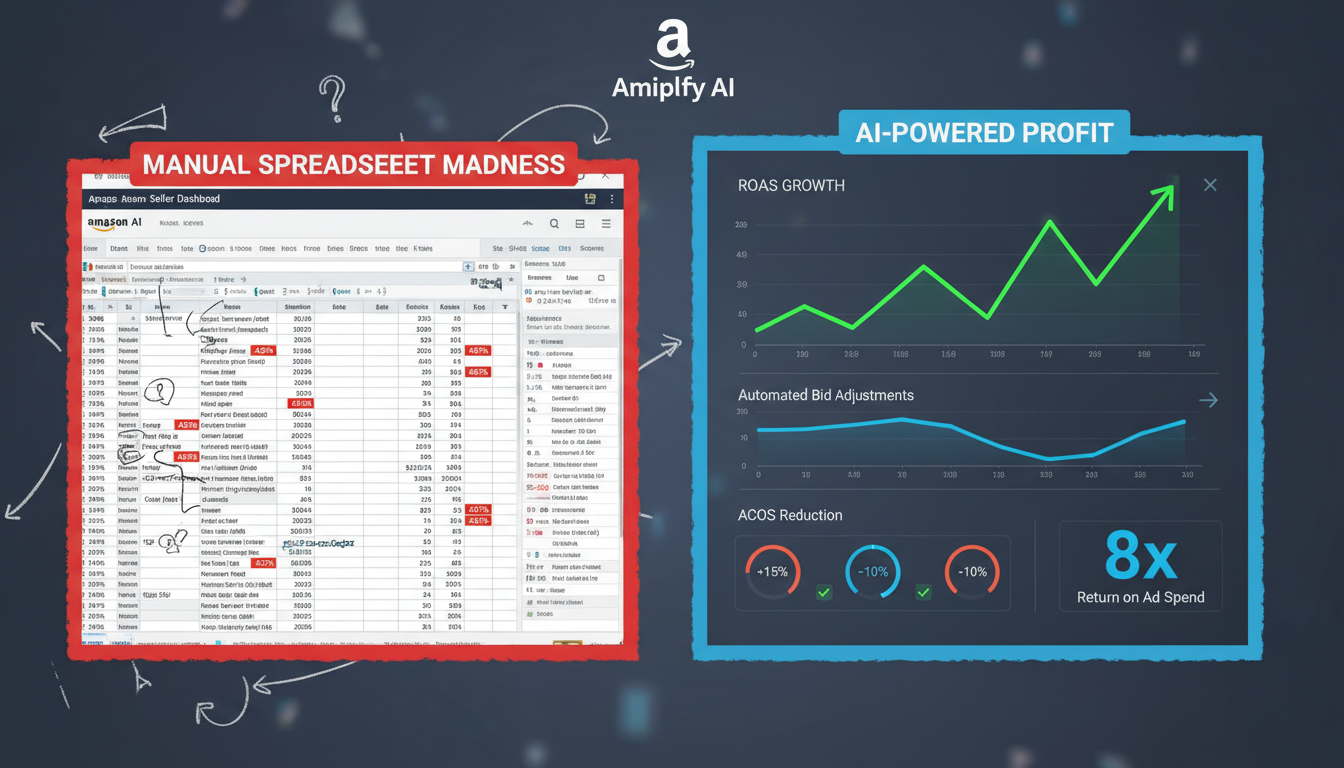
Research from leading Amazon PPC automation platforms confirms that switching from manual to AI-driven bid management can reduce campaign management time from 15+ hours per week to under 2 hours — while improving ROAS by 25–40%. That's not incremental improvement; that's a fundamental shift in your advertising operating model.
What Intelligent Bid Management Actually Considers
A sophisticated AI PPC management system doesn't just look at ACoS on a 14-day window and apply a percentage adjustment. It synthesizes multiple signals simultaneously:
| Signal Type | What It Captures | Impact on Bidding |
|---|---|---|
| Time-of-Day / Daypart | Conversion rate by hour and day | Bid up during peak hours; suppress during low-conversion windows |
| Keyword-Level CVR Trend | Rolling 7/14/30-day conversion velocity | Accelerate or decelerate spend based on performance trajectory |
| Competitor Auction Pressure | CPC volatility and impression share shifts | Defensive bid floors to maintain visibility without overpaying |
| ASIN-Level Margin Data | True Profit per ASIN after COGS and fees | Set bid ceilings that protect profitability, not just ACoS |
| Inventory & BSR Signals | Stock levels and rank momentum | Throttle spend on near-OOS products; amplify on rank-climbing ASINs |
This is where AI-powered advertising strategies diverge permanently from rule-based automation. Rules react to history. AI anticipates future performance based on pattern recognition across thousands of data points — and acts accordingly.
“The difference between a 35% ACoS and a 19% ACoS isn't usually the keywords you chose — it's the discipline and intelligence with which you manage bids across every hour of every day.”
Strategy 4: Unlock the Hidden ROAS Multiplier — AI-Generated Ad Creatives
Most Amazon advertisers obsess over bids and keywords while almost completely ignoring the creative layer. This is a massive, untapped opportunity. Your ad creative — the headline, imagery, and copy of your Sponsored Brands and video ads — directly determines your click-through rate. And CTR directly determines the effective CPCs you pay in the auction.
Think about it: improving your CTR from 0.35% (below benchmark) to 0.60% (at benchmark) effectively doubles your traffic volume at the same cost. That's a powerful lever that most sellers never pull.
Why Static Creative Kills Campaign Performance
Human creative teams are constrained by time, bandwidth, and subjective opinions about what will resonate. A brand team might produce two or three ad variations per quarter. Meanwhile, shopper behavior, seasonal intent, and competitor messaging shift weekly.
AI-generated creatives solve this at scale. AdAstraa's AdCreative+ module generates on-brand ad copy, headlines, and visual concepts in minutes — enabling rapid A/B testing across dozens of variations simultaneously. The system learns which creative elements drive the highest CTR and conversion rates for your specific product category and audience segment, then surfaces winners automatically.
Real-World Impact: A Supplement Brand's Breakthrough
Consider a mid-size supplement brand running a standard Sponsored Brands campaign with a single static creative. After implementing AI-generated creative testing across 12 headline and image variations, their CTR increased from 0.31% to 0.68% within 45 days. The downstream effect: their effective CPC dropped because higher relevance scores lowered their auction cost, and their overall campaign ROAS jumped from 2.8× to 4.1×.
The product didn't change. The targeting didn't change. The creative intelligence did — and it delivered a breakthrough that months of manual optimization had failed to produce.
Discover how AdCreative+ and Autopilot work together to build a self-optimizing Amazon advertising engine for your brand.
Explore AdAstraa's Full Platform →Strategy 5: Use Buyer Intent Intelligence to Outbid Competitors Where It Actually Matters
The final — and arguably most powerful — strategy is one that almost no seller is deploying effectively: competing not just on price and bid, but on intent signal quality.
Not all search traffic on Amazon has equal purchase probability. A shopper searching "best protein powder for muscle gain under $40" is dramatically closer to buying than one searching "what is whey protein." Yet many brands bid uniformly across both query types — overpaying for low-intent traffic and underbidding on high-intent gold.
Decoding Shopper Intent at Scale
AdAstraa's Shopper OS module continuously analyzes buyer behavior signals — search query patterns, browsing sequences, purchase velocity, and seasonal intent shifts — to score search terms by their real-time conversion probability.
This means your campaign isn't just reacting to historical ACoS data. It's proactively allocating budget toward the moments in the customer journey where conversion probability is highest, and pulling back from moments where intent is exploratory rather than transactional.
Practical Intent Segmentation You Can Start Today
Even without an AI platform, you can begin segmenting by intent manually using these signals from your Search Terms Report:
- High-intent markers: Specific model numbers, "buy", "best [product] for [use case]", size/quantity specifiers, brand + product combinations.
- Mid-intent markers: Category-level terms, comparison queries ("vs"), feature-specific searches without clear buying language.
- Low-intent markers: "How to", "review", "what is", broad single-word category terms with no specificity.
Build separate campaigns for each tier with escalating bid aggressiveness. This step-by-step intent segmentation alone can reduce blended ACoS by 10–20% within a single billing cycle.
When combined with real-time AI scoring from a Shopper OS intelligence layer, the compounding effect becomes truly transformative for long-term Amazon advertising campaign profitability.
Putting It All Together: The Integrated Amazon Advertising Operating System
These five strategies don't operate in isolation — they compound. A bulletproof campaign structure feeds cleaner data into your negative keyword engine. Better negative coverage improves the quality score of your remaining traffic. Smarter bids lower your effective CPC. Higher-performing creatives lift CTR. Intent intelligence ensures every dollar targets the highest-probability converters.
Executed manually, this system demands 15–20 hours of expert analysis every week per account. That's why the brands scaling fastest on Amazon aren't building bigger manual teams — they're deploying AI-powered advertising software that runs this entire loop automatically, continuously, and with a precision no human team can match at scale.
The Metric That Actually Matters: True Profit Per ASIN
ACoS and ROAS are directionally useful, but they're incomplete profitability signals. A campaign delivering 2.8× ROAS on a product with a 15% net margin after COGS, FBA fees, and returns is actually destroying value — not creating it.
The ultimate north star for Amazon advertising management is True Profit per ASIN: the net margin contribution of each product after all variable costs, including advertising. This is the metric that AdAstraa surfaces in real-time, giving brand managers and agency teams an instant, honest read on whether a campaign is genuinely growing the business or just generating impressive-looking revenue numbers.
Explore how to build this reporting layer into your existing workflow in our deep-dive on AI advertising strategies for Amazon-first brands.
Additional Resources
Deepen your knowledge of Amazon advertising and AI-powered marketing with these authoritative external references:
- 🔗 Amazon Ads: Official ACoS Guide — Amazon's own documentation on calculating and interpreting Advertising Cost of Sales, including tips for goal-setting by campaign type.
- 🔗 Marketplace Pulse: Amazon Advertising Revenue Tracker — Up-to-date quarterly data on Amazon's advertising services revenue growth, essential context for understanding ad market competitiveness.
- 🔗 Forbes: Small Brands Spend 3× More on Amazon Ads Than Big Brands — Critical insight into ad spend disparity between 1P and 3P sellers and what it means for your bidding strategy.
- 🔗 Amazon Advertising Benchmarks 2026 by Category — Industry benchmark data for ACoS, CPC, CTR, and conversion rates across major Amazon product categories.
- 🔗 Improvado: AI Marketing Automation — The Ultimate 2026 Guide — Comprehensive breakdown of how AI marketing automation is transforming campaign reporting, analytics, and optimization workflows.
The Bottom Line: Your Amazon Advertising Campaign Can't Wait
Amazon advertising grew to $68.6 billion in 2025 — and every dollar of that growth came from sellers and brands competing for the same eyeballs, the same keywords, and the same customer wallets. The winners in that competition aren't necessarily the brands with the biggest budgets. They're the brands with the smartest systems.
The five strategies outlined here — structured campaigns, disciplined negative keyword management, AI-powered dynamic bidding, creative intelligence, and buyer intent segmentation — represent the proven playbook for sustainable advertising profitability on Amazon.
But executing all five simultaneously, continuously, and at scale requires more than ambition. It requires the right ad management platform. AdAstraa was purpose-built for exactly this challenge: giving Amazon-first brands and agencies an effortless, all-in-one system that automates the hard work, surfaces the right insights, and compounds your competitive advantage day after day.
You can view real-world outcomes from brands already running this playbook in our client case studies — the numbers speak for themselves.
Your Competitive Advantage Is One Step Away
Stop manually managing bids, chasing wasted spend, and second-guessing your campaigns. Let AdAstraa's Autopilot, Shopper OS, and AdCreative+ do the heavy lifting — so you can focus on scaling.
Get Started with AdAstraa Free →