

Here's the uncomfortable truth: the average Amazon brand wastes 30–40% of its entire advertising budget on keywords that will never generate a single conversion.
That's not a rounding error — it's a profit crisis happening in slow motion, campaign after campaign, quarter after quarter. With Amazon's advertising revenue surpassing $56.2 billion globally in 2025 and average CPC rising 10–15% year-over-year, the cost of running inefficient ads has never been higher.
But here's what the most successful Amazon-first brands have discovered: AI advertising doesn't just reduce waste — it fundamentally rewires how campaigns learn, optimize, and compound returns over time. Brands using AI-powered advertising tools are reporting ACoS reductions of 20–35% and ROAS improvements of up to 41.8% in a single quarter.
In this guide, you'll find 5 proven, essential AI advertising strategies specifically built for Amazon brands ready to stop burning budget and start scaling profit — intelligently.
Ready to eliminate wasted ad spend?
See how AdAstraa's AI advertising platform cuts ACoS and boosts ROAS — starting day one.
Start Your Free Trial Today →Why Manual Amazon PPC Management Is Quietly Killing Your Margins
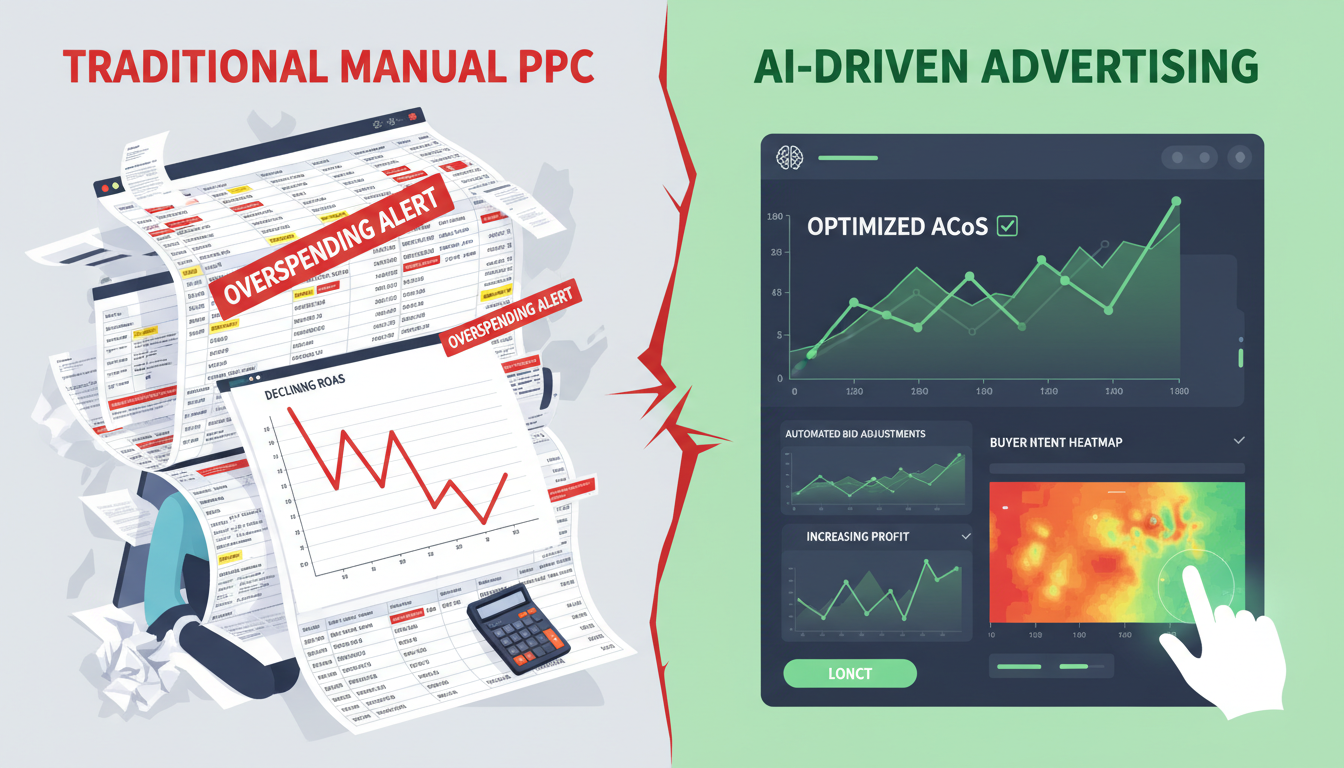
Before diving into the strategies, it's worth understanding the structural problem that AI advertising solves. Manual Amazon PPC management is not simply slow — it's architecturally broken for the pace at which Amazon's auction environment moves.
Consider what a human campaign manager would need to do manually to keep a 500-keyword campaign performing at peak efficiency:
- Review bid performance across every keyword multiple times per day as auction prices shift
- Identify and suppress non-converting search terms before they drain the daily budget
- Reallocate budget toward high-intent, high-converting segments in real time
- Adjust bids dynamically for time-of-day, competitor activity, and seasonal demand curves
- Generate creative variants, analyze ASIN-level profitability, and surface actionable signals simultaneously
No human team — regardless of how talented — can execute all of this continuously. AI advertising platforms can, and do, 24 hours a day.
The result? Brands managing campaigns manually consistently leave significant profit on the table through over-bidding during low-conversion windows, under-bidding during peak-intent moments, and funding irrelevant keyword traffic that drives up ACoS without contributing to revenue.
The following five strategies represent the breakthrough shift from reactive, manual management to proactive, AI-driven advertising dominance.
Strategy 1: Deploy 24/7 AI Bid Optimization to Stop Overspending Instantly
The single most powerful lever in Amazon PPC management is bid optimization — and it's also the one task that's utterly impossible to do well manually at scale. Amazon's ad auction is a dynamic, millisecond-level pricing environment. Bids that are profitable at 9 AM on a Tuesday may be wasteful at 3 PM on a Saturday.
How AI Bidding Engines Actually Work
AI bid optimization tools ingest continuous streams of data — click-through rates, conversion rates, competitor bid pressure, time-of-day signals, and historical ASIN performance — and adjust bids at the keyword level across your entire campaign portfolio in real time.
Unlike rule-based automation (which follows static if/then logic), modern AI advertising strategies use machine learning models that improve their predictions the longer they run. Every impression, click, and conversion becomes a training signal that sharpens the model's accuracy.
The Autopilot Advantage
AdAstraa's Autopilot module runs continuous bid adjustments across 9 marketplaces without any human intervention required. Brands on the Growth plan have seen an average ROAS lift of +41.8% — a result that's structurally impossible with manual bid management alone.
The practical impact is straightforward: your budget is always working at peak efficiency, not just during the hours your team is at a desk.
"Before AI bid optimization, we were manually reviewing bids every two days and still missing windows where our CPCs were spiking by 40% with zero conversion lift. Switching to 24/7 AI management essentially gave us a full-time PPC analyst who never sleeps."
— D2C Supplement Brand, running on AdAstraa Autopilot
Action step: Audit your last 30-day search term report and identify keywords with a CPC spike greater than 20% week-over-week and a conversion rate below your category benchmark. These are the exact patterns AI bidding engines eliminate effortlessly and instantly.
Strategy 2: Use Buyer Intent Intelligence to Target Shoppers Who Are Actually Ready to Buy
Not all traffic is equal. The biggest hidden cost in Amazon advertising isn't high CPCs — it's spending money on shoppers who are still in the discovery phase rather than the purchase phase. This is where buyer intent intelligence becomes a game-changing competitive advantage.
Understanding the Intent Signal Stack
Buyer intent data layers multiple behavioral signals to predict how likely a specific shopper is to convert on a given search query. These signals include:
- Search query specificity — long-tail, brand-specific, or use-case queries signal higher purchase intent than broad, generic terms
- Shopping behavior patterns — repeat category visitors, compare-and-buy patterns, and add-to-cart signals
- Time-contextual signals — seasonal demand shifts, deal event proximity, and category-level traffic anomalies
- Competitor positioning gaps — moments when a competing ASIN loses the Buy Box, triggering a high-intent bidding opportunity
How Shopper OS Puts This Into Practice
AdAstraa's Shopper OS module processes these multi-dimensional intent signals in real time and surfaces the highest-probability buyer moments for each ASIN. Instead of bidding uniformly across a keyword list, your campaigns automatically concentrate spend on the queries and moments most likely to drive conversion.
This approach directly addresses a core insight from Amazon advertising data: across most product categories, the top 20% of search terms drive 80% of conversions. Shopper OS buyer intent intelligence ensures your budget is perpetually weighted toward that productive 20% — not diluted across the remaining 80% that rarely converts.
For FMCG brands and high-SKU D2C sellers, this is particularly essential. When you're managing hundreds of ASINs simultaneously, manual intent analysis is impossible. AI makes it effortless.
Strategy 3: Automate Negative Keyword Management to Eliminate Guaranteed Waste
If you've ever manually reviewed a Search Term Report line by line, you already know the frustration: hundreds of irrelevant queries eating through your budget while your team plays catch-up weeks after the damage is done. AI-driven negative keyword automation is the most underrated, highest-ROI action available to Amazon advertisers in 2025.
The Hidden Cost of Delayed Negative Keyword Updates
Here's the brutal math: if a campaign runs for 14 days before you review the Search Term Report, you've funded two full weeks of irrelevant traffic. At a modest $200/day budget, that's potentially $2,800 spent on queries that could never have converted — before a single negative keyword was added.
According to data from Amazon PPC practitioners, negative keywords alone can reduce wasted ad spend by 15–30% when managed proactively and continuously. The challenge is that manual review is inherently retrospective and periodic — the exact opposite of what effective PPC automation demands.
How AI Handles Negative Keywords Continuously
AI-powered Amazon PPC management tools monitor search term performance in real time and apply negative keyword rules automatically based on configurable performance thresholds — for example, automatically suppressing any search term that generates more than 5 clicks with zero conversions.
This creates a self-cleaning campaign ecosystem where irrelevant traffic is eliminated before it accumulates into significant budget waste. Over time, this continuous pruning compounds — your campaigns become increasingly precise, your average CPC drops, and your ACoS converges toward your target margin.
The step-by-step logic for setting up AI-driven negative keyword automation:
- Define your suppression thresholds — typically 5–8 clicks with 0 conversions, or an ACoS greater than 3× your target
- Configure match type logic — use exact match negatives for high-spend irrelevant terms; phrase match for broader category exclusions
- Segment by campaign type — Sponsored Products, Sponsored Brands, and Sponsored Display each warrant different suppression aggressiveness
- Set up automated alerts for sudden spikes in zero-conversion traffic, signaling a new irrelevant search trend entering your category
- Review and refine monthly — even AI systems benefit from human oversight to catch edge cases and update rules as your catalog evolves
Strategy 4: Generate High-Converting Ad Creatives with AI to Boost CTR at Scale
Bid optimization and keyword management determine when your ads show. But ad creative determines whether shoppers click. In a competitive Amazon search results page, creative quality is the difference between a 0.2% CTR and a 0.7% CTR — a gap that translates directly into revenue at scale.
The challenge: producing high-quality, A/B-testable ad creative at the volume Amazon advertising demands is prohibitively time-consuming and expensive when done manually. AI creative generation solves this with breakthrough speed and precision.
What AI-Powered Ad Creative Generation Delivers
Modern AI creative platforms can generate, test, and iterate on ad visuals, headlines, and copy variations in hours — not weeks. This is especially powerful for Amazon Sponsored Brand video ads and display creatives, where creative fatigue is a real performance killer.
AdAstraa's AdCreative+ module generates AI-powered ad creatives optimized specifically for Amazon's advertising placements — analyzing top-performing competitor creatives, category visual trends, and historical click data to produce assets that are engineered to convert, not just to look good.
A Proven Creative Testing Framework
To get the most from AI creative generation, structure your testing systematically:
| Creative Variable | Test Hypothesis | Typical CTR Impact |
|---|---|---|
| Headline framing | Benefit-led vs. feature-led copy | +15–30% lift |
| Hero image style | Lifestyle vs. product-only imagery | +10–25% lift |
| Social proof element | Star rating badge vs. no badge | +8–18% lift |
| CTA phrasing | "Shop Now" vs. "See Deal" | +5–12% lift |
With AI creative generation, running all four of these tests simultaneously across multiple ASINs is a matter of minutes — not the weeks of design, copy, and QA work traditional production requires. The compounding impact on CTR and conversion rates is genuinely game-changing for brands competing in saturated categories.
See AI creatives built for Amazon conversion
AdCreative+ generates high-converting ad assets in minutes. Explore what's possible for your brand.
Explore AdCreative+ Free →Strategy 5: Track True Profit per ASIN to Make Smarter Budget Allocation Decisions
This is the strategy most Amazon brands get catastrophically wrong — and it's the one that separates truly profitable advertisers from those chasing vanity metrics. ACoS and ROAS alone are incomplete profit signals. A campaign can show a healthy 18% ACoS while the underlying ASIN is operating at a net loss once you account for FBA fees, returns, COGS, and storage costs.
Why ACoS Alone Is a Dangerous Metric
Here's a real-world scenario that plays out across thousands of Amazon accounts: a brand identifies its top-performing campaign by ACoS — a Sponsored Products campaign at 16% ACoS, well below category average. They double the budget. But when profitability is mapped at the ASIN level, the product in question has a 45% return rate and high FBA fees, making the actual net margin deeply negative.
Without True Profit per ASIN visibility, advertising optimization is built on a fundamentally flawed foundation. You can optimize toward the wrong outcome with perfect algorithmic precision.
ASIN-Level Profit Intelligence in Practice
AI-powered Amazon advertising management platforms now integrate ad spend data with COGS, FBA fee structures, return rates, and storage costs to calculate a True Profit per ASIN figure in real time. This changes budget allocation from a guessing game into a data-driven, mathematically sound decision.
The practical framework for True Profit-led advertising strategy:
- Tier your ASIN portfolio by True Profit margin — Tier 1 (high margin, scale aggressively), Tier 2 (moderate margin, optimize efficiency), Tier 3 (low/negative margin, defensive or pause)
- Set ASIN-specific ACoS targets derived from actual margin, not category averages — a 45% margin product can sustain 30% ACoS; a 15% margin product cannot
- Integrate returns data into your performance model — high-return ASINs require significantly lower target ACoS to remain profitable
- Review quarterly at minimum — True Profit margins shift as Amazon adjusts fees, COGS fluctuates, and competitive pricing moves
AdAstraa's platform surfaces True Profit per ASIN as a core dashboard metric, giving brands and agency teams an always-current view of which ASINs genuinely deserve more ad investment — and which are silently draining profitability behind a misleadingly acceptable ACoS number.
Real-World Results: How an FMCG Brand Transformed Its Amazon Advertising in 90 Days
A fast-moving consumer goods brand selling across personal care and home essentials categories was managing over 800 active keywords manually across 120 ASINs. Their in-house team of two PPC managers was spending 60+ hours per week on campaign maintenance — and still struggling with a blended ACoS of 34%, well above their target margin of 22%.
After implementing an AI-powered advertising platform, the following outcomes emerged within 90 days:
- ACoS dropped from 34% to 21% — achieved through continuous bid optimization and automated negative keyword management
- ROAS improved by 38% — driven by buyer intent intelligence concentrating budget on high-conversion search windows
- PPC management time reduced by 74% — the team went from 60+ hours to under 16 hours weekly, redirecting effort toward growth strategy
- 5 previously "profitable" ASINs identified as net-loss products — discovered through True Profit per ASIN analysis, immediately paused, saving an estimated $18,000/month in wasteful spend
The most significant insight? The brand had been funding those 5 loss-making ASINs for over 8 months — not because the data wasn't there, but because no one had the bandwidth or tooling to surface it. AI advertising doesn't just optimize — it reveals what manual management structurally cannot see.
How to Choose the Right AI Advertising Platform for Amazon Brands
The market for AI advertising tools has exploded — and not all platforms deliver equivalent value. When evaluating an AI advertising platform for Amazon, there are several must-know criteria that separate genuinely intelligent systems from marketing automation tools with an AI label.
Essential Platform Evaluation Criteria
- Real-time bid optimization — not hourly or daily batch updates, but genuine real-time or near-real-time adjustment capability
- Intent signal integration — does the platform leverage behavioral and contextual data beyond basic keyword performance?
- Creative generation capability — can the platform produce Amazon-optimized ad creatives natively, or does it require a separate workflow?
- True profitability reporting — does it surface ASIN-level profit metrics inclusive of all cost components?
- Multi-marketplace support — if you sell internationally, the platform must handle bid optimization across regional Amazon marketplaces simultaneously
- Transparent AI logic — you should be able to understand why the system made a bid decision, not just accept it as a black box
AdAstraa is purpose-built against all six of these criteria — combining Autopilot, Shopper OS, AdCreative+, and EcomGPT into a single, unified all-in-one Amazon advertising platform that addresses every layer of the advertising optimization stack.
For brands evaluating options, the AdAstraa pricing page offers a transparent breakdown of plan tiers — including a free trial to validate performance against your own account data before committing.
Additional Resources
The following authoritative sources provide deeper context for the strategies covered in this guide:
- Amazon Advertising — Official Sponsored Products Guide — Amazon's official documentation on Sponsored Products campaign setup, targeting types, and best practices for new and experienced advertisers.
- FTC Guide to Endorsements and Testimonials in Advertising — Essential compliance reading for brands incorporating user reviews and influencer content into their Amazon advertising strategy.
- Harvard Business Review — How to Design an AI Marketing Strategy — A rigorous framework from HBR on aligning AI marketing tools with business objectives and team structure.
- McKinsey — The Economic Potential of Generative AI — McKinsey's landmark research on how generative AI creates measurable economic value in marketing and sales functions.
- eMarketer — Amazon Advertising Insights — Up-to-date market research and benchmarks on Amazon advertising spend, performance trends, and competitive landscape analysis.
The Brands That Win on Amazon in 2025 Will Be AI-First
The five strategies outlined in this guide — 24/7 AI bid optimization, buyer intent intelligence, automated negative keyword management, AI creative generation, and True Profit per ASIN tracking — are not theoretical future-state aspirations. They are proven, operational capabilities that Amazon-first brands are deploying right now to compound competitive advantage.
The data tells a clear story: the AI-enabled e-commerce market has crossed $8.65 billion in 2025, with 92% of marketers already reporting the use of AI tools in their operations. The question is no longer whether AI advertising belongs in your Amazon strategy — it's whether you implement it before your competitors do.
Manual PPC management isn't just inefficient — it's becoming structurally uncompetitive. Every hour your team spends manually reviewing bid spreadsheets is an hour a competitor's AI is making 10,000 optimized bid adjustments across their catalog.
The path forward is clear: automate the tactical, so your team can own the strategic. Let AI handle the 24/7 mechanics of bid management, negative keyword suppression, and creative testing — while your team focuses on brand building, product development, and long-term growth initiatives that genuinely require human judgment.
AdAstraa is built precisely for this transition — an intelligent, purpose-built AI advertising operating system for Amazon-first brands that want to stop wasting budget and start compounding returns.
Your next-best Amazon advertising decision
Stop funding non-converting keywords. Start compounding ROAS with AI.
Join 1,500+ brands already running on AdAstraa Autopilot. No contracts, no guesswork.
Start Your Free Trial — No Credit Card Required →