


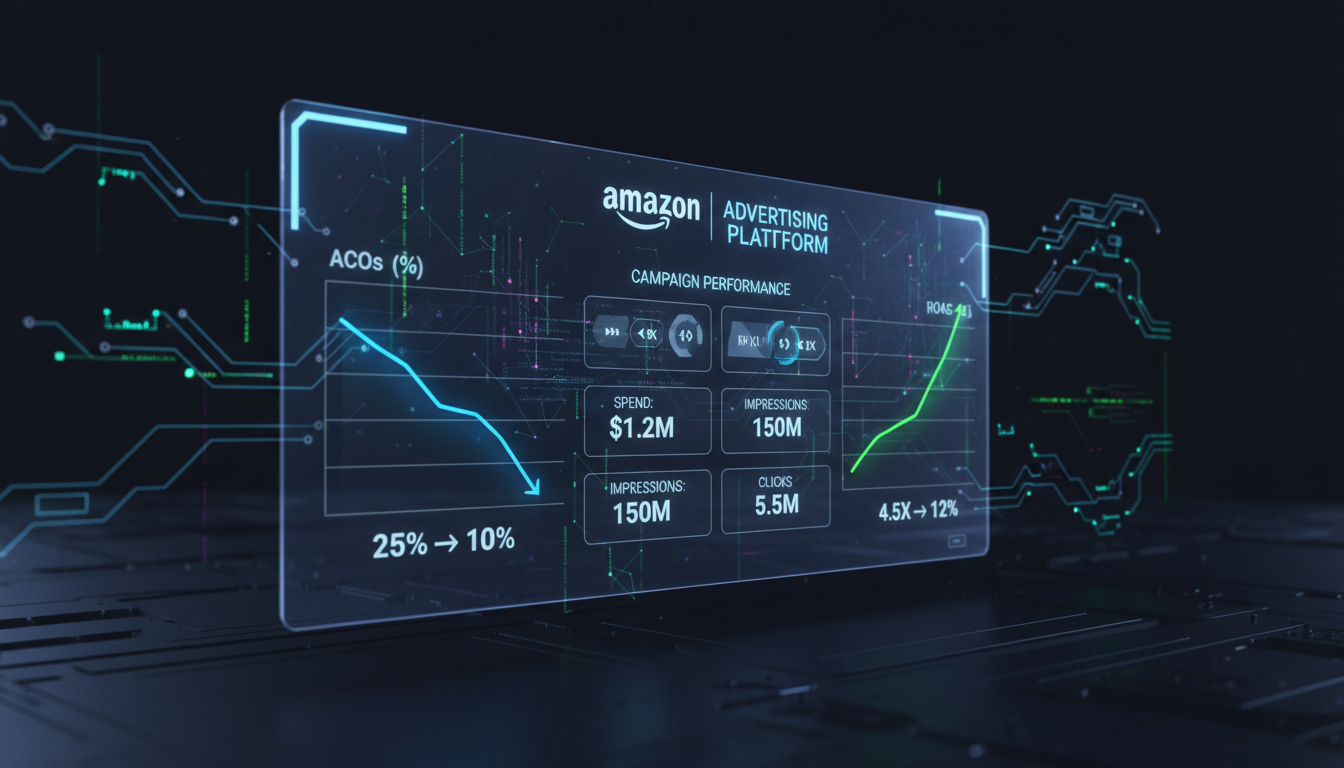
⚠️ Here's a number that should stop you cold:
Amazon sellers collectively wasted billions of dollars on non-converting ad clicks in 2024 — and most didn't even know it was happening. With Amazon advertising revenue hitting $47.4 billion in 2024 alone (a 24% year-over-year jump), the competition for every sponsored placement has never been more brutal, or more expensive.
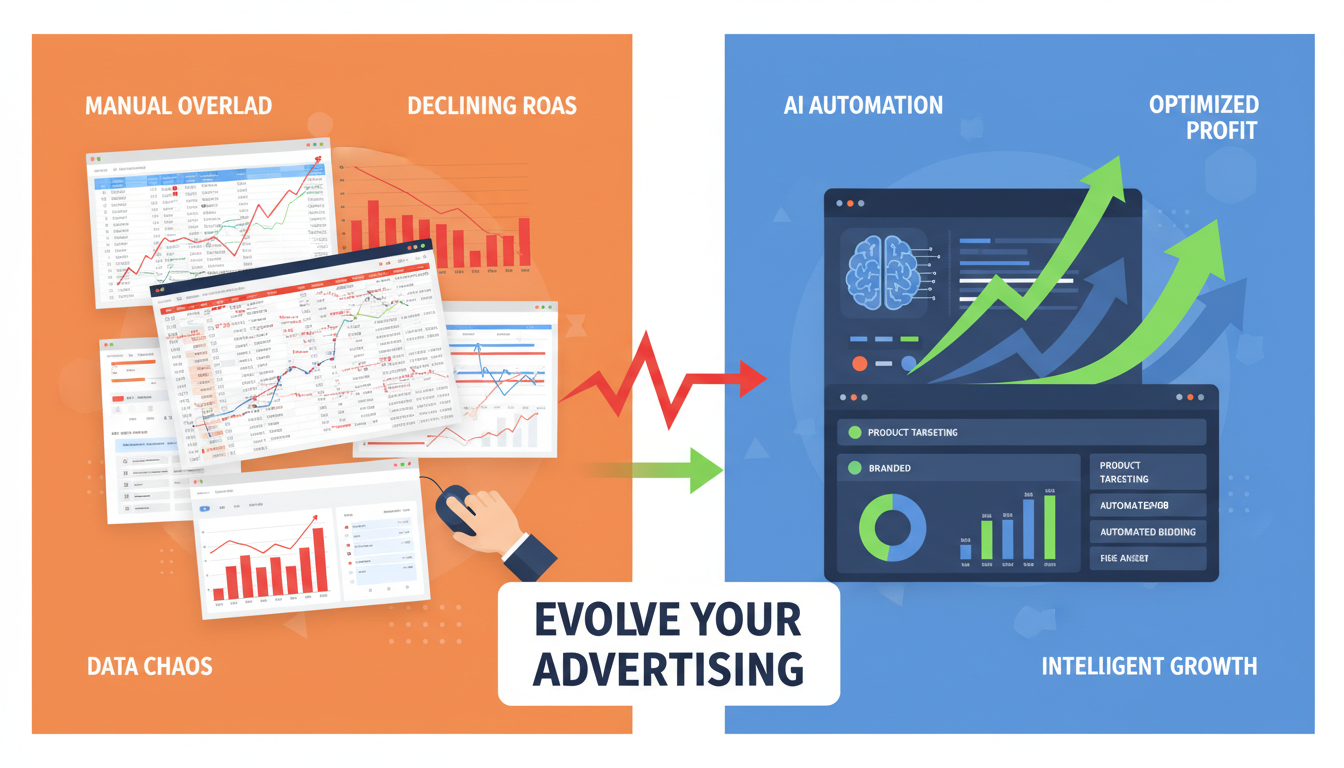
If your ACoS is creeping above 30% and your ROAS feels stuck, it's not because Amazon ads don't work. It's because the playbook you're running is outdated. Manual bid checks twice a week, gut-feel keyword harvesting, and set-it-and-forget-it campaigns simply cannot compete with brands using AI-powered ad optimization that reacts in real time, 24 hours a day.
This guide cuts straight to the strategies that actually move the needle — from smarter keyword architecture to AI advertising automation that runs while you sleep. Whether you manage 5 ASINs or 500, these are the essential techniques that separate profitable Amazon sellers from those bleeding budget every single month.
Stop bleeding ad spend. AdAstraa's AI Autopilot adjusts your bids 24/7 and eliminates non-converting keywords automatically.
🚀 Start Your Free Trial Today →
1. Build an Ironclad Keyword Architecture (Most Sellers Skip This)
The single most impactful structural decision you'll make in Amazon PPC is how you organize your keyword match types. Running broad, phrase, and exact match keywords inside the same ad group is one of the most common — and costly — mistakes sellers make.
The proven approach is a 3-campaign architecture: one auto campaign for discovery, one broad/phrase manual campaign for expansion, and one exact match manual campaign for your top converters. This isolates your highest-performing keywords in an environment where you control bids precisely.
Use Auto Campaigns as a Discovery Engine
Your auto campaign should run at a conservative bid — its only job is to surface new converting search terms. Once a term proves itself (typically after 10–15 clicks with a conversion), graduate it to an exact match manual campaign where you can bid aggressively on it.
Meanwhile, immediately negate that term in your auto campaign to prevent cannibalization. This loop — discover, harvest, negate, scale — is the backbone of every top-performing Amazon advertising campaign.
Negative Keywords: The Secret Weapon You're Underusing
Negative keywords are arguably the most underrated lever in Amazon PPC. Every irrelevant click you prevent is pure profit saved. Review your search term reports weekly — look for any term with 20+ clicks and zero conversions and add it as a negative keyword immediately.
AI-powered Amazon PPC tools like AdAstraa's Autopilot perform this hygiene automatically, flagging and eliminating wasteful terms without you having to comb through thousands of rows of data.
2. Master Dynamic Bid Optimization with AI
Manual bidding is a full-time job — and even then, it's a job a human simply cannot do as well as a machine. The market shifts by the hour. A keyword that converts at a $1.20 CPC on a Tuesday morning may deliver zero returns on a Friday evening.
AI-powered bid optimization continuously analyzes conversion probability, time-of-day patterns, and competitor bid movements to set the precise optimal bid for every keyword, every moment. This is where brands using automation pull decisively ahead of manual managers.
Target ACoS vs. Portfolio ACoS — Know the Difference
Not all campaigns should hit the same ACoS target. Defensive keyword campaigns (protecting your brand terms) can tolerate a higher ACoS because the alternative is a competitor stealing your customer. Product launch campaigns should accept short-term high ACoS to build ranking and review velocity.
Set your ACoS targets at the campaign level, not as a blanket number across your whole account. Platforms with AI PPC management capabilities — like AdAstraa's AI advertising strategies suite — let you configure granular ACoS goals per campaign type, then automate the bidding logic to hit them.
Use Dayparting to Capture Peak Buying Windows
Most product categories have distinct buying peaks — often mid-morning and early evening on weekdays. Increasing your bids by 15–25% during these windows and pulling back during off-peak hours can meaningfully reduce your average CPC without sacrificing impression share where it counts.
Advanced AI advertising platforms automate dayparting adjustments in real time, eliminating the manual work of scheduling bid changes.
3. Structure Your Amazon Advertising Campaigns by Funnel Stage
One of the breakthrough shifts in Amazon advertising strategy is moving from product-based campaign organization to intent-based, funnel-stage organization. When you map campaigns to where a shopper is in their buying journey, your budget allocation becomes dramatically more efficient.
Top of Funnel: Sponsored Brands for Awareness
Sponsored Brands campaigns with video creatives are your most powerful tool for reaching shoppers who are browsing but not yet searching for your specific product. These campaigns accept higher ACoS because they're building brand recognition that fuels future organic and branded searches.
The mistake most sellers make is either skipping Sponsored Brands entirely, or applying the same strict ACoS targets they use on Sponsored Products. Treat these as your awareness investment — measure them on new-to-brand purchase rate, not just immediate ACoS.
Bottom of Funnel: Exact Match Campaigns for Conversion
Your exact match manual campaigns should contain only your highest-converting, most commercially intent-rich keywords. Bid aggressively here. If a shopper is typing the exact phrase your product solves, every click you lose to a competitor is a sale you handed them.
Review your best exact match terms monthly and segment them into a separate "hero keyword" campaign with an uncapped daily budget — your most profitable terms should never lose impressions due to budget exhaustion.
4. Five Step-by-Step Tactics to Reduce ACoS Without Killing Sales Volume
Reducing ACoS isn't simply about slashing bids. Done recklessly, bid cuts crater your impression share, kill sales velocity, and can damage organic ranking. These are the nuanced tactics that bring ACoS down while protecting — or growing — your revenue.
- 1. Harvest and negate weekly, not monthly. Search term hygiene is the single fastest way to cut wasted spend. One extra week of irrelevant clicks adds up to hundreds or thousands of dollars in wasted budget annually.
- 2. Pause keywords below a 0.2% CTR threshold. Poor CTR signals that your ad is appearing for irrelevant searches or that your listing creative isn't compelling enough for that keyword. Either fix the creative or kill the keyword.
- 3. Implement placement bid modifiers strategically. Top-of-search placements typically convert 2–3× better than product page or rest-of-search placements. Add a 30–50% top-of-search bid modifier on your highest-converting exact match campaigns.
- 4. Align ad spend with listing quality. A conversion rate below 8% on a high-traffic keyword usually means your listing — not your bid — is the problem. Improve main images, bullets, and A+ content before pouring more budget into that keyword.
- 5. Use True Profit per ASIN as your north star metric. ACoS is incomplete. A product with a 22% ACoS but thin margins may be less profitable than one with a 30% ACoS and strong margins. AdAstraa's platform surfaces True Profit per ASIN in real time so you optimize for actual profit, not vanity metrics.
5. Leverage Shopper Intent Intelligence to Outbid Competitors Precisely
Most sellers bid on keywords. The smartest sellers bid on buyer intent signals. There's a massive difference between a shopper typing a broad informational query and one who has already compared products, reviewed listings, and is ready to buy.
Buyer intent intelligence platforms analyze behavioral signals — what shoppers view, compare, add to cart, and ultimately purchase — to score the conversion probability of every search query in real time. This means your bids scale up automatically when conversion probability is high and pull back when it's low.
How AdAstraa Shopper OS Transforms Bid Intelligence
AdAstraa's Shopper OS maps buyer intent at a granular level — identifying which keywords, product categories, and competitive ASINs are driving the highest-intent traffic to your listings. Instead of bidding the same amount on "best protein powder" (informational intent) and "vanilla whey protein 5lb buy" (purchase intent), you can calibrate bids to reflect the true commercial value of each query.
The result: dramatically higher conversion rates on your top keywords, lower CPC waste on bottom-funnel queries, and a ROAS that consistently outperforms category benchmarks.
6. Use AI-Powered Ad Creative Optimization to Boost CTR Instantly
Even the most perfectly optimized bid strategy fails if your creative isn't compelling enough to earn the click. With CPCs rising 15% year-over-year across most Amazon categories, getting more from every impression is no longer optional — it's a survival requirement.
AI ad creative tools now make it possible to generate, test, and iterate on Sponsored Brands creatives, video ad thumbnails, and display ad visuals at a pace no human creative team can match. Continuous creative testing — rotating 3–5 headline and image variants simultaneously — consistently improves CTR by 20–40% over static, single-creative campaigns.
AdCreative+ by AdAstraa: Game-Changing Creative at Scale
AdAstraa's AdCreative+ uses generative AI to produce high-converting Amazon ad creatives that reflect real shopper preferences. It analyzes what's working across your category — headline structures, image compositions, value proposition framing — and generates creatives optimized for conversion, not just aesthetics.
For brands managing dozens of ASINs, this is the difference between having a part-time creative team and having a 24/7 creative engine that never misses a split test.
Video Ads as a ROAS Multiplier
Sponsored Brands video ads consistently deliver higher CTR and lower CPC than static banner ads in most categories. Yet fewer than 20% of Amazon sellers actively run video campaigns. If you're not testing Sponsored Brands video, you're leaving a powerful — and relatively uncrowded — channel entirely on the table.
Use 15–30 second product demonstration videos that front-load the key benefit in the first 3 seconds. Shoppers scroll fast. Your value proposition needs to land before the thumb moves.
7. Allocate Budget Strategically — Stop Treating All Campaigns Equally
Budget exhaustion mid-day is one of the most powerful — and invisible — revenue killers in Amazon advertising. When your campaign runs out of daily budget at 11 AM, you lose every potential customer who searches for your product from noon onward. You don't even know the sales you're missing.
The fix is tiered budget allocation based on campaign profitability. Your exact match hero campaigns should always have a budget buffer — never let them exhaust. Auto and broad campaigns, which drive discovery but aren't guaranteed to convert, get tighter daily caps.
Real-Time Budget Reallocation with AI
AI marketing automation tools take budget management further by dynamically reallocating spend across campaigns based on real-time performance. If Campaign A is hitting a 2.0 ACoS this morning and Campaign B is at 6.5 ACoS, the AI shifts available budget to Campaign A — automatically, without a manual intervention ever needed.
This kind of intelligent, real-time budget management is what separates the top 1% of Amazon advertisers from the rest. And it's exactly what AdAstraa's platform was built to deliver at scale.
See how AdAstraa's Autopilot + Shopper OS can cut wasted spend and reclaim your ROAS. Real results, real time — no manual management required.
📊 Explore AdAstraa's Full Platform →8. Unlock Hidden Revenue with Product and Competitor ASIN Targeting
Keyword targeting is just one half of the Amazon advertising equation. ASIN targeting — placing your Sponsored Product ads directly on competitor and complementary product pages — is an underutilized strategy that delivers some of the highest-intent traffic available.
When a shopper is already viewing a competitor's product page, they are deep in the buying funnel. An ad that appears at that exact moment — offering a better price, more reviews, or a clearer value proposition — can intercept the sale with remarkable efficiency.
Defensive Targeting on Your Own ASINs
Run Sponsored Product campaigns targeting your own ASINs on your own product pages. This blocks competitors from buying ads on your listings and prevents shoppers from being poached mid-consideration. The incremental cost is low; the protection is invaluable.
For complementary product targeting, look for items frequently purchased alongside yours. A seller of coffee grinders, for example, should be advertising on coffee bean and French press listings — capturing shoppers at the exact moment they're building their coffee setup.
9. Demand Real-Time Analytics — Vanity Metrics Are Costing You Money
ACoS is the metric most Amazon sellers live and die by. But ACoS is fundamentally incomplete. It tells you the cost of ad-attributed sales, but it tells you nothing about actual profitability once you factor in COGS, FBA fees, returns, and storage costs.
True Profit Per ASIN: The Ultimate Visibility Metric
The most powerful shift you can make in your Amazon advertising management is switching from ACoS-centric reporting to True Profit Per ASIN reporting. This metric accounts for every cost layer — ad spend, unit economics, fulfillment fees — and gives you a ground-truth view of which products are actually making you money.
Some sellers are shocked to discover that their best-selling ASIN (by revenue) is actually their least profitable one. Others find that a mid-tier product with a "high" ACoS is still their most profitable unit after all costs are factored in. This clarity is the foundation of every great AI marketing strategy.
How AI Turns Data into Decisions Instantly
Modern marketing analytics AI doesn't just report what happened — it tells you what to do next. AdAstraa surfaces actionable recommendations in plain language: which ASINs need bid increases, which campaigns are approaching budget exhaustion, which keywords are showing early conversion signals that warrant immediate exact-match expansion.
This transforms your analytics workflow from reactive reporting to proactive profit management.
10. A Real-World Look: How AI Advertising Turned a Struggling Brand Into a Profitable One
Consider the scenario of a mid-size FMCG brand selling in the supplements category on Amazon — a hyper-competitive space where average CPCs frequently exceed $2.50 and category ACoS benchmarks hover around 28–35%.
"We were manually managing 12 campaigns across 40 ASINs. Our ad manager was spending 25+ hours a week just on bid adjustments and search term reports. We were burning budget but couldn't see why."
— Brand Manager, FMCG Supplements Seller
After implementing AI-powered ad automation — with continuous bid optimization, automated negative keyword management, and buyer intent targeting — the brand saw transformative results within 60 days:
| Metric | Before AI Automation | After AI Automation |
|---|---|---|
| Average ACoS | 38% | 21% |
| ROAS | 2.6x | 4.8x |
| Weekly Ad Management Hours | 25+ hours | Under 3 hours |
| Non-Converting Keywords Eliminated | 0 (manual process) | 340+ (automated) |
This is not an outlier result. Studies on AI-driven programmatic advertising consistently show 20–45% ROI improvements over manual management. The mechanisms are straightforward: AI processes more data, reacts faster, never gets fatigued, and optimizes continuously — a combination humans simply cannot replicate at scale.
Bonus: Automate Customer Operations to Protect Your Conversion Rate
Here's a truth most Amazon advertising guides won't tell you: your ad performance is directly tied to your listing's review velocity, Q&A responses, and seller feedback score. A listing with sparse or negative reviews converts at a fraction of the rate of one with 4.5+ stars and fresh, recent reviews.
Every conversion-rate improvement compounds your advertising ROI — the same ad spend generates more sales. AdAstraa's EcomGPT automates customer operations: review requests, Q&A responses, and customer messaging — all powered by AI to run continuously and compliantly within Amazon's Terms of Service.
Brands that improve their listing conversion rate from 10% to 14% effectively cut their ACoS by 28% without changing a single bid. That's the power of treating your listing as part of your advertising strategy, not separate from it.
Additional Resources
Deepen your expertise with these authoritative external resources on Amazon advertising, AI marketing, and PPC optimization:
- 📘 Amazon Ads Official Learning Console — Comprehensive guides and certifications directly from Amazon's advertising team covering all ad types, targeting strategies, and measurement frameworks.
- 📊 AI Applications for Marketing: A Literature Review (ScienceDirect) — Peer-reviewed academic research on AI-powered marketing automation tools and their measurable impact on campaign performance and ROI.
- 🏫 Harvard Business School: Digital Marketing and AI Transformation — Foundational research on how machine learning is reshaping digital advertising strategy and competitive advantage.
- 📈 FTC Endorsement and Advertising Guidelines — Essential compliance reference for all Amazon sellers running advertising and influencer campaigns.
- 🔬 eMarketer: Amazon Advertising Insights — Industry-leading data and forecasts on Amazon ad spend, market share, and emerging trends in ecommerce advertising.
The Amazon Advertising Edge: AI Is No Longer Optional
The brands winning on Amazon in 2025 and beyond are not necessarily the ones with the biggest budgets. They're the ones with the smartest, most adaptive advertising systems. They've stopped treating Amazon PPC as a manual task and started treating it as an always-on, data-driven growth engine.
Every strategy in this guide — from ironclad keyword architecture to dynamic bid optimization to True Profit visibility — is available to you right now. The question is whether you implement them manually, one spreadsheet at a time, or whether you deploy AI to do the heavy lifting at machine speed.
AdAstraa was purpose-built for exactly this challenge. Autopilot handles 24/7 bid optimization. Shopper OS delivers buyer intent intelligence. AdCreative+ generates high-converting creatives at scale. EcomGPT automates your customer operations. Together, they form the only end-to-end Amazon advertising operating system built for growth-focused brands who refuse to leave profit on the table.
Ready to transform your Amazon advertising performance?
Join hundreds of Amazon-first brands that have cut wasted spend, slashed ACoS, and unlocked real profit with AdAstraa's AI-powered advertising OS.
🎯 Get Started with AdAstraa — Free →