
Here is a number that should alarm every Amazon seller: 30–40% of all Amazon ad spend goes to keywords that never generate a single conversion. Not occasionally. Every single day.
If you are managing your Amazon advertising campaigns manually — refreshing dashboards, adjusting bids one keyword at a time, guessing at budgets — you are not just losing money. You are losing to competitors who have already automated what you are still doing by hand.
The brands dominating Amazon search results in 2025 are not necessarily the ones with the biggest budgets. They are the ones running smarter, more structured, AI-assisted advertising campaigns that eliminate waste and compound returns over time.
In this guide, you will find 10 proven, step-by-step Amazon advertising campaign strategies built for D2C sellers, FMCG brands, and agencies who are done tolerating inefficiency. Whether you are launching your first campaign or overhauling a bloated account, these are the essential moves that separate profitable sellers from those permanently stuck in the red.
AdAstraa Autopilot
Stop guessing. Start winning. Let AI manage your bids 24/7.
Activate Your Free Trial →
1. Build a Winning Amazon Campaign Structure From Day One
Most Amazon advertising disasters start with poor campaign architecture. Sellers dump dozens of products into a single broad campaign, set a flat daily budget, and wonder why ACoS climbs every week.
A proven campaign structure separates your advertising goals into three distinct layers: discovery, performance, and defence. Discovery campaigns (auto-targeting) harvest new converting keywords. Performance campaigns (manual exact and phrase match) scale what already works. Defence campaigns protect your brand from competitor conquesting.
Auto vs Manual: Why You Need Both
Auto campaigns are your intelligence layer — they surface buyer intent signals at scale. Sellers using structured hybrid campaign setups report 28% higher click-through rates and 20% less wasted ad spend compared to single-campaign approaches.
The game-changing move is to harvest high-converting search terms from your auto campaigns weekly, then graduate them into exact match manual campaigns where you control the bid. This compound flywheel is what separates breakout brands from stagnating ones. Explore AdAstraa's complete Amazon PPC guide for detailed campaign architecture templates.
Single Keyword Ad Groups (SKAGs) for Precision Bidding
Grouping multiple keywords into one ad group is one of the most common and costly mistakes in Amazon advertising. SKAGs give you granular bid control, cleaner performance data, and faster optimization cycles. When one keyword in a group underperforms, it should not drag down your entire budget — and with SKAGs, it never does.
2. Master Keyword Targeting With Buyer Intent Intelligence
Not all keywords are created equal. High-volume keywords look attractive in research tools but are often the fastest way to drain your budget without results. The essential insight for 2025 is this: buyer intent matters more than search volume.
Intent-driven keywords — those with transactional modifiers like "buy", "best", "deal", or specific product attributes — convert at dramatically higher rates. Brands using AdAstraa's Shopper OS buyer intent intelligence can identify which search terms reflect genuine purchase intent versus casual browsing, eliminating spend on the latter entirely.
The Negative Keyword Strategy That Cuts Waste Instantly
Negative keywords are the single most underutilised tool in Amazon PPC. Every irrelevant search term your ads appear for is a click that costs you money and converts no one. Running a weekly search term report and aggressively building your negative keyword list is not optional — it is the foundation of a profitable campaign.
Top-performing accounts maintain negative keyword lists of hundreds to thousands of terms, built up over months of systematic harvesting. The result: every dollar of ad spend works harder because it is only reaching shoppers who are genuinely ready to buy.
Long-Tail Keywords: The Breakthrough Opportunity Most Sellers Ignore
Long-tail keywords typically have lower competition, lower CPCs, and higher purchase intent. A shopper searching "organic protein powder for women unflavored 2lb" is far closer to purchase than someone searching "protein powder." Structuring dedicated campaigns around long-tail variations is a powerful way to acquire high-intent traffic at breakthrough efficiency.
3. Use Intelligent Bid Management to Stop Overpaying Per Click
Manual bid management is one of the most time-consuming and error-prone aspects of Amazon advertising. A human can check bids once or twice a day. Amazon's auction, however, fluctuates every hour — and on peak shopping days, every minute.
Brands that switch from manual to AI-driven bid automation consistently see ACoS reductions of 20–35% within the first quarter. The reason is simple: automated systems can process hundreds of bid adjustments per day, responding to conversion signals that no human could track at scale.
Dayparting and Placement Bid Adjustments
Not all hours are equal on Amazon. Conversion rates vary significantly by time of day, day of the week, and device type. Brands using dayparting strategies — increasing bids during high-conversion windows and pulling back during low-conversion periods — reclaim meaningful budget that would otherwise be wasted.
Placement bid adjustments for top-of-search, rest-of-search, and product pages add another layer of precision. If top-of-search placements convert at 3× the rate of product page placements for your specific ASINs, your bidding should reflect that reality. AdAstraa's AI advertising platform adjusts all of these variables continuously, without lifting a finger.
4. Set Profitable ACoS and ROAS Targets Based on True Margins
Here is a trap that catches countless Amazon sellers: optimising for a generic ACoS target without factoring in their actual product margins. An ACoS of 25% looks healthy — until you realise your product margin is only 22%.
The right ACoS target is a function of your gross margin, your product lifecycle stage, and your growth objectives. A brand new product may tolerate a higher ACoS to drive ranking and reviews. A mature, top-ranked ASIN should run at a much tighter efficiency threshold.
True Profit Per ASIN: The Metric That Changes Everything
ROAS and ACoS are surface metrics. True Profit per ASIN — which accounts for ad spend, COGS, FBA fees, returns, and storage costs — is the number that actually tells you whether a campaign is building or destroying value.
Most sellers do not have real-time access to True Profit per ASIN, which means they are optimising based on incomplete information. AdAstraa surfaces this metric at the ASIN level in real time, giving brand managers the clarity to make genuinely profitable campaign decisions.
5. Allocate Ad Budgets Strategically Across Your ASIN Portfolio
Spreading budget equally across your entire product catalogue is a guaranteed way to underperform. Your portfolio almost certainly has a small number of ASINs that generate the vast majority of your revenue and profit. Those products deserve disproportionate advertising investment.
Apply the 80/20 principle ruthlessly: identify your top-performing ASINs by True Profit contribution and concentrate at least 70–80% of your advertising budget on scaling them. Allocate a smaller discovery budget to emerging products and pause spend on ASINs with consistently negative ad-attributed profit.
Seasonal Budget Adjustments You Cannot Afford to Miss
Amazon's biggest sales events — Prime Day, Black Friday, Cyber Monday, and category-specific peaks — require proactive budget scaling, not reactive responses. Brands that pre-load budgets for known high-conversion windows capture sales that budget-capped competitors miss entirely.
Equally important: do not burn budget at full throttle during known low-conversion periods. Strategic drawdown during slow weeks protects cash flow and concentrates firepower for when shoppers are most ready to buy.
Real Results, Real Brands
+41.8% avg ROAS lift. ₹218Cr ad spend optimized. 1,523 brands on Autopilot.
Join the brands already running on AI-powered Amazon PPC automation.
See AdAstraa in Action →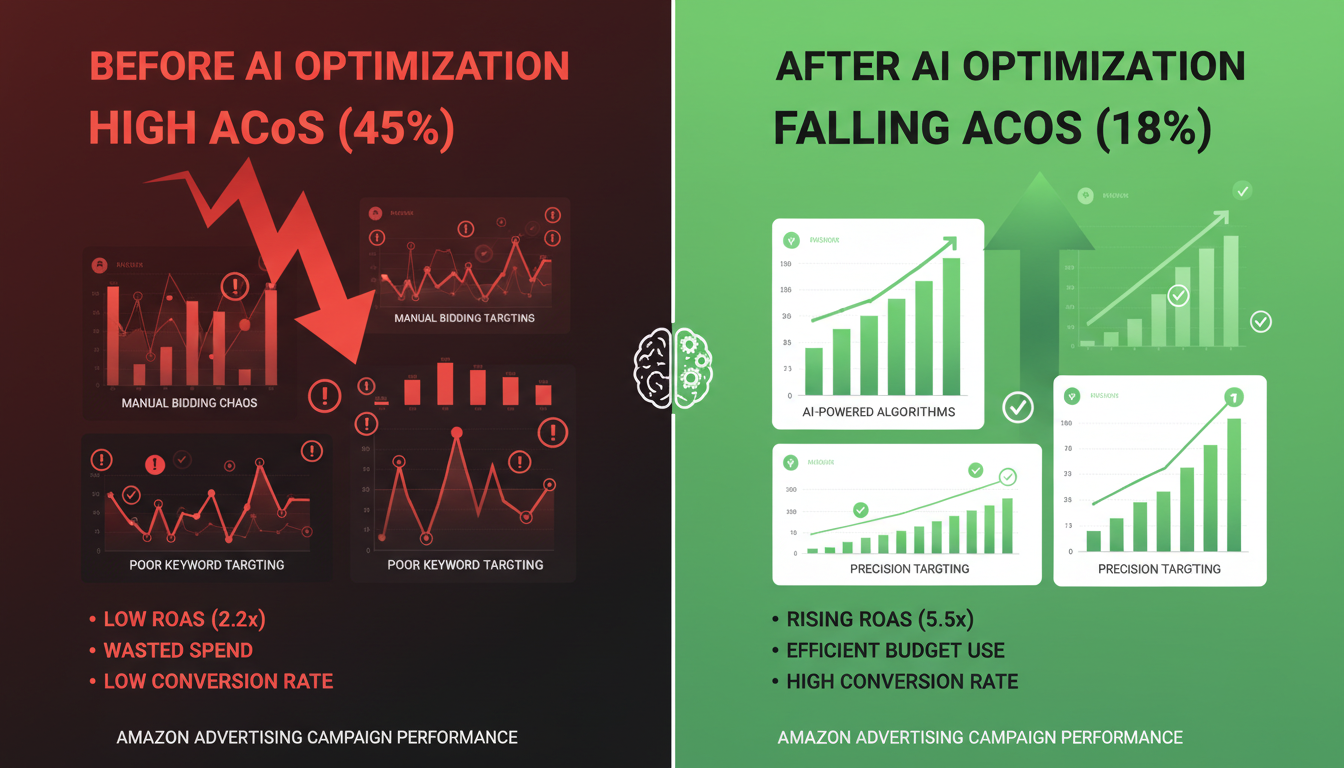
6. Harness AI-Powered Ad Creatives to Boost Click-Through Rates
Your bid strategy can be perfect, but if your creative does not stop the scroll, you are invisible. In an Amazon search results page crowded with competitors, your product image, headline, and copy are your first — and often only — impression.
AI-generated ad creatives are proving to be a game-changing advantage for brands willing to test at scale. Amazon's own research has shown full-funnel campaigns using AI-optimised creatives achieved a 144% lift in conversion rate. Brands using AI ad generators can produce and test dozens of creative variants in hours rather than weeks — a breakthrough in speed-to-insight that manual creative processes simply cannot match.
Sponsored Brands Video: The Must-Use Format in 2025
Sponsored Brands Video ads auto-play in search results and command dramatically higher engagement than static creatives. They are underutilised by the majority of sellers, which means the brands adopting them now are capturing category attention at lower effective CPCs while the opportunity remains open.
AdAstraa's AdCreative+ tool generates brand-consistent video and image ad creatives powered by AI, reducing production time from days to minutes while maintaining the visual quality that converts shoppers into buyers.
A/B Test Everything: Images, Headlines, and CTAs
Creative performance varies dramatically by audience segment, product category, and time of year. A systematic A/B testing programme — rotating creative variables one at a time — builds a compounding knowledge base that makes every future campaign more effective than the last. Never run a single creative in isolation when you can run two and learn from both.
7. Deploy Product and Competitor Targeting for Market Share Gains
Keyword targeting is not the only path to Amazon visibility. Product targeting allows you to place your ads directly on competitor product pages and in category browse pages — intercepting shoppers who are already in a purchase mindset but have not yet committed to a specific brand.
This strategy is especially powerful when targeting direct competitors with higher prices or weaker reviews. A shopper reading a competitor's product page who sees your well-priced, better-reviewed alternative is already halfway to a conversion. Defensive targeting — placing ads on your own ASINs — prevents competitors from poaching customers who are already viewing your listings.
ASIN-Level Targeting: Surgical Precision Over Spray-and-Pray
Rather than targeting entire competitor categories (which can be expensive and imprecise), identify specific high-traffic ASINs in your category and target them individually. This surgical approach yields higher relevance, better conversion rates, and cleaner performance data to optimise against.
8. Invest in Real-Time Reporting and Campaign Analytics
Most Amazon advertising decisions are made on data that is 48–72 hours old. In a live auction environment where competitor activity and shopper demand shift constantly, stale data leads to stale decisions. Real-time campaign analytics are not a luxury — they are a competitive requirement.
The essential metrics to monitor in real time are: ACoS by campaign and keyword, ROAS by ASIN, impression share trends, search term conversion rate, and True Profit per ASIN. When these metrics are visible at a glance — rather than buried in exported spreadsheets — brand managers can act on signals before they become costly problems.
Understanding the Halo Effect: PPC's Impact on Organic Rankings
Unlike Google Ads, Amazon PPC directly influences organic rankings. When a keyword drives both ad-attributed and organic sales velocity, Amazon's algorithm rewards that keyword with higher organic placement — amplifying the return on your ad spend beyond what ACoS alone captures.
Brands that measure and optimise for this halo effect — tracking organic rank changes alongside PPC performance — extract significantly more value from every campaign dollar. This is a powerful, often overlooked dimension of Amazon advertising strategy. See how AdAstraa's AI advertising strategies account for the full organic-plus-paid performance picture.
9. Automate Repetitive Campaign Management Tasks to Reclaim Hours
The average Amazon advertising manager spends 15–20 hours per week on tasks that AI can execute in minutes: bid adjustments, negative keyword additions, budget reallocations, search term harvesting, and performance reporting. Every hour spent on these manual tasks is an hour not spent on strategy, creative, or brand building.
Campaign management automation is not about removing human judgment from advertising. It is about removing human bottlenecks from execution. Your team's insight and strategic intuition are irreplaceable. The mechanical execution of that strategy — adjusting bids at 3am to capture a spike in conversion rate — should never require a human to be awake.
Real-World Example: FMCG Brand Reclaims 18 Hours Per Week
An FMCG brand managing 47 active ASINs across three Amazon marketplaces was spending 20+ hours per week on manual bid management and reporting. After onboarding AdAstraa's Autopilot, their team reclaimed 18 hours per week while ACoS dropped 28% in the first 60 days — purely from 24/7 algorithmic bid optimisation responding to signals the team could never have caught manually.
Automation at this level is not the future of Amazon advertising — it is the present. Brands not running some form of intelligent campaign automation are already operating at a structural disadvantage relative to competitors who are.
10. Scale Your Amazon Advertising Campaigns Without Sacrificing Profitability
Scaling Amazon advertising is the point where most brands make their most expensive mistakes. They see a campaign performing well and immediately 2× the budget — only to watch ACoS spike and ROAS collapse. Aggressive budget increases outpace the algorithm's ability to spend it efficiently, pushing bids into non-converting placements.
The proven approach to profitable scaling is gradual, data-driven, and structured. Increase budgets by no more than 20–30% at a time and allow 7–10 days of data to stabilise before making additional changes. Monitor impression share alongside ACoS — a rising ACoS with a rising impression share indicates you are moving into less competitive (but less converting) territory.
Expanding to New Amazon Marketplaces: The Next Scaling Frontier
For brands that have saturated their home marketplace, international expansion offers the single largest incremental revenue opportunity available. Amazon operates 9 major global marketplaces — each with its own search behaviour, competitive dynamics, and seasonal patterns.
The brands scaling internationally fastest are those using AI-powered campaign management platforms that can execute consistent strategy across all marketplaces simultaneously, without requiring a dedicated team for each geography. AdAstraa's Autopilot currently operates across 9 marketplaces with 24/7 live bid adjustments — giving growing brands the infrastructure to scale globally without scaling headcount.
Additional Resources
Deepen your knowledge with these authoritative external references on Amazon advertising, PPC strategy, and AI in marketing:
- 📘 Amazon Ads Official Strategy Library — Amazon's own best-practice guides covering Sponsored Products, Sponsored Brands, DSP, and creative optimisation.
- 📊 Statista: AI Usage Among Amazon Sellers (2024) — Data-backed research on how Amazon brands are adopting AI across advertising, listing, and operations tasks.
- 🎓 Amazon Ads Learning Console — Free certification courses covering Amazon PPC fundamentals, campaign management, and advanced advertising strategy.
- 📰 Marketing Dive: How Amazon AI Is Reshaping Advertising — Industry analysis on Amazon's AI-powered advertising ecosystem and what it means for brand marketers.
- 🔬 Amazon Ads: How Agentic AI Powers Creative Performance — Expert perspectives from Amazon's partner network on using AI to improve ad creative results at scale.
The Bottom Line on Amazon Advertising Campaign Management
Amazon advertising in 2025 rewards the structured, the strategic, and the automated. The sellers still running a handful of broad-match auto campaigns with unchanged bids from six months ago are not just leaving money on the table — they are actively funding competitors who have figured this out.
The 10 proven strategies in this guide — from campaign architecture and intelligent bid management to AI-powered creatives, real-time analytics, and profitable scaling — represent the complete playbook of what top-performing Amazon brands are executing right now.
The breakthrough insight tying all of these strategies together is simple: the brands winning on Amazon are not the ones working harder — they are the ones automating smarter. Every manual task you eliminate through intelligent automation is time, energy, and budget redirected toward the decisions that actually grow your brand.
AdAstraa is purpose-built to execute all of it — Autopilot for 24/7 bid optimisation, Shopper OS for buyer intent intelligence, AdCreative+ for AI-generated creatives, and EcomGPT for automated customer operations. One platform. Every lever you need to scale profitably on Amazon.
Ready to Stop Wasting Ad Spend?
Put all 10 strategies to work — automatically.
Join 1,500+ brands already scaling profitably with AdAstraa's AI-powered Amazon advertising platform.
Start Your Free Trial Today →