



Here is a stat that should make every Amazon seller stop scrolling: Amazon's advertising revenue surpassed $68.6 billion in 2025 — a 22% year-over-year increase. That is not just Amazon's win. It is a signal that competition for every sponsored placement is intensifying at a pace most brands are completely unprepared for.
Meanwhile, average cost-per-click is climbing 10–15% year-over-year across most product categories. If your campaigns are still running on gut instinct, weekly manual bid checks, and recycled creatives, you are not just underperforming — you are actively funding your competitors' growth.
This guide cuts through the noise. Below are 10 proven, battle-tested Amazon advertising strategies that serious brands use to slash ACoS, maximize ROAS, and reclaim hours lost to manual campaign management — many of them powered by the kind of intelligent automation that separates thriving brands from those quietly burning budget.
🚀 Stop leaving profit on the table with manual PPC management.
AdAstraa's AI advertising platform puts 24/7 bid optimization, buyer intent intelligence, and automated creatives to work for your brand — starting today.
Start Your Free Trial on AdAstraa →
1. Master Negative Keywords Before Anything Else
Most brands obsess over which keywords to add. The essential first move is deciding which ones to block. Irrelevant search terms quietly consume 20–40% of ad budgets in un-optimized accounts — spend that produces zero conversions.
Negative keyword management is the single most immediate lever you can pull. Advertisers who consistently manage negative keywords report a 15–25% reduction in wasted ad spend within the first 60 days, without reducing visibility on profitable terms.
Negative Exact vs. Negative Phrase: Know the Difference
- Negative Exact: Blocks only that precise search string. Use it to cut specific high-spend, zero-conversion terms.
- Negative Phrase: Blocks any search containing that phrase. Use it to eliminate entire categories of irrelevant traffic (e.g., "free", "DIY", "used").
- Campaign-level vs. Ad Group-level: Apply campaign-level negatives for brand-wide exclusions; use ad group-level to protect specific product segments.
Tools like AdAstraa's AI advertising engine automatically flag non-converting search terms in real time, eliminating the manual Search Term Report grind that eats hours every week.
2. Build a Campaign Structure That Actually Scales
A flat, disorganized campaign structure is one of the most underrated profit killers in Amazon advertising. When high-intent keywords and broad discovery terms compete in the same ad group, you lose granular control over bidding, attribution, and budget allocation.
The Three-Tier Campaign Architecture
- Top-of-funnel (Auto): Discovery campaigns that feed keyword and ASIN data into your strategy.
- Middle-of-funnel (Broad/Phrase): Harvest converting search terms; build negative lists from low performers.
- Bottom-of-funnel (Exact): Your proven converters. Protect these with aggressive bids and dedicated budgets.
This architecture unlocks precise budget control, makes AI-powered bid optimization more effective, and gives you clear visibility into where every dollar is working. For a deep-dive on building this foundation, explore the AdAstraa Amazon PPC guide.
3. Replace Manual Bidding with AI-Powered Automation
Manual bid adjustments are yesterday's strategy. By the time you log in to raise a bid on a high-converting keyword, the auction has already happened — hundreds of times. Amazon's marketplace moves in milliseconds. Human oversight cycles in days.
AI bid optimization continuously evaluates conversion probability, competitive pressure, day-parting signals, and your target ACoS or ROAS goals to make micro-adjustments at a speed and scale no team can replicate. The result? Q4 2024 data from accounts under AI management showed an average ROAS of 3.89x — delivered at the platform's lowest ACoS period of the year (25.7%).
What 24/7 Autopilot Actually Means for Your Budget
AdAstraa's Autopilot module operates across every hour of the selling day — including the peak windows between midnight and 6 AM when competitors' manual strategies go dark. Bid increases during high-conversion windows, automated cuts during low-intent hours, and real-time response to competitor bidding shifts are all handled without a single manual input.
This is not incremental improvement. For brands managing 50+ ASINs, this is the difference between a lean, profitable advertising operation and an unmanageable spreadsheet that grows stale by the hour.
4. Harness Buyer Intent Intelligence to Target Smarter
Not every click is created equal. A shopper searching "best vitamin C serum" is browsing. A shopper searching "vitamin C serum 20% L-ascorbic acid 1 fl oz" is buying. The ability to distinguish high-purchase-intent signals from research queries is a game-changing competitive advantage.
Modern buyer intent platforms like AdAstraa's Shopper OS aggregate behavioral signals — search patterns, competitor page dwell time, add-to-cart actions, and repeat purchase cycles — to surface the exact moments your ideal customer is closest to converting. When your bidding strategy is informed by this data, you stop paying for curiosity and start paying for intent.
Three Buyer Intent Signals Worth Acting On Immediately
- High-specificity long-tail keywords (4+ words, product-attribute focused)
- Competitor ASIN targeting against products with declining review ratings
- Category pages where your product has a conversion rate advantage
5. Track True Profit Per ASIN — Not Just ACoS
ACoS is a useful metric. But it is dangerously incomplete. An ASIN with a 20% ACoS that carries high fulfillment costs, frequent returns, and thin margins could actually be losing money. Meanwhile, an ASIN at 35% ACoS with high AOV and strong LTV could be your most profitable product.
True Profit per ASIN layers in CoGS, FBA fees, return rates, storage costs, and ad spend to give you an honest picture of which products deserve more ad budget and which are quietly destroying margin.
"Brands that optimize for True Profit per ASIN rather than ACoS alone consistently outperform category benchmarks within two quarters — because they're investing in winners, not averages."
This level of granularity is only possible with an AI-powered marketing strategy platform that can pull, unify, and interpret multi-source data in real time — not a weekly spreadsheet pull.
💡 Ready to see True Profit per ASIN across your entire catalog?
AdAstraa's unified dashboard gives you real-time visibility into every margin driver — all in one place, zero manual effort required.
See AdAstraa in Action — Try It Free →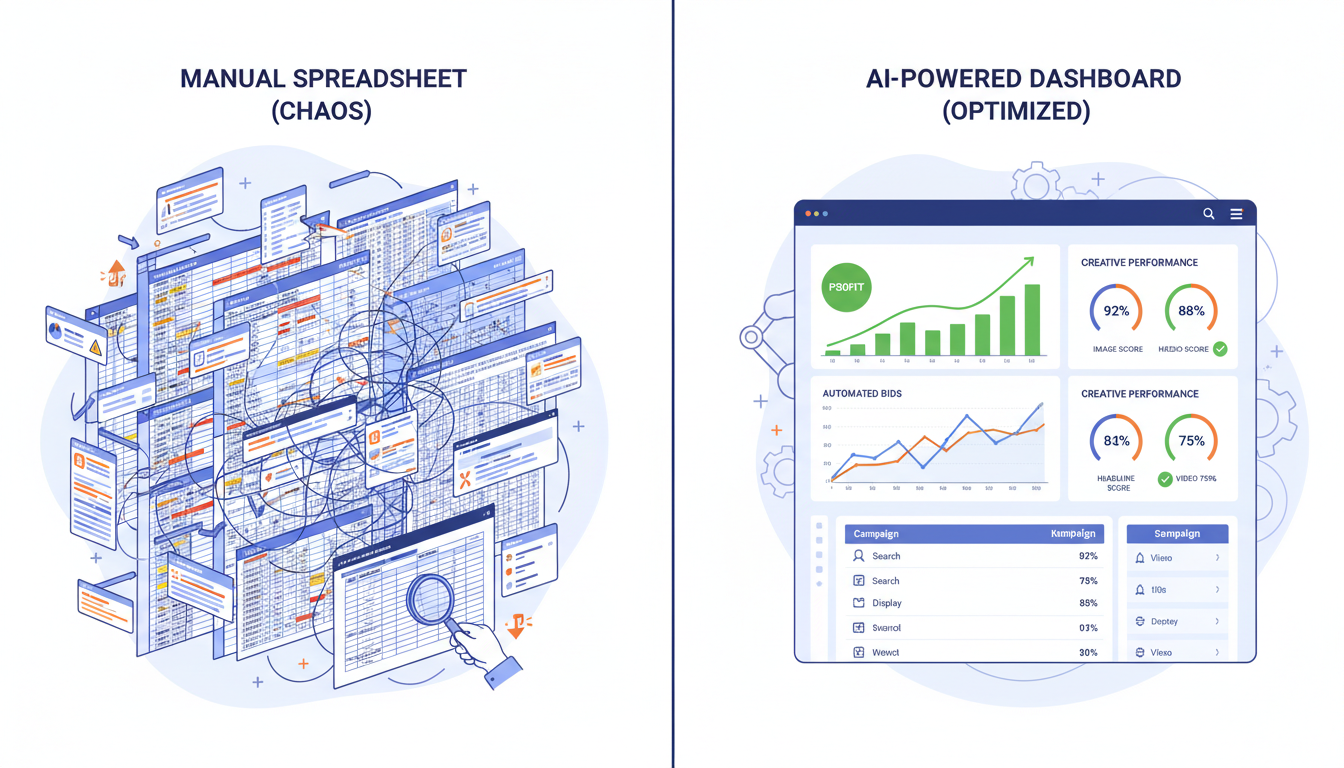
6. Use AI-Generated Ad Creatives to Win the Attention War
Creative quality is the most overlooked variable in Amazon advertising performance. Two sellers bidding on the same keyword — the one with the more compelling, visually optimized creative wins the click. Every time. And yet most brands are still running the same product-on-white-background creative they uploaded two years ago.
AI ad creative generation tools can now produce lifestyle imagery, A/B-testable headline variations, and Sponsored Brand Video thumbnails in minutes — without a photographer or a design agency. Amazon itself introduced generative AI image capabilities at unBoxed 2023, specifically to help brands produce richer ad experiences at scale.
A Step-by-Step Creative Testing Framework
- Generate 3–5 variants per ASIN using an AI ad creator — vary background, lifestyle context, and headline copy.
- Run a controlled A/B test for 14 days minimum. Use identical targeting and bidding parameters.
- Measure CTR and CVR — not just clicks. A high-CTR creative that doesn't convert is a budget drain.
- Promote the winner. Kill the losers. Ruthless iteration is the engine of creative performance improvement.
Platforms like AdAstraa's AdCreative+ handle the entire creative generation and performance-tracking workflow, so your team focuses on strategy — not Photoshop.
7. Deploy Smart Dayparting and Budget Scheduling
Budget exhaustion is a silent performance killer. When your campaigns run out of budget at 2 PM on a Saturday — peak purchase intent time for many categories — you are handing qualified traffic directly to competitors. Conversely, running full budgets during low-conversion windows in the early morning hours is pure waste.
Smart dayparting uses historical performance data to identify your highest-converting hours and days, then allocates budget concentration toward those windows. For many categories, this single adjustment produces a 10–20% ROAS lift without increasing total spend.
Key Dayparting Signals to Analyze First
- Conversion rate by hour of day (pull 90 days of data for accuracy)
- Cost per conversion by day of week (weekends vs. weekdays vary dramatically by category)
- Budget exhaustion timestamps — the exact moment your campaigns go dark
8. Systematically Target Competitor ASINs at Scale
Product targeting campaigns are one of the most underutilized yet powerful tools in Amazon's advertising suite. Rather than waiting for shoppers to find you through keyword searches, ASIN targeting lets you place your product directly on a competitor's product detail page — right at the moment they're considering a purchase.
The most effective approach is identifying competitor ASINs that are:
- Weakly reviewed (below 4.0 stars or recent review decline)
- Priced above yours with comparable or inferior features
- Out of stock frequently — a signal captured through inventory intelligence tools
Real-World Example: A mid-sized supplement brand targeting 47 competitor ASINs with deteriorating review profiles reported a 34% lower CPC compared to their keyword campaigns, while maintaining a conversion rate 11% above their account average. The reason: shoppers visiting those pages are already committed to buying — they just need a better option presented to them.
9. Elevate Performance with AI-Powered Marketing Analytics
Data without interpretation is just noise. Most Amazon sellers have access to more performance data than they know what to do with — campaign reports, search term reports, placement reports, brand analytics — yet remain stuck in reactive mode because no one on the team has the bandwidth to synthesize it all.
AI-powered marketing analytics platforms solve this by automatically surfacing anomalies, spotlighting scaling opportunities, and alerting teams to campaign degradation before it costs meaningful budget. Think of it as a 24/7 analyst embedded in every campaign — one that never sleeps, never misses a data point, and never loses context between sessions.
The Four Metrics That Actually Drive Amazon Advertising Decisions
| Metric | What It Tells You | Action Trigger |
|---|---|---|
| ACoS | Ad cost as % of ad revenue | Cut bids if above target; scale if below |
| ROAS | Revenue generated per $1 spent | Below 2.5x triggers immediate review |
| CVR | Click-to-purchase rate | Below category avg signals listing issue |
| True Profit/ASIN | Net margin after all costs | Negative margin = immediate budget pause |
10. Automate Customer Operations to Protect Your Ad Investment
Every dollar you spend on Amazon advertising drives a shopper to your listing. What happens after the click determines whether that investment compounds or evaporates. Slow response times on customer messages, unresolved review issues, and listing suppression from policy flags all erode conversion rates — directly undermining your advertising ROI.
This is the breakthrough insight that most PPC-focused guides miss entirely: advertising optimization and customer operations are inseparably linked. A 5% improvement in post-click conversion rate can have a more significant impact on ROAS than a 20% bid reduction.
AI tools like AdAstraa's EcomGPT automate buyer message responses, flag listing health issues in real time, and generate review-response templates — ensuring that every shopper your ads bring in encounters a friction-free purchase experience. When your listing converts better, your ad spend stretches further, your organic rank improves, and the entire flywheel accelerates.
The Integrated Approach: Why Strategy Without the Right Platform Stalls
Each of the ten strategies above delivers measurable results in isolation. But the most powerful advertising operations on Amazon are those where these strategies work together — informed by shared data, executed at scale, and continuously optimized without human bottlenecks.
That is not achievable with a spreadsheet, a part-time PPC manager, and three disconnected tools. It requires an all-in-one advertising platform built specifically for Amazon-first brands — one that connects bid management, creative optimization, buyer intent intelligence, and operational automation into a single, coherent system.
AdAstraa was built from the ground up to deliver exactly this. Whether you are a D2C brand scaling past your first million in ad spend, an FMCG company managing hundreds of ASINs, or an agency handling multiple client accounts, the platform eliminates the manual overhead that prevents brands from moving at the speed the marketplace demands.
The result: brands on AdAstraa consistently report lower ACoS, higher ROAS, reclaimed management hours, and — most importantly — a clear, confident view of where every advertising dollar is going and what it is returning. Explore the full suite in the AdAstraa platform overview or see how real brands have scaled with AdAstraa.
Additional Resources
Deepen your Amazon advertising knowledge with these authoritative external sources:
- Amazon Ads Official Strategy Guides — Amazon's own library of advertising best practices, campaign tutorials, and product-specific playbooks for every ad format.
- FTC Business Guidance on Digital Advertising — Essential compliance reference for brands running digital ad campaigns, covering disclosure requirements and advertising standards.
- Harvard Business Review: Marketing Budget Allocation Strategy — Research-backed framework for balancing acquisition vs. retention spend, directly applicable to Amazon advertising budget decisions.
- Amazon Advertising Statistics 2025 — Sequence Commerce — Comprehensive annual benchmark report covering CPC trends, ROAS benchmarks, CTR averages, and category-level performance data.
- Search Engine Land: Reducing Wasted Amazon Ad Spend — Practical editorial deep-dive on audience targeting, campaign segmentation, and efficiency optimization strategies from one of digital marketing's leading publications.
Your Next Move: From Strategy to Execution
Amazon advertising in 2025 is not a set-it-and-forget-it game. It is a high-velocity, data-dense environment where the brands that win are those moving faster, making smarter decisions, and leveraging intelligent automation at every stage of the campaign lifecycle.
The 10 proven strategies in this guide — from ruthless negative keyword discipline and granular campaign architecture to AI-powered bid automation, buyer intent targeting, and creative optimization — are not theoretical. They are the operating principles of the most profitable Amazon advertisers running today.
The question is not whether these strategies work. It is whether you have the tools and infrastructure to execute them consistently, at scale, without burning out your team. That is precisely the problem AdAstraa was built to solve.
🎯 Turn these 10 strategies into automated, 24/7 Amazon advertising performance.
Join the Amazon-first brands already using AdAstraa's AI-powered platform to lower ACoS, boost ROAS, and reclaim hundreds of management hours every month.
Get Started with AdAstraa — Free Trial →